
Top Features to Evaluate in Portable Interactive Projectors
- Essential Buying Guide for Portable Interactive Projector
- Brightness and Ambient-Light Performance for Portable Interactive Projector
- Resolution and Image Fidelity in a Portable Interactive Projector
- Interaction Technologies to Evaluate in a Portable Interactive Projector
- Latency and Responsiveness of Portable Interactive Projector
- Portability, Weight and Power: Practical Considerations for Portable Interactive Projector
- Connectivity and Content Sources for Portable Interactive Projector
- Software Ecosystem, Content Tools and Developer Support for Portable Interactive Projector
- Durability, Serviceability and Warranty for Portable Interactive Projector
- Comparison: Light Source and Portability — Practical Specs Table for Portable Interactive Projector
- Use-Case Evaluation: Which Portable Interactive Projector Fits Your Scenario?
- Testing Checklist Before Purchase of a Portable Interactive Projector
- Price vs Value: Practical Scoring Matrix for Portable Interactive Projector
- Mantong Digital — Manufacturer Profile and Solutions for Portable Interactive Projector
- Mantong's Competitive Strengths for Portable Interactive Projector Projects
- Mantong's Main Products and Solution Areas
- How to Choose a Vendor and Validate Claims for Portable Interactive Projector
- Final Buying Checklist and Next Steps for Portable Interactive Projector
- Frequently Asked Questions (FAQ) about Portable Interactive Projector
- 1. What brightness (ANSI lumens) do I need for a portable interactive projector?
- 2. Does a portable interactive projector require a special surface?
- 3. How important is latency for interactive applications?
- 4. Can projection mapping be done with portable interactive projector models?
- 5. What maintenance should I expect for a portable interactive projector?
- 6. How do I ensure compatibility with my content and software?
- Contact & Product Inquiry
- References
Essential Buying Guide for Portable Interactive Projector
Choosing a portable interactive projector is more than selecting a bright device — it requires aligning technical capabilities with real-world use cases. This guide breaks down the critical features you should evaluate, how to compare models objectively, and practical testing steps so your investment delivers reliable, engaging interactive experiences in education, retail, events, or corporate environments.
Brightness and Ambient-Light Performance for Portable Interactive Projector
Brightness is the first spec most buyers look at, but context matters. For interactive projection the usable contrast and color fidelity under ambient light are as important as raw lumen numbers. Always check ANSI lumens (industry standard) rather than vendor marketing lumens when possible.
- Recommended lumen ranges: classroom or dim meeting rooms — 1,000–2,000 ANSI lumens; bright rooms, retail windows or outdoor twilight — 2,500–4,000 ANSI lumens. For projection mapping on dark surfaces, 800–1,500 ANSI lumens is often sufficient.
- Consider optical throw and surface reflectivity: higher throw ratio spreads light thinner; high-gain or white matt surfaces improve effective brightness.
- Ambient light rejection (ALR) screens or short-throw optics are especially valuable in portable setups where controlling ambient light is difficult.
Reference metric: ANSI lumen definition and measurement methodologies are detailed by industry resources and testing labs — insist on ANSI-equivalent values when comparing products.
Resolution and Image Fidelity in a Portable Interactive Projector
Resolution affects legibility for text, fine graphics and touch alignment. For interactive applications where users annotate content or interact with UI elements, native resolution should match the intended content complexity.
- Recommendations: WXGA (1280×800) minimum for simple interactive whiteboard use; Full HD (1920×1080) for detailed graphics, video and mapping; WUXGA or higher for high-precision mapping or 3D projection games.
- Pixel alignment: interactive systems that rely on camera-tracking or IR pens need predictable pixel geometry — avoid heavy digital scaling or unsymmetrical keystone correction.
Interaction Technologies to Evaluate in a Portable Interactive Projector
‘Interactive’ can mean many things: touch-on-surface, motion tracking, multi-user gesture, or projection-mapped interactive content. Choose the technology that matches your content and environment.
- Infrared (IR) pens and IR cameras: low cost, good reliability for single-point interactions.
- Optical camera-based tracking: supports multi-touch and gestures; requires careful calibration and may be sensitive to ambient lighting and surface texture.
- Structured light / depth sensors (e.g., ToF): higher precision for floor or 3D interaction but increase system complexity and power draw.
- Capacitive/Resistive touch on interactive screens: not projector-native but an alternative if you require robust, low-latency touch.
Choose systems offering SDKs and open protocols for integration; evaluate whether the projector vendor supports developer access for content customization.
Latency and Responsiveness of Portable Interactive Projector
Latency is a critical, measurable attribute for interactive experiences. High lag breaks the sense of direct manipulation and reduces learning effectiveness in classrooms and immersion in games or exhibits.
- Target values: aim for end-to-end interaction latency (input → visual feedback) below 50 ms for fluid multi-touch; under 100 ms is acceptable for many educational activities.
- Test in real conditions: wireless streaming or heavy image processing can add unpredictable delay — test with your actual content and network configuration.
Portability, Weight and Power: Practical Considerations for Portable Interactive Projector
Portability combines size, weight, setup complexity and battery life. Ask whether ‘portable’ means battery-powered, suitcase-portable, or simply small enough to move between rooms.
- Weight: sub-3 kg devices are easy to hand-carry; 3–8 kg require small trolley or backpack solutions.
- Battery: if on-battery operation is required, check realistic runtime at interactive brightness (vendors sometimes quote runtime at low-brightness eco-mode).
- Quick setup features: integrated keystone correction, flexible mounting threads, and magnetic or tripod accessories reduce deployment time.
Connectivity and Content Sources for Portable Interactive Projector
Modern interactive projectors must connect to diverse content sources reliably. Evaluate wired and wireless options and support for streaming, USB media, and device mirroring.
- Essential ports: HDMI (with HDCP support), USB-A for media or touch HID, USB-C (DisplayPort alt mode) increasingly valuable for laptops and tablets.
- Wireless: AirPlay, Miracast, Chromecast and vendor-specific apps — measure latency and multi-device handling.
- Local media support: onboard players, SD card slots, or internal storage simplify standalone demos or exhibits.
Software Ecosystem, Content Tools and Developer Support for Portable Interactive Projector
Hardware is only as good as the software. Evaluate bundled authoring tools, content libraries, scheduling and CMS capabilities, plus SDKs for custom interactive applications.
- Built-in content creation: interactive whiteboard features, templates, and lesson management are valuable for education buyers.
- Projection mapping tools: for immersive and event use, integrated mapping and warping tools accelerate deployment.
- SDK & APIs: open access to touch events, calibration data and asset management enables integration with kiosks, retail POS, or games.
Durability, Serviceability and Warranty for Portable Interactive Projector
Portable units face more handling, transportation and outdoor exposure. Check IP ratings, fan/filter maintenance, and warranty terms that cover interactive components (cameras, sensors) as well as optics.
- Expected lifetimes: LED/laser light sources commonly rated 20,000–30,000 hours; traditional lamps need regular replacement (1,500–5,000 hours depending on lamp type).
- Service options: on-site support, rapid spare parts access and global partnerships matter for deployment outside the vendor’s home market.
Comparison: Light Source and Portability — Practical Specs Table for Portable Interactive Projector
| Light Source | Typical ANSI Lumens | Lifetime (hours) | Pros | Cons |
|---|---|---|---|---|
| LED | 300–2,000 | 20,000–30,000 | Compact, low heat, instant on/off | Lower peak brightness for larger rooms |
| Laser (phosphor) | 1,000–6,000+ | 20,000–30,000+ | High brightness, better color, long life | Higher cost, slightly heavier cooling needs |
| UHP Lamp | 1,500–5,000+ | 1,500–5,000 | High peak brightness, established tech | Frequent replacements, heat and fan noise |
Sources: Product spec sheets and industry summaries (see references).
Use-Case Evaluation: Which Portable Interactive Projector Fits Your Scenario?
Define your primary use-case and score each requirement when comparing models. Example scenarios:
- Education: prioritize low latency, integrated whiteboard tools, multi-user touch and affordable pricing.
- Retail/Wayfinding: high brightness, vivid color, reliable scheduled playback and remote content management.
- Events & Immersive Shows: laser brightness, mapping tools, multi-projector edge-blending and DMX or show-control integration.
- Outdoor / Tours: battery operation, weather-rated housings (IP54+), robust mounts and wireless streaming.
Testing Checklist Before Purchase of a Portable Interactive Projector
Always perform a hands-on trial or a site demo. Use this checklist:
- Confirm measured ANSI lumens with vendor or third-party tests.
- Test interaction latency end-to-end with the content you plan to use.
- Check multi-device wireless mirroring under expected Wi‑Fi conditions.
- Verify calibration stability after moving the projector (critical for portable deployments).
- Inspect heat, fan noise and how the unit performs after extended runs.
Price vs Value: Practical Scoring Matrix for Portable Interactive Projector
| Category | Weight | High-End Priority | Budget Priority |
|---|---|---|---|
| Brightness & Image Quality | 25% | Laser 2,500+ ANSI | LED 800–1,500 ANSI |
| Interaction & Latency | 20% | Depth sensors / multi-touch camera | IR pen or single-point touch |
| Portability & Battery | 15% | Integrated battery + ~3 kg | Lightweight, no battery |
| Software & Support | 20% | Full SDK + CMS | Basic app and templates |
| Durability & Warranty | 20% | On-site service, 3+ yrs | Standard 1 yr warranty |
Mantong Digital — Manufacturer Profile and Solutions for Portable Interactive Projector
Mantong Digital is a one-stop interactive projection solution provider and direct manufacturer based in Guangzhou, China, with over 10 years of industry experience. We are dedicated to providing innovative, flexible and cost-effective projection solutions, offering both hardware and software to meet various needs.
At ManTong, we specialize in providing customized solutions for a wide range of application scenarios through innovative projection technology. Whether it's immersive experiences, interactive entertainment or outdoor lighting and projection shows, our solutions can transform your ideas into stunning visual effects. Our projection technology provides customized solutions for a variety of scenarios, delivering immersive and interactive visual experiences.
We are now looking for business partnerships worldwide. Our vision is to become the world's leading interactive projection manufacturer. Our website is https://www.mtprojection.com/
Mantong's Competitive Strengths for Portable Interactive Projector Projects
- Direct manufacturer: cost advantage and flexible customization without additional channel markups.
- Integrated hardware + software: single-vendor responsibility for calibration, SDK access and long-term support.
- Deep application experience: over a decade delivering immersive projection, interactive floors, walls, room-scale installations, and projection shows.
- Global partnership focus: service and logistics for international deployments and after-sales support.
Mantong's Main Products and Solution Areas
Mantong specializes in immersive projection, interactive floor projection, interactive projection, interactive wall projection, immersive room, 3D projection, interactive projection games, Projection Show, and interactive projection mapping. These product lines are designed for education, retail, events, museums, themed entertainment and outdoor projection shows.
How to Choose a Vendor and Validate Claims for Portable Interactive Projector
Vendor selection should include factory audits if possible, reference installs review, SLA and warranty terms, and verification of test data. Ask for:
- Third-party test reports or ANSI lumen measurements.
- Reference visits or case studies in similar climates and usage patterns.
- Clear firmware update policy and SDK documentation.
Final Buying Checklist and Next Steps for Portable Interactive Projector
- Define primary use-case and environment (ambient light, surface, user count).
- Set minimum specs for ANSI lumens, resolution and latency.
- Request on-site demo with your content and network.
- Verify warranty, spare parts availability and support SLA.
- Consider total cost of ownership: spare lamp costs, maintenance and software licensing.
If you'd like a tailored evaluation or to schedule a demo with Mantong Digital's portable interactive projector offerings, contact Mantong via their website to discuss your scenario and request a quote.
Frequently Asked Questions (FAQ) about Portable Interactive Projector
1. What brightness (ANSI lumens) do I need for a portable interactive projector?
Answer: For dim classrooms or dark exhibits, 800–1,500 ANSI lumens may suffice. For bright classrooms, retail windows, or outdoor twilight use, target 2,500–4,000 ANSI lumens. Always verify ANSI-equivalent measurements and test in your environment.
2. Does a portable interactive projector require a special surface?
Answer: While standard matte white walls work, ALR screens or matte white projection films improve image contrast in ambient light. For floor interaction use durable matte films or bespoke interactive floor materials that withstand foot traffic.
3. How important is latency for interactive applications?
Answer: Very important. Aim for sub-50 ms end-to-end latency for tactile interaction (drawing, games). Higher latency can feel unresponsive and reduce user engagement.
4. Can projection mapping be done with portable interactive projector models?
Answer: Yes — many portable projectors now include geometric correction and mapping tools. For complex multi-projector mapping, choose devices with warping, edge blending and synchronized playback features.
5. What maintenance should I expect for a portable interactive projector?
Answer: Maintenance depends on light source. LED/laser units require minimal light-source replacement but still need dust-filter checks and occasional recalibration of sensors. Lamp-based units need periodic lamp replacement and more frequent cooling/fan service.
6. How do I ensure compatibility with my content and software?
Answer: Confirm the vendor provides SDKs or standard HID protocols for touch input, and test your content (video, interactive apps) during a demo. Ask for sample projects or developer documentation.
Contact & Product Inquiry
For product demos, customization, or business partnerships worldwide, visit Mantong Digital at https://www.mtprojection.com/. Their team can provide tailored proposals, factory-direct pricing, and integration support for immersive projection, interactive floor and wall solutions, and projection shows.
References
- Video projector — Wikipedia. https://en.wikipedia.org/wiki/Video_projector (Accessed 2025-12-27)
- DLP (Digital Light Processing) — Wikipedia. https://en.wikipedia.org/wiki/Digital_light_processing (Accessed 2025-12-27)
- ProjectorCentral — Lumen and Brightness: What You Should Know. https://www.projectorcentral.com/ (Accessed 2025-12-27)
- InfoComm/AVIXA standards overview — Measuring Projector Brightness and Contrast. https://www.avixa.org/ (Accessed 2025-12-27)
- Manufacturer product pages and spec sheets (various LED/laser/lamps) — Examples: Epson, BenQ, Sony product pages for lamp/laser spec comparisons (Accessed 2025-12-27)
- Mantong Digital official website — https://www.mtprojection.com/ (Accessed 2025-12-27)
Projection mapping vs interactive projection: differences
How Interactive Floor Games Boost Foot Traffic and Sales
Top global interactive experience companies list
How to Choose the immersive arcade room manufacturer and supplier in China?
One-Stop Projection Solution Provider Since 2011
What information do you need to know before making the proposal/solution?
We know that everyone wants to know the price, but the price of our products is determined by many factors since most of our products are custom, so no ready price list. In order to fast understand what you need, can you send us an inquiry like this?
For example: I am really interested in your immersive projection products, we are a company in the USA and want to install some in my restaurant. It is about 50 meters long, and 5m in width. Projection size you can decide but the length should be not less than 20 meters. We want some content about SeaWorld because our place is all about the sea. Thank you.
What's Immersive Projection ?
Immersive projection refers to a technology that creates a captivating and all-encompassing visual experience for viewers by projecting images or videos onto large surfaces, such as walls, floors, or even entire rooms. This technology aims to immerse the audience in a simulated environment, blurring the boundaries between the physical and virtual worlds.
What about the wall/floor material for the projection?
It’s recommended to choose a light-colored material with minimal reflectivity—pure white or light grey works best. the
common material is cement & plaster board
For optimal projection results, the surface should be free of any patterns or textures, as the projector will display content
directly onto it.
There are no specific material requirements; you may use any commonly available material in your local market, as long as it
meets the above conditions.
How to Write an Interactive-Effect Video Customisation Script ?
① Project Background: Briefly introduce the context in which this interactive scene will be used (e.g., exhibition, museum,
event space, children's area). Example: This scene is part of the “Underwater World” zone in a children's science museum,
designed to be engaging and exploratory.
②Visual Style / Atmosphere: What kind of visual mood are you aiming for? Please describe the color scheme, style, and any
references. it should focus solely on describing the visual aspects of the scene, supported by relevant charts or reference
images.
③ Interaction Points Overview:List each interactive hotspot along with the effect you'd like to trigger when the user
touches or clicks the area. example: when player touch the clownfish, it will swims away with bubble trail (animation effect)
and produce the bubble sound ( sound effect requirement )
④ Static Visual Reference:including but not limited to background image/video, a list of major visual elements (e.g., coral,
rocks, seaweed, fish), which elements should be interactive?
How to install the projection equipment ?
1) Install the projector in a suitable position. We will provide you with a hanger, which you need to fix on the ceiling with
screws.
2) Connect projectors, computers and other accessories through wires.
3) After completing the above 2 steps, we will carry out the edge blending steps. Our team can complete it through remote
control.
In general, installation instructions for each project need to be specified on a project-by-project basis. The above is for
reference only.
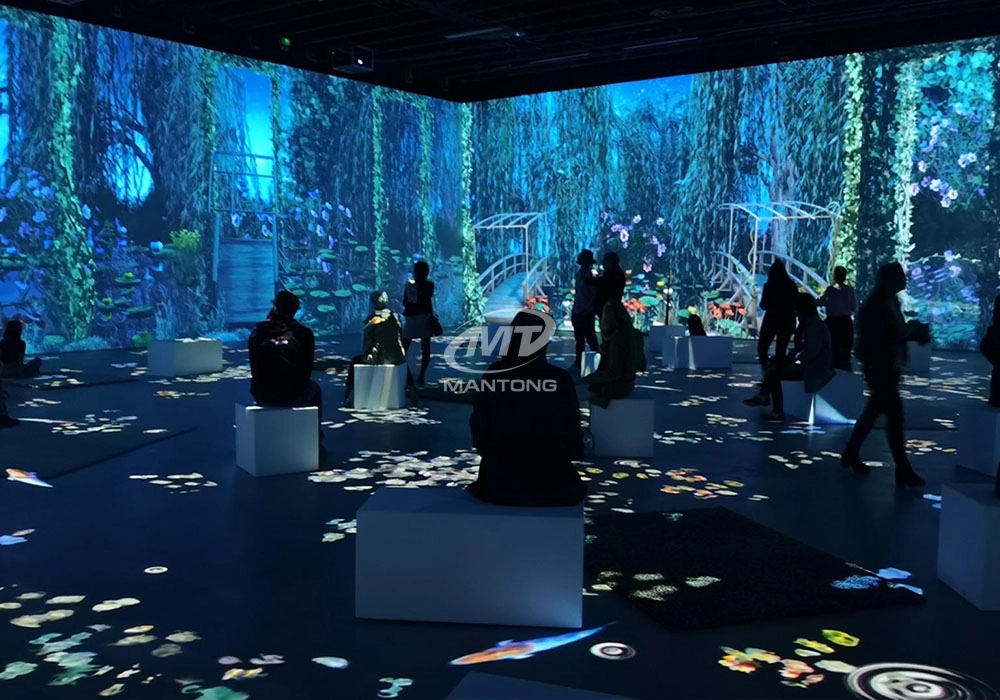
Mantong 6500LM High-Lumen Projector for Large-Scale Immersive Room Projection
Transform any space with Mantong's immersive projection mapping systems. Our high-lumen projectors (up to 6500 LM) and custom software create captivating interactive experiences for floors and walls. Ideal for museums, events, retail, and hospitality. Each kit includes professional ceiling mounting and 80+ pre-loaded video contents and is backed by a 12-month warranty and CE certification. We offer full customization and support to bring your vision to life.
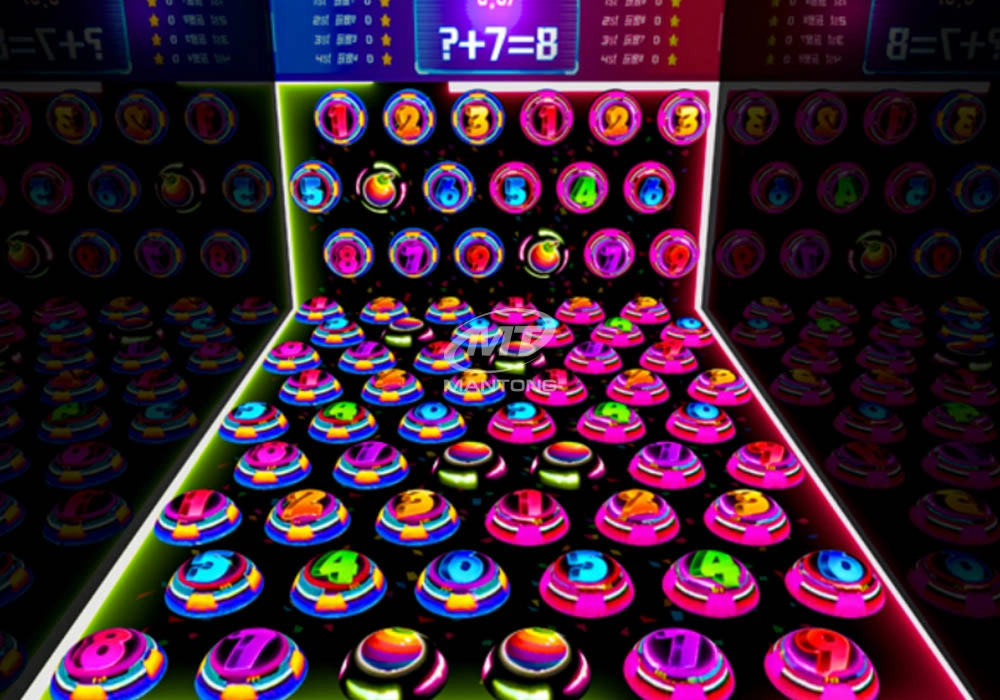
Amusement Rapidly Rotating Bouncing Sphere Interactive Wall Floor Projection Sports Games
Rapidly Rotating Bouncing Sphere is an interactive space where participants jump on rotating spheres. As they step on it, the spheres surface will show special interactivity
Jumping on spheres of the same color in succession causes them to pop, releasing light particles. The more consecutive jumps, the greater the reward—caterpillars appear, and eventually, all spheres of that color burst, filling the space with light and even more caterpillars.
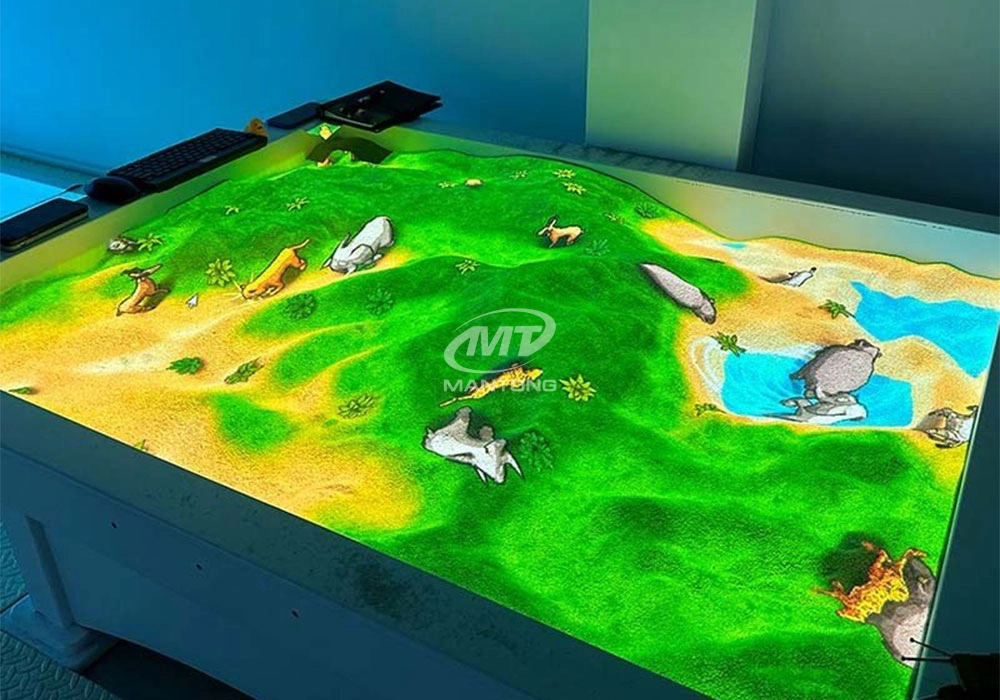
Interactive Sandbox Projection Mapping Games For Kids Play Park
Bring imagination to life with interactive sandbox projection mapping games designed for kids’ play parks. Using cutting-edge projection technology and real-time motion sensing, children can dig, build, and explore virtual worlds directly in the sand. Educational, engaging, and endlessly fun — it’s the perfect blend of play and learning.
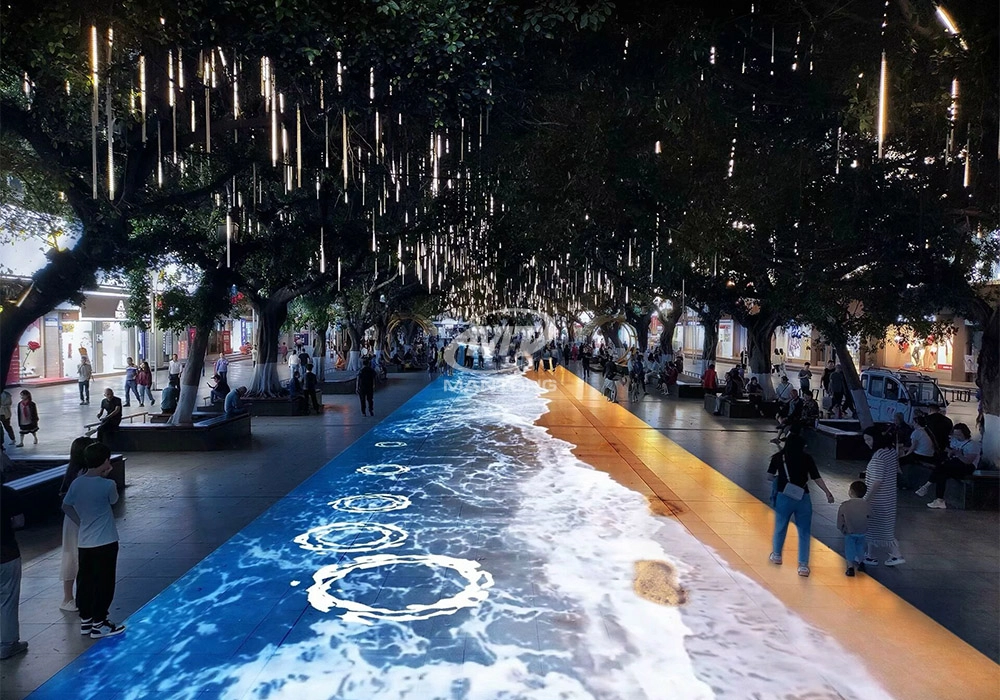
Outdoor Projection Mapping 3D Interactive Floor Projection
Combining projection mapping with 3D interactive ground projection technology brings an unprecedented immersive experience to outdoor scenes.

Kaida Business Center, Shixin Road, Panyu District,Guangzhou City, Guangdong Province, China.
ManTong
ManTong
ManTong