
Top Questions to Ask an Interactive Projection Mapping Supplier
- Why asking the right supplier questions matters
- What the right questions reveal
- Risk areas that commonly surface
- Reference standards and procurement best practices
- Technical questions to validate capability
- Which projector models, brightness and optics do you recommend and why?
- How do you handle content warping, edge blending and real-time calibration?
- What interactive technologies and sensors are used for user input?
- Commercial, operational and contractual questions
- Are you a manufacturer, a systems integrator, or both?
- What are lead times, delivery responsibilities and site-service terms?
- What warranty, maintenance and SLA options do you offer?
- Evaluation, validation and proof points
- Can you provide a site survey, POC or prototype run?
- Can you share case studies, references and performance metrics?
- How do you manage compliance, safety and environmental constraints?
- Comparison matrix: how I score suppliers during evaluation
- Questions that test honesty and long-term fit
- Can you break down a typical total cost of ownership?
- How do you handle intellectual property and content ownership?
- What happens at project handover and what documentation will you supply?
- About Mantong Digital — a solution provider example
- Practical checklist to bring to your supplier meeting
- Site and project specifics
- Performance and acceptance criteria
- Documentation to request
- Final tips from my field experience
- Don't be swayed only by visuals
- Prioritize repeatability and maintainability
- Use contracts to allocate risk clearly
- FAQ
- 1. What should be my first question to any interactive projection mapping supplier?
- 2. How do I know the projector brightness will be sufficient?
- 3. Should I insist on a prototype or POC?
- 4. What maintenance should I budget for after installation?
- 5. How important is supplier documentation and training?
- 6. Can I combine multiple suppliers for hardware and creative content?
Summary for and search: If you are vetting an interactive projection mapping supplier for an installation, event, museum or branded experience, you need a structured set of technical, commercial and validation questions to separate sales pitches from real capability. I draw on my decade-plus experience in projection systems and commercial deployments to list the questions that reveal a supplier's hardware choices, content workflow, integration risk, manufacturing capability, support commitments and compliance with quality standards.
Why asking the right supplier questions matters
What the right questions reveal
When I evaluate an interactive projection mapping supplier, I look for evidence, not promises. The questions I ask are designed to expose actual resources: manufacturing capability, engineering depth, content pipeline, maintenance processes, and documented past performance. These elements reduce deployment risk and ensure your project will behave as expected in production—not just in a glossy demo.
Risk areas that commonly surface
Typical failure points include projector choice and placement, network and control integration, content performance on curved or textured surfaces, environmental resilience for outdoor shows, and handover/support gaps. Asking focused questions early helps surface these risks and assign responsibility before contracts are signed.
Reference standards and procurement best practices
For quality management I look for suppliers aligned with industry best practices such as ISO 9001. For technology context, the projection mapping entry on Wikipedia provides a helpful overview of techniques and applications. For procurement and supplier selection frameworks I often reference strategic guidance such as Harvard Business Review.
Technical questions to validate capability
Which projector models, brightness and optics do you recommend and why?
Ask the supplier to specify exact projector models, lumen ratings, lens throw ratios, and light-source type (laser vs lamp). I expect detailed calculations: lux targets at specified distances, keystone/correction requirements, and heat/noise profiles. If a supplier provides only an estimated lumen range without model names, that's a red flag.
How do you handle content warping, edge blending and real-time calibration?
Interactive projection mapping relies on precise geometric correction. I ask which mapping software they use (e.g., proprietary engine, TouchDesigner, Resolume, or other middleware) and whether they provide live calibration tools, camera-based auto-warp, or manual control. Request a technical walkthrough or demo video showing the calibration process on a complex surface.
What interactive technologies and sensors are used for user input?
Interaction layers can be based on depth cameras (e.g., Intel® RealSense), infrared sensors, LiDAR, pressure mats, or computer vision using RGB cameras. I always request model names, sample latency metrics, and examples of ambient-light robustness. For installations in public spaces, ask how the system discriminates intended interactions from noise (crowds, shadows, reflective floors).
Commercial, operational and contractual questions
Are you a manufacturer, a systems integrator, or both?
Knowing whether your interactive projection mapping supplier is a direct manufacturer (OEM) or a reseller/integrator affects price, lead time, customization and accountability. As a manufacturer, a supplier can iterate hardware, provide spare parts quickly and adapt firmware. If they are resellers, ask how they manage warranty and spare-part logistics.
What are lead times, delivery responsibilities and site-service terms?
Get a clear timeline: production, delivery, installation and commissioning. Clarify who is responsible for site surveys, cabling, scaffolding and permits. For international projects, inspect customs and shipping responsibilities (Incoterms). Ask for a sample project schedule and milestones with associated acceptance criteria.
What warranty, maintenance and SLA options do you offer?
Projectors and interactive hardware must be covered by a clear warranty and available maintenance plans. I expect suppliers to offer on-site support windows, remote diagnostics and spare-part availability. Ask for mean time to repair (MTTR) commitments, parts availability in your region and escalation procedures.
Evaluation, validation and proof points
Can you provide a site survey, POC or prototype run?
A professional interactive projection mapping supplier should offer a site survey and, where feasible, a proof-of-concept (POC) or small-scale prototype. I ask for the scope and deliverables of their site survey (laser scan, photogrammetry, power and network diagrams) and for a POC that demonstrates the intended interaction and content fidelity under real ambient light.
Can you share case studies, references and performance metrics?
Ask for documented case studies with photos, videos and measurable results (dwell time, interaction counts, uptime %). Contact references and ask specific questions: Did the system meet the timeline? How responsive was support? Were there unforeseen costs? Verifiable references matter more than a long portfolio list.
How do you manage compliance, safety and environmental constraints?
For outdoor shows, I check for IP ratings, weatherproof housings, and safe mounting solutions. For public indoor spaces, I ask about tripping hazards, emergency lighting interactions and local electrical code compliance. Suppliers should demonstrate awareness of local regulations or have experience working with local contractors who do.
Comparison matrix: how I score suppliers during evaluation
| Criteria | Why it matters | What I expect |
|---|---|---|
| Manufacturing capability | Control of components, lead time, customization | OEM or direct manufacturer with facility photos and QA process (ISO 9001) |
| Technical depth | System reliability and integration ease | Named projector models, software stack, calibration tools |
| Support & SLA | Operational uptime | Local or regional support, MTTR, spare parts inventory |
| Commercial clarity | Budget predictability and risk allocation | Itemized quotes, clear warranty, change-order process |
| Proven outcomes | User satisfaction and campaign ROI | Case studies with metrics and client references |
Questions that test honesty and long-term fit
Can you break down a typical total cost of ownership?
I ask suppliers to provide a 3–5 year TCO estimate including hardware depreciation, lamp or laser maintenance, software licensing, support and projected electricity costs (especially for multi-projector arrays). Real suppliers give line items; evasive ones use high-level estimates.
How do you handle intellectual property and content ownership?
You must clarify who owns the creative content, the mapping files and any custom software modules. I insist on contractual language that protects my clients' IP and clarifies reuse rights, licensing fees for content engines, and access to raw media files for future updates.
What happens at project handover and what documentation will you supply?
Detailed handover should include system architecture diagrams, source files for content, calibration profiles, maintenance manuals, spare-part lists, and training sessions for onsite staff. Suppliers should commit to a knowledge-transfer plan as part of commissioning.
About Mantong Digital — a solution provider example
In the latter stages of vendor selection I often look for suppliers who combine R&D, manufacturing and systems integration. Mantong Digital is a one-stop interactive projection solution provider and direct manufacturer based in Guangzhou, China, with over 10 years of industry experience. We are dedicated to providing innovative, flexible and cost-effective projection solutions, offering both hardware and software to meet various needs. At ManTong, we specialize in providing customized solutions for a wide range of application scenarios through innovative projection technology. Whether it's immersive experiences, interactive entertainment or outdoor lighting and projection shows, our solutions can transform your ideas into stunning visual effects. Our projection technology provides customized solutions for a variety of scenarios, delivering immersive and interactive visual experiences. We are now looking for business partnerships worldwide. Our vision is to become the world's leading interactive projection manufacturer. Our website is https://www.mtprojection.com/.
From my evaluation perspective, Mantong's strengths include: direct manufacturing capability (which shortens lead times and enables custom housings), a combined hardware+software stack for tighter integration, a portfolio covering immersive projection, interactive floor projection, interactive wall projection, immersive rooms, 3D projection, interactive projection games, projection shows and interactive projection mapping. Their experience in producing turnkey interactive systems and willingness to offer POCs makes them a candidate to consider when you need both creative content and dependable hardware.
Practical checklist to bring to your supplier meeting
Site and project specifics
- Surface dimensions, material and texture (send photos and a site plan).
- Ambient lighting conditions (lux measurements at proposed projector positions).
- Network and power availability (UPS, distribution boards, cable pathways).
Performance and acceptance criteria
- Target lux/contrast, mapping accuracy tolerances, interactive latency thresholds.
- Uptime % targets and response times for faults under SLA.
- Training and handover deliverables with dates.
Documentation to request
- Bill of materials with exact part numbers and alternatives.
- Service manuals, calibration procedures and software version control.
- Case studies and at least two client references with similar scope.
Final tips from my field experience
Don't be swayed only by visuals
Projection demos are designed to impress; they can hide fragilities like fragile workflows, manual recalibration needs, or bespoke one-off solutions that are hard to maintain. I always ask to see the behind-the-scenes work: the calibration steps, content rendering profiles and error logs where available.
Prioritize repeatability and maintainability
An installation that can be recalibrated quickly with documented steps saves months of downtime down the line. Prefer modular systems where components are swappable and firmware/software updates are versioned and reversible.
Use contracts to allocate risk clearly
Ensure contracts define acceptance tests, deliverable formats, change-order processes and ongoing support. For events, define dry-run dates and penalties for missed milestones if uptime is business-critical.
FAQ
1. What should be my first question to any interactive projection mapping supplier?
Start by asking whether they are a direct manufacturer or an integrator/reseller, and request recent case studies that match your project scale. This quickly clarifies capacity, customization ability and accountability.
2. How do I know the projector brightness will be sufficient?
Ask for lux calculations at target projection surfaces including ambient light measurements. Reliable suppliers will provide a lumen-to-lux conversion with projector model, throw distance and lens details documented.
3. Should I insist on a prototype or POC?
Yes—especially for complex interactions or non-flat surfaces. A POC identifies technical constraints early and validates interaction latency, content readability and calibration workflows.
4. What maintenance should I budget for after installation?
Budget for periodic calibration, spare parts (projector lamps or modules, cables, mounts), software updates, and an annual service visit. Ask suppliers for a 3–5 year TCO estimate to avoid surprises.
5. How important is supplier documentation and training?
Critical. Good documentation and operator training reduce reliance on vendor visits and shorten MTTR. Ensure documentation includes wiring diagrams, calibration steps, software backups and contact escalation paths.
6. Can I combine multiple suppliers for hardware and creative content?
Yes, but this adds integration risk. If you separate creative and hardware suppliers, define clear interface specifications, file formats and responsibilities for calibration and final rendering.
If you want help vetting proposals, reviewing technical quotes, or arranging a proof-of-concept with a manufacturer, I can assist. For manufacturers who offer full-stack solutions, consider Mantong Digital — a Guangzhou-based OEM with a broad product range including immersive projection, interactive floor projection, interactive wall projection, immersive room experiences, 3D projection, interactive projection games, projection shows and interactive projection mapping. Learn more or request a quote at https://www.mtprojection.com/.
Contact us to schedule a supplier audit, request a POC, or evaluate a proposal: visit https://www.mtprojection.com/ for product details and partnership inquiries.
References: Projection mapping overview — Wikipedia; Quality management standard — ISO 9001; Supplier selection guidance — Harvard Business Review.
The interactive projection mapping Cost Guide
What is wall mapping projection ?
The latest trends for immersive arcade room
Scalability: Planning Large Interactive Projection Installations
One-Stop Projection Solution Provider Since 2011
How to install the projection equipment ?
1) Install the projector in a suitable position. We will provide you with a hanger, which you need to fix on the ceiling with
screws.
2) Connect projectors, computers and other accessories through wires.
3) After completing the above 2 steps, we will carry out the edge blending steps. Our team can complete it through remote
control.
In general, installation instructions for each project need to be specified on a project-by-project basis. The above is for
reference only.
What about the wall/floor material for the projection?
It’s recommended to choose a light-colored material with minimal reflectivity—pure white or light grey works best. the
common material is cement & plaster board
For optimal projection results, the surface should be free of any patterns or textures, as the projector will display content
directly onto it.
There are no specific material requirements; you may use any commonly available material in your local market, as long as it
meets the above conditions.
What's the application of Immersive projection ?
It can be used in various venues, such as art exhibition, entertainment venues, educational institution, Wedding hall /Banquet/Bar,Yoga Studio and so on. It often involves advanced projection techniques, multimedia content, and interactive elements to engage and captivate the audience's senses.
What's Immersive Projection ?
Immersive projection refers to a technology that creates a captivating and all-encompassing visual experience for viewers by projecting images or videos onto large surfaces, such as walls, floors, or even entire rooms. This technology aims to immerse the audience in a simulated environment, blurring the boundaries between the physical and virtual worlds.
Are you trader or manufacturer ?
We are direct manufacturer who specialize in providing one-stop solution for different outdoor & indoor projection project with our stable software and qualified projectors
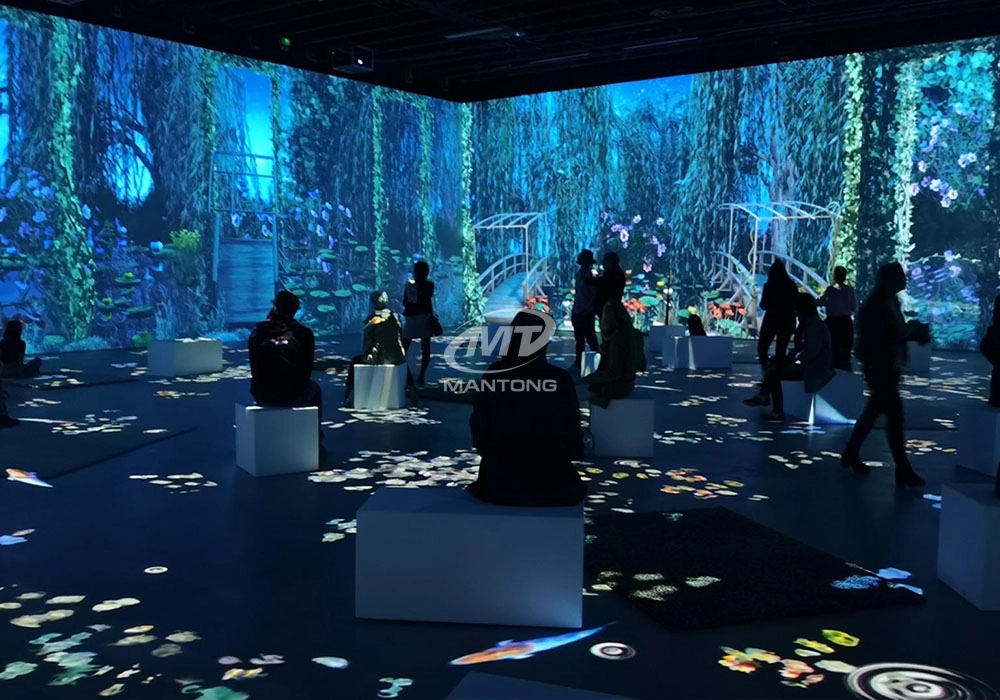
Mantong 6500LM High-Lumen Projector for Large-Scale Immersive Room Projection
Transform any space with Mantong's immersive projection mapping systems. Our high-lumen projectors (up to 6500 LM) and custom software create captivating interactive experiences for floors and walls. Ideal for museums, events, retail, and hospitality. Each kit includes professional ceiling mounting and 80+ pre-loaded video contents and is backed by a 12-month warranty and CE certification. We offer full customization and support to bring your vision to life.
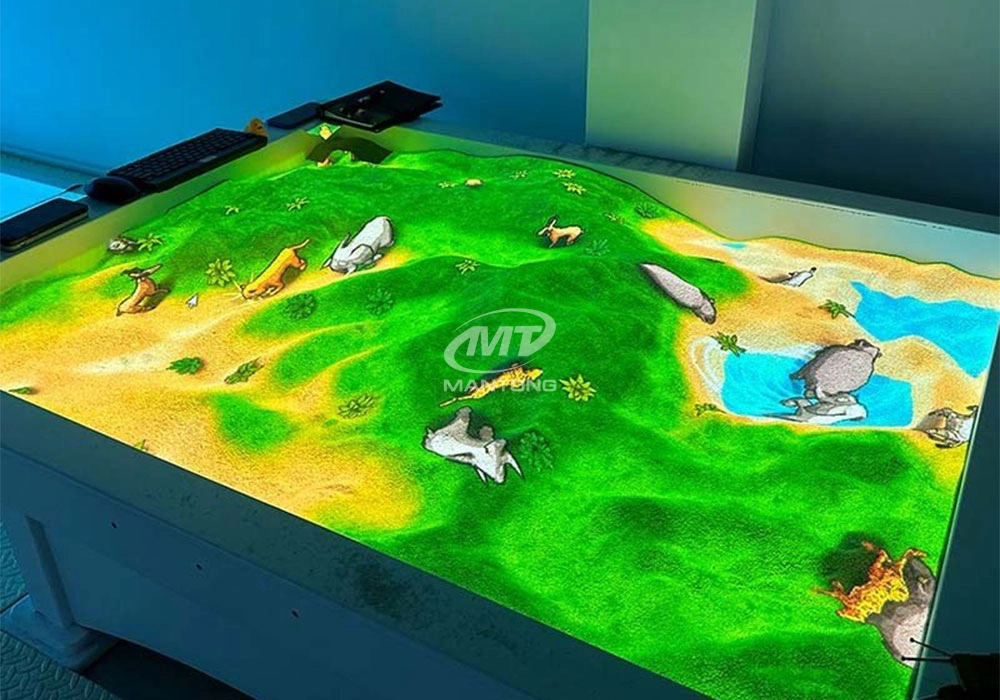
Interactive Sandbox Projection Mapping Games For Kids Play Park
Bring imagination to life with interactive sandbox projection mapping games designed for kids’ play parks. Using cutting-edge projection technology and real-time motion sensing, children can dig, build, and explore virtual worlds directly in the sand. Educational, engaging, and endlessly fun — it’s the perfect blend of play and learning.
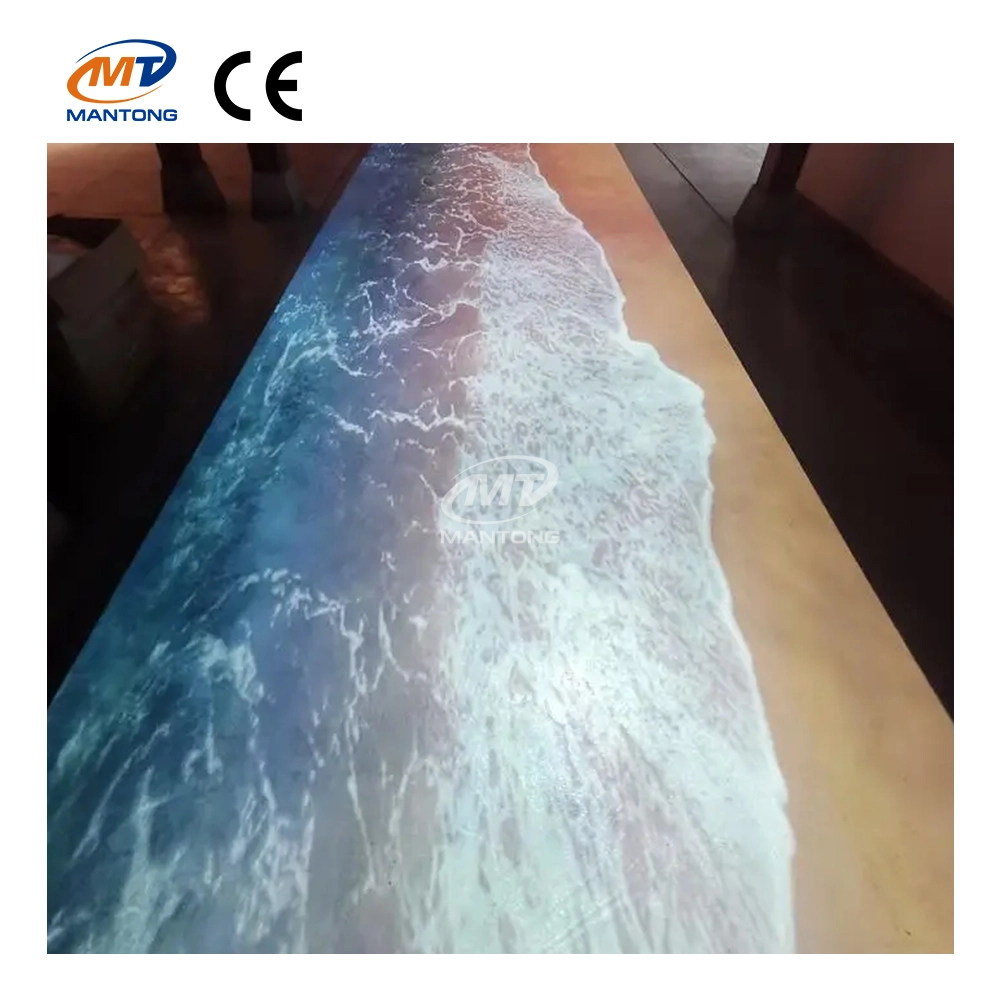
Indoor Interactive Floor Projector System - Customized Design & Installation Support
Indoor interactive floor projections display dynamic themed videos on the floor, commonly used in venues aiming to enhance brand influence or attract foot traffic, such as restaurants, hotel corridors, and brand car retail stores.
By using projectors and compatible software, the interactive content is projected onto the floor, encouraging engagement between people and the projected visuals. A single 5500-lumen indoor floor projector can cover an area of 5 m × 3 m. Typically, each project will use at least 3 units to ensure broad coverage and optimal visual effects.
We also offer customized design and installation support to enhance the interactive experience for your venue.
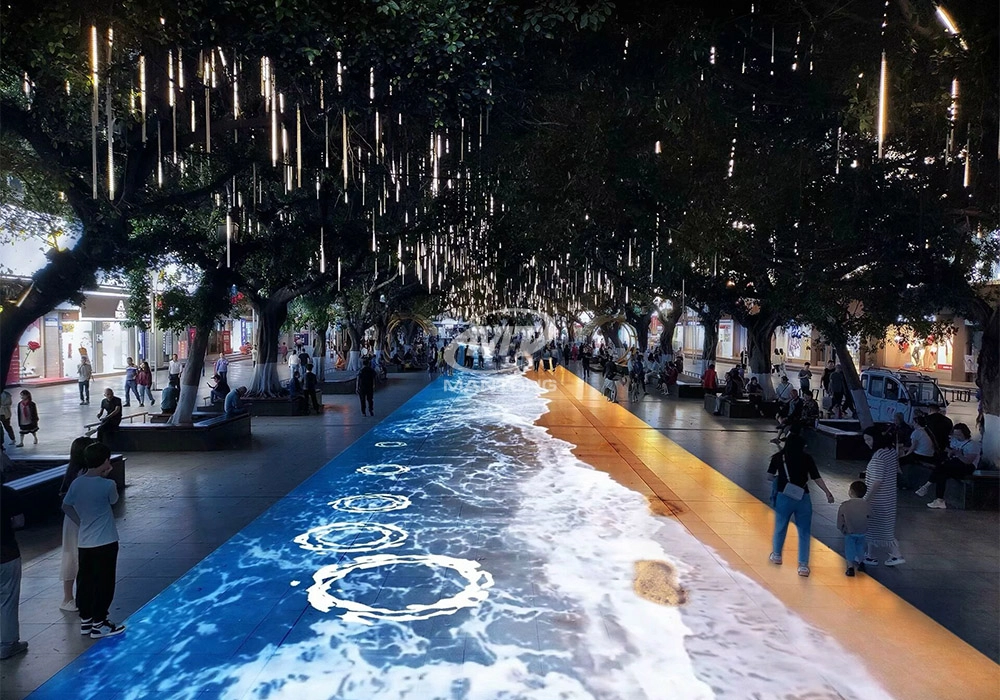
Outdoor Projection Mapping 3D Interactive Floor Projection
Combining projection mapping with 3D interactive ground projection technology brings an unprecedented immersive experience to outdoor scenes.

Kaida Business Center, Shixin Road, Panyu District,Guangzhou City, Guangdong Province, China.
ManTong
ManTong
ManTong