
How to Choose the Best Interactive Projection Solution for Schools
- How to Choose the Best Interactive Projection Solution for Schools
- Why an interactive projection solution matters for modern classrooms
- Understand your school's core needs
- Identify instructional goals and use cases
- Assess room characteristics
- Key technical factors to evaluate
- Brightness and image quality
- Throw distance and shadow reduction
- Interactivity method and accuracy
- Durability, serviceability and safety
- Software and content ecosystem
- Curriculum alignment and teacher tools
- Third-party content and compatibility
- Installation, classroom layout and accessibility
- Mounting, cabling and sight lines
- Accessibility and ease of use
- Comparing common projector choices
- Which projector type fits your classroom?
- Budgeting and total cost of ownership (TCO)
- Balance upfront cost with lifecycle costs
- Consider financing and pilot programs
- Maintenance, warranty and support
- Ask about local support and spare parts
- Training and teacher adoption
- Vendor selection checklist
- What to require from a vendor
- About Mantong Digital
- Experience and offerings
- Quick selection checklist for school decision-makers
- Actionable steps before purchase
- FAQ
- What is the difference between UST and short-throw projectors?
- How important is brightness for classroom projectors?
- Do interactive projectors require special screens?
- Can students use their tablets or laptops with an interactive projection solution?
- How do I ensure teacher adoption?
- How do I get support or request a demo from Mantong Digital?
How to Choose the Best Interactive Projection Solution for Schools
Why an interactive projection solution matters for modern classrooms
Interactive projection solution technology transforms traditional lessons into hands-on, visual experiences. In classrooms, well-chosen systems increase student engagement, support differentiated instruction, and enable collaborative learning without replacing a teacher’s role. Schools that choose the right interactive projection solution balance interactivity, durability, and cost-effectiveness to maximize classroom time and learning outcomes.
Understand your school's core needs
Identify instructional goals and use cases
Before evaluating hardware or software, list how teachers will use the system: whole-class instruction, small-group tasks, maker activities, STEM labs, or assemblies. An interactive projection solution for STEM labs may require high accuracy and multi-touch, while an all-purpose classroom needs good visibility, low maintenance and simple controls.
Assess room characteristics
Measure classroom size, ceiling height, ambient lighting and wall/screen surfaces. A compact room with bright windows benefits from higher-brightness or laser light sources and ultra-short-throw (UST) projectors to reduce shadows. Larger spaces or auditoriums need higher lumen outputs and flexible lens options.
Key technical factors to evaluate
Brightness and image quality
Choose a projector brightness and resolution appropriate to room lighting and screen size. Laser projectors maintain consistent brightness longer and require less frequent lamp replacement. For typical classrooms, aim for a clear, legible image at the distance and screen size teachers will use.
Throw distance and shadow reduction
Ultra-short-throw (UST) interactive projectors mount close to the screen and drastically reduce shadows and glare — valuable for active classrooms. Short-throw models are a middle ground; standard-throw units suit larger spaces or ceiling mounts when proper positioning is possible.
Interactivity method and accuracy
Interactivity can be delivered via touch-capable projection surfaces, interactive pens, camera-based systems, or external sensors. For younger students who use touch heavily, high-accuracy multi-touch is preferable. For collaborative activities, support for multiple simultaneous touch points and simple calibration matters.
Durability, serviceability and safety
Classroom equipment must be robust. Laser projectors typically outlast lamp-based models and require less maintenance. Check ingress protection for dusty environments, warranty terms, and the availability of local service. Choose products with safe laser classifications and secure mounting options to protect students.
Software and content ecosystem
Curriculum alignment and teacher tools
An interactive projection solution is only as useful as its software. Prioritize platforms that support common file types (PDF, PPT, video), offer lesson templates, and integrate with LMS systems. Intuitive annotation, save/export functions, and straightforward lesson preparation reduce teacher prep time and increase adoption.
Third-party content and compatibility
Look for open standards and compatibility with popular educational apps. Built-in libraries and the ability to run interactive simulations or connect to student devices (tablets, laptops) enhance classroom flexibility. Avoid vendor lock-in that limits content choices.
Installation, classroom layout and accessibility
Mounting, cabling and sight lines
Plan projector placement to avoid glare and shadows, optimize sight lines, and keep cables tidy. UST units simplify installation because they sit on or near the teaching wall; ceiling-mounted projectors require more careful alignment and secure mounts. Factor in the cost of professional installation if your IT team lacks projection experience.
Accessibility and ease of use
Systems should be easy for teachers to operate without technical support. Simple on/off controls, automatic source detection, and quick calibration improve daily usability. Also ensure that interactive content is accessible for students with disabilities (text-to-speech, contrast options, large fonts).
Comparing common projector choices
Which projector type fits your classroom?
Below is a practical comparison of common projector types to help you match classroom needs with the right interactive projection solution.
| Projector Type | Best for | Advantages | Considerations |
|---|---|---|---|
| Ultra-Short-Throw (UST) Laser | Small to medium classrooms, active lessons | Minimal shadows, easy installation, durable laser light source | Higher upfront cost, wall quality matters |
| Short-Throw Laser | Medium classrooms, flexible placement | Reduced shadows, good brightness, lower maintenance vs lamps | Requires careful positioning; more space than UST |
| Standard-Throw Laser/Lamp | Large rooms, auditoriums | Long throw distances, flexible mounting, cost-effective lamps | More shadows, requires ceiling mount; lamp maintenance if not laser |
| Interactive Floor/Projection Mapping | Special programs, STEM labs, immersive activities | Engaging, great for kinesthetic learning | Higher setup complexity and calibration, space required |
Budgeting and total cost of ownership (TCO)
Balance upfront cost with lifecycle costs
Don’t judge solutions solely on purchase price. Consider installation, warranty, expected lifespan, spare parts, and teacher training. Laser projectors typically reduce lamp replacement and maintenance costs over their lifecycle, which can make them more cost-effective long term despite higher initial investment.
Consider financing and pilot programs
Piloting an interactive projection solution in a few classrooms allows teachers to evaluate usability before large-scale rollout. Many manufacturers and vendors offer education financing, trade-in programs, or bundle pricing for multiple units and software licenses.
Maintenance, warranty and support
Ask about local support and spare parts
Verify warranty terms, response times, and availability of on-site technicians. For schools in regions where immediate service is limited, extended warranties or stocked spare units can prevent long classroom downtime. Ensure firmware and software updates are straightforward and documented.
Training and teacher adoption
Successful deployment includes practical teacher training, quick reference guides, and ongoing professional development. Choose vendors that provide classroom-ready training materials and responsive technical support to maintain high adoption rates.
Vendor selection checklist
What to require from a vendor
When evaluating vendors for an interactive projection solution, request: on-site demos, references from other schools, transparent TCO projections, clear warranty and service SLAs, and examples of curriculum integration. Confirm the vendor’s experience in education deployments and their ability to customize solutions for your classrooms.
About Mantong Digital
Experience and offerings
Mantong Digital is a one-stop interactive projection solution provider and direct manufacturer based in Guangzhou, China, with over 10 years of industry experience. We provide hardware and software for immersive experiences, interactive entertainment, and projection shows. Mantong focuses on customized, cost-effective solutions for education and other scenarios and seeks global business partnerships.
Quick selection checklist for school decision-makers
Actionable steps before purchase
1) Define instructional goals and target classrooms. 2) Measure rooms and test ambient light. 3) Pilot a UST or short-throw system in 1–2 rooms. 4) Evaluate software ease-of-use and content alignment. 5) Confirm warranty, service, and teacher training. 6) Budget for installation, mounts, and spare parts.
FAQ
What is the difference between UST and short-throw projectors?
UST units sit very close to the wall and produce minimal shadows — ideal for active teaching. Short-throw projectors need more distance but still reduce shadows compared to standard-throw models.
How important is brightness for classroom projectors?
Brightness (measured in lumens) matters relative to room size and ambient light. Choose a projector that delivers a crisp, readable image at your intended screen size and lighting conditions. Laser projectors maintain brightness over time better than lamp-based models.
Do interactive projectors require special screens?
Many systems work well on painted whiteboards or projection walls, but dedicated interactive screens and ambient-light-rejecting surfaces can improve color, contrast and touch accuracy. Confirm compatibility with your chosen interactivity method.
Can students use their tablets or laptops with an interactive projection solution?
Yes. The best solutions support multi-device connectivity for screen sharing, remote control, and collaborative activities. Verify network and software compatibility before purchase.
How do I ensure teacher adoption?
Provide short hands-on training, lesson templates, and quick-start guides. Start with a pilot and collect teacher feedback to refine workflows and reduce friction.
How do I get support or request a demo from Mantong Digital?
Visit Mantong Digital’s website at https://www.mtprojection.com/ to request demos, technical specifications, or partnership inquiries. Discuss your classroom sizes and use cases to receive a customized proposal.
Multi-user Interactive Projector Walls for Collaborative Workspaces
Interactive Projector Games for Retail: Boost Customer Engagement
What Is Interactive Floor Projection? A Beginner's Guide
Top Use Cases for Immersive Rooms in Museums and Exhibitions
One-Stop Projection Solution Provider Since 2011
What about the wall/floor material for the projection?
It’s recommended to choose a light-colored material with minimal reflectivity—pure white or light grey works best. the
common material is cement & plaster board
For optimal projection results, the surface should be free of any patterns or textures, as the projector will display content
directly onto it.
There are no specific material requirements; you may use any commonly available material in your local market, as long as it
meets the above conditions.
How to install the projection equipment ?
1) Install the projector in a suitable position. We will provide you with a hanger, which you need to fix on the ceiling with
screws.
2) Connect projectors, computers and other accessories through wires.
3) After completing the above 2 steps, we will carry out the edge blending steps. Our team can complete it through remote
control.
In general, installation instructions for each project need to be specified on a project-by-project basis. The above is for
reference only.
What information do you need to know before making the proposal/solution?
We know that everyone wants to know the price, but the price of our products is determined by many factors since most of our products are custom, so no ready price list. In order to fast understand what you need, can you send us an inquiry like this?
For example: I am really interested in your immersive projection products, we are a company in the USA and want to install some in my restaurant. It is about 50 meters long, and 5m in width. Projection size you can decide but the length should be not less than 20 meters. We want some content about SeaWorld because our place is all about the sea. Thank you.
What's Immersive Projection ?
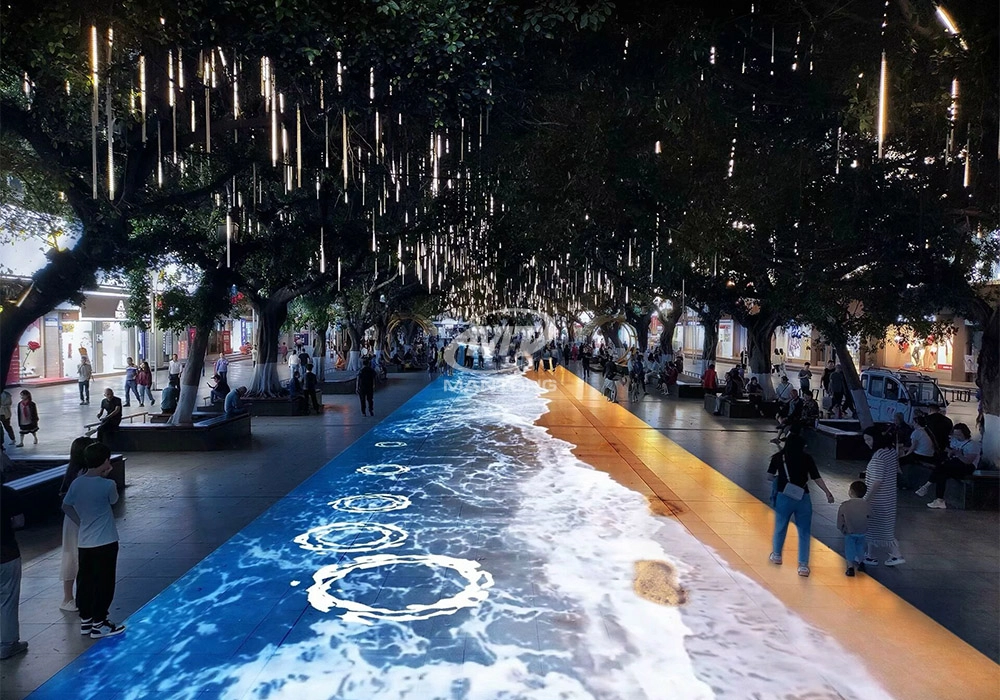
Immersive projection refers to a technology that creates a captivating and all-encompassing visual experience for viewers by projecting images or videos onto large surfaces, such as walls, floors, or even entire rooms. This technology aims to immerse the audience in a simulated environment, blurring the boundaries between the physical and virtual worlds.
Are you trader or manufacturer ?
We are direct manufacturer who specialize in providing one-stop solution for different outdoor & indoor projection project with our stable software and qualified projectors
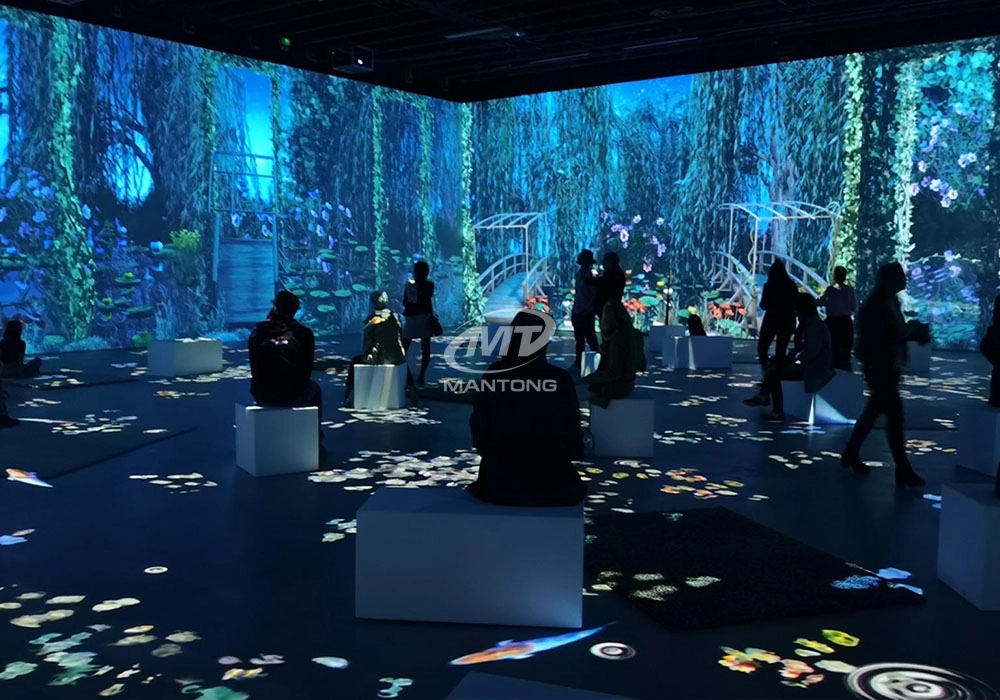
Mantong 6500LM High-Lumen Projector for Large-Scale Immersive Room Projection
Transform any space with Mantong's immersive projection mapping systems. Our high-lumen projectors (up to 6500 LM) and custom software create captivating interactive experiences for floors and walls. Ideal for museums, events, retail, and hospitality. Each kit includes professional ceiling mounting and 80+ pre-loaded video contents and is backed by a 12-month warranty and CE certification. We offer full customization and support to bring your vision to life.
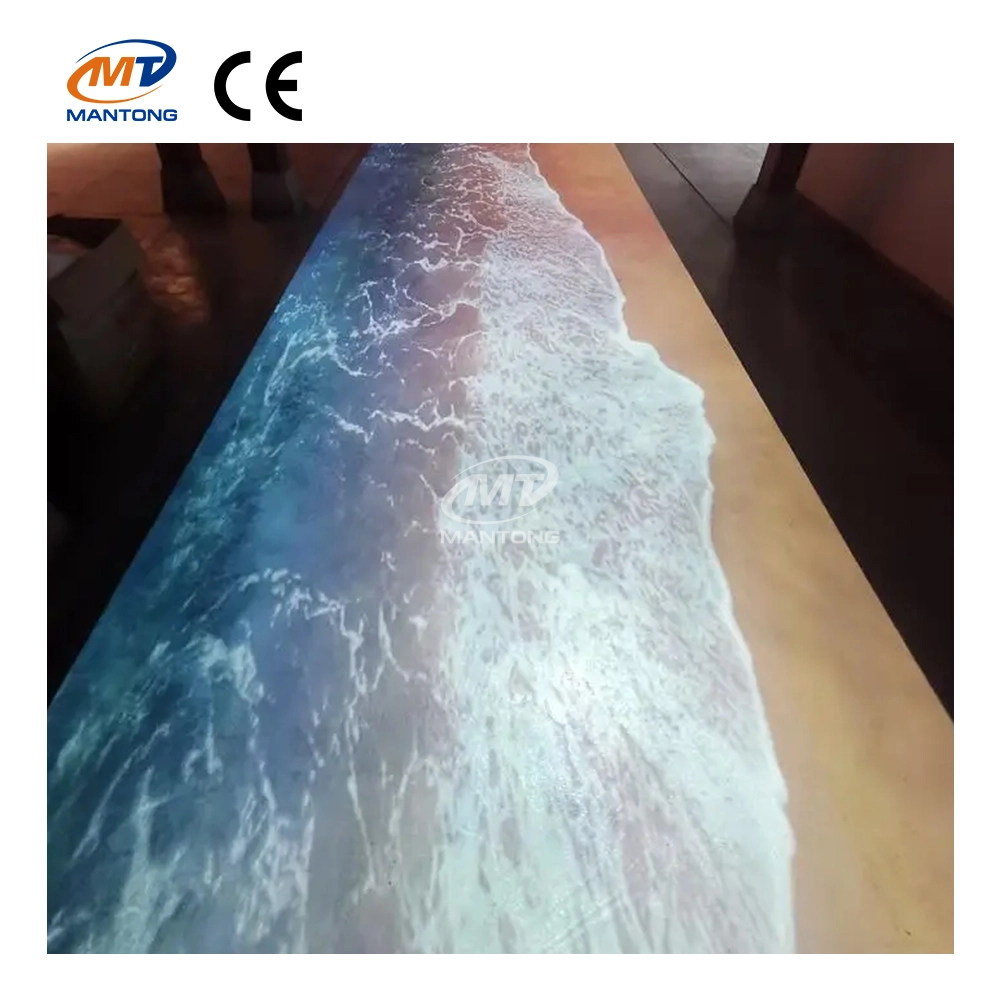
Indoor Interactive Floor Projector System - Customized Design & Installation Support
Indoor interactive floor projections display dynamic themed videos on the floor, commonly used in venues aiming to enhance brand influence or attract foot traffic, such as restaurants, hotel corridors, and brand car retail stores.
By using projectors and compatible software, the interactive content is projected onto the floor, encouraging engagement between people and the projected visuals. A single 5500-lumen indoor floor projector can cover an area of 5 m × 3 m. Typically, each project will use at least 3 units to ensure broad coverage and optimal visual effects.
We also offer customized design and installation support to enhance the interactive experience for your venue.
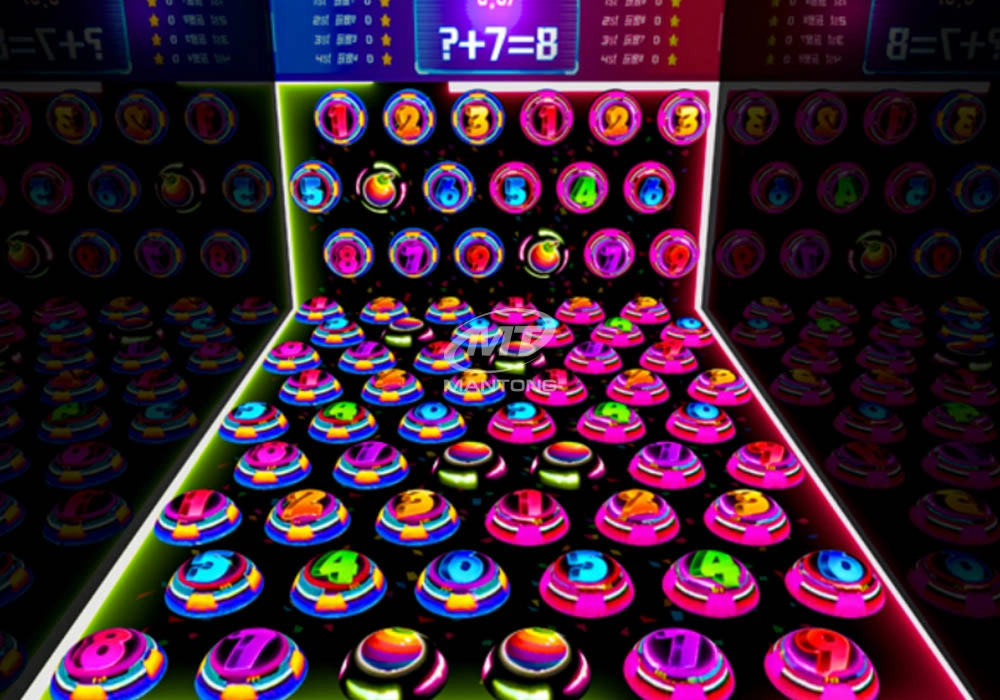
Amusement Rapidly Rotating Bouncing Sphere Interactive Wall Floor Projection Sports Games
Rapidly Rotating Bouncing Sphere is an interactive space where participants jump on rotating spheres. As they step on it, the spheres surface will show special interactivity
Jumping on spheres of the same color in succession causes them to pop, releasing light particles. The more consecutive jumps, the greater the reward—caterpillars appear, and eventually, all spheres of that color burst, filling the space with light and even more caterpillars.
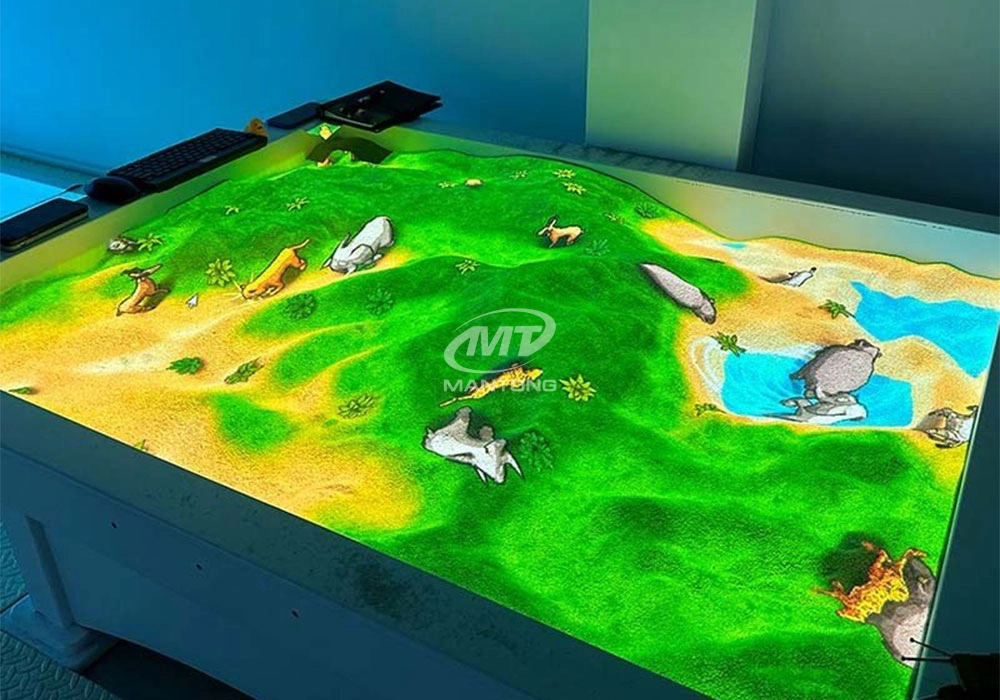
Interactive Sandbox Projection Mapping Games For Kids Play Park
Bring imagination to life with interactive sandbox projection mapping games designed for kids’ play parks. Using cutting-edge projection technology and real-time motion sensing, children can dig, build, and explore virtual worlds directly in the sand. Educational, engaging, and endlessly fun — it’s the perfect blend of play and learning.

Kaida Business Center, Shixin Road, Panyu District,Guangzhou City, Guangdong Province, China.
ManTong
ManTong
ManTong