
Case Study: Immersive Rooms Transforming Corporate Training
- Why modern corporations are investing in immersive room training
- Training challenges in large organizations
- What an immersive room actually does
- Business intent: from skill transfer to behavioral change
- Evidence and outcomes: measurable benefits of immersive room training
- Learning effectiveness and retention
- Time and cost efficiencies
- Business metrics improved by immersive rooms
- Comparing training modalities: immersive room vs alternatives
- Key comparative dimensions
- Case studies: real deployments and lessons learned
- Walmart and large-scale VR training (relevant insights)
- KFC 'The Hard Way' and role-play fidelity
- Custom enterprise pilot: design to scale
- Designing an effective immersive room program
- Technology stack and content pipeline
- Measurement and evaluation framework
- Operational considerations: space, scheduling, and facilitation
- ROI model: estimating value for your organization
- Sample ROI table (illustrative)
- Partner profile: ManTong Digital - immersive projection experts
- Who ManTong Digital is
- Core strengths and differentiators
- Products and capabilities for enterprise training
- Implementation checklist and best practices
- 10-step roadmap for successful deployment
- Common pitfalls to avoid
- FAQ
- 1. What is an immersive room and how does it differ from VR headsets?
- 2. What training use cases benefit most from immersive rooms?
- 3. How much does it cost to build an immersive room?
- 4. How do we measure training effectiveness?
- 5. Can immersive rooms scale across global operations?
- 6. Are immersive rooms accessibility-friendly?
- 7. How long does it take to create scenario content?
- Contact and call to action
- References
Why modern corporations are investing in immersive room training
Training challenges in large organizations
Enterprises face rising expectations for faster onboarding, measurable skills transfer, and cost control. Traditional classroom sessions and e-learning often deliver low engagement and spotty retention—problems that scale with headcount. An immersive room (dedicated space with projection, interactive surfaces and sensors) can address these gaps by creating embodied, contextual learning that mirrors real-world complexity.
What an immersive room actually does
An immersive room uses high-resolution projection, interactive floor/wall surfaces, motion tracking, and spatial audio to place learners inside a simulated environment. Unlike individual VR headsets, immersive rooms emphasize collaborative, shared experiences—ideal for team-based scenarios, safety drills, sales role-play, and customer-experience rehearsals.
Business intent: from skill transfer to behavioral change
When selecting an immersive solution, decision-makers typically expect three outcomes: faster time-to-proficiency, higher long-term retention, and demonstrable behavioral change on the job. These are measurable objectives that should guide room design, content choice, and success metrics.
Evidence and outcomes: measurable benefits of immersive room training
Learning effectiveness and retention
Multiple industry studies indicate immersive and simulation-based training can significantly improve learning outcomes. For example, PwC's 2020 study on virtual-reality soft-skills training reported faster learning and higher confidence compared to traditional methods (see References). In immersive rooms, the addition of physical movement and group dynamics amplifies those effects, enabling better situational judgment and teamwork.
Time and cost efficiencies
Organizations deploying immersive environments report reductions in repeated classroom delivery costs and travel. While initial capital outlay exists for projection hardware and space modifications, per-learner costs decline as utilization increases—especially for recurring certifications and scenario rehearsals.
Business metrics improved by immersive rooms
Typical KPIs influenced by immersive room deployments include:
- Time to proficiency (reduced)
- First-time pass rates on assessments (increased)
- Behavioral adherence in workplace evaluations (improved)
- Training satisfaction and engagement scores (higher)
Comparing training modalities: immersive room vs alternatives
Key comparative dimensions
When evaluating options—classroom, LMS e-learning, VR headsets, and immersive rooms—organizations should compare engagement, scalability, group collaboration, and cost. The table below summarizes typical industry findings; numerical estimates are drawn from published studies and aggregated industry reports (sources listed in References).
| Metric | Classroom | LMS E-learning | VR Headset | Immersive Room |
|---|---|---|---|---|
| Engagement | Medium | Low | High (individual) | High (group) |
| Retention (relative) | Baseline | -10% to 0% vs baseline | +50% to +300% (study-dependent) | +60% to +250% (group scenarios) |
| Time to proficiency | Moderate | Long | Faster | Faster (with collaborative practice) |
| Per-learner cost (recurring) | Moderate | Low | Moderate to High | Low to Moderate (at scale) |
| Collaboration | High | Low | Limited (individual) | High (team-based) |
Notes: retention and time-to-proficiency ranges vary by use case. Peer-reviewed and industry reports referenced below provide case-specific numbers (PwC 2020, LinkedIn Learning 2020, Strivr/Walmart case studies).
Case studies: real deployments and lessons learned
Walmart and large-scale VR training (relevant insights)
Walmart partnered with immersive training providers to scale scenario-based training to thousands of stores. The approach showed that centralized simulation content plus distributed immersive spaces (including dedicated rooms) can deliver consistent standards across a vast workforce. Key takeaways: prioritize repeatable scenarios, measure behavior change on the job, and plan for content updates.
KFC 'The Hard Way' and role-play fidelity
KFC's early VR campaign highlighted the power of realistic scenario immersion for procedural training. For companies focused on operational consistency (food prep, safety protocols), immersive rooms can combine projection-based walkthroughs with tactile elements to improve muscle memory and on-floor compliance.
Custom enterprise pilot: design to scale
In typical enterprise pilots, companies start with a single immersive room focused on a high-impact use case—safety drills, high-stakes customer interactions, or emergency response. Success metrics include pre/post assessments, supervisor-rated behavioral changes, and operational KPIs. A phased roll-out with content modularity ensures easier scaling and cost amortization.
Designing an effective immersive room program
Technology stack and content pipeline
A robust immersive room combines hardware (projectors, servers, sensors), software (simulation engines, analytics), and content (scenarios, branching narratives). Important specifications include projection resolution and brightness, low-latency tracking, and an authoring workflow for iterative content updates.
Measurement and evaluation framework
Before launch, define evaluation criteria: knowledge tests, scenario performance metrics, supervisor behavior rubrics, and business KPIs (error rates, sales conversion). Use built-in analytics in the immersive software to collect objective measures (response time, decision paths) and correlate them with workplace performance.
Operational considerations: space, scheduling, and facilitation
Plan for room acoustics, access control, and scheduling to maximize utilization. Trained facilitators improve the transfer from simulation to job—invest in facilitator guides and train-the-trainer programs.
ROI model: estimating value for your organization
Sample ROI table (illustrative)
The table below demonstrates a simplified ROI for a mid-size company deploying one immersive room focused on safety training, comparing three-year cumulative costs vs. traditional classroom repeated delivery.
| Item | Immersive Room (3 years) | Traditional Classroom (3 years) |
|---|---|---|
| Initial capital (hardware & installation) | $120,000 | $10,000 (AV) |
| Annual content & maintenance | $30,000 | $15,000 |
| Delivery labor & travel | $10,000 | $90,000 |
| Per-learner time cost (productivity) | $40,000 (reduced by faster training) | $70,000 |
| Total (3 years) | $270,000 | $185,000 |
| Net benefit driver | Lower recurring delivery cost, improved retention, fewer on-the-job errors | Lower capex but higher recurring costs and inconsistent delivery |
Interpretation: While immersive rooms require higher upfront investment, they often deliver superior long-term ROI for high-frequency, mission-critical training by reducing travel/delivery and improving outcomes. Exact calculus depends on utilization rate, cost of errors, and workforce scale.
Partner profile: ManTong Digital - immersive projection experts
Who ManTong Digital is
ManTong Digital is a one-stop interactive projection solution provider and direct manufacturer based in Guangzhou, China, with over 10 years of industry experience. We are dedicated to providing innovative, flexible and cost-effective projection solutions, offering both hardware and software to meet various needs.
Core strengths and differentiators
At ManTong, we specialize in providing customized solutions for a wide range of application scenarios through innovative projection technology. Whether it's immersive experiences, interactive entertainment or outdoor lighting and projection shows, our solutions can transform your ideas into stunning visual effects. Our projection technology provides customized solutions for a variety of scenarios, delivering immersive and interactive visual experiences.
Products and capabilities for enterprise training
ManTong's portfolio covers immersive projection, interactive floor projection, interactive wall projection, immersive room solutions, 3D projection, interactive projection games, projection shows, and interactive projection mapping. As a direct manufacturer, ManTong offers tight integration between hardware and software, faster customization, and competitive pricing. We are now looking for business partnerships worldwide. Our vision is to become the world's leading interactive projection manufacturer. Website: https://www.mtprojection.com/.
Implementation checklist and best practices
10-step roadmap for successful deployment
- Define clear learning objectives tied to business KPIs.
- Choose scenarios with high transfer-to-work potential.
- Design modular content for iterative improvement.
- Specify projection and tracking requirements for fidelity.
- Plan space layout for collaboration and safety.
- Implement facilitator training and assessment frameworks.
- Instrument analytics for continuous measurement.
- Run a controlled pilot and collect pre/post metrics.
- Refine content based on learner feedback and performance data.
- Scale through multiple rooms or mobile deployments where appropriate.
Common pitfalls to avoid
Avoid treating the immersive room as a novelty. Without clear objectives, facilitator training, and measurement, even excellent technology can fail to produce behavior change. Also budget for content lifecycle—static scenarios degrade as business contexts evolve.
FAQ
1. What is an immersive room and how does it differ from VR headsets?
An immersive room is a shared, projection-based environment that uses walls, floors, spatial audio, and sensors to create a collective simulation. Unlike VR headsets which are individual and occluding, immersive rooms enable face-to-face interaction, team exercises, and facilitator-led scenarios without isolating participants.
2. What training use cases benefit most from immersive rooms?
Best-fit use cases include team-based customer service simulations, emergency response drills, complex operational procedures, leadership and soft-skills scenarios, and experiential onboarding where context and social interaction matter.
3. How much does it cost to build an immersive room?
Costs vary widely. A basic interactive projection room can start in the tens of thousands of dollars; fully featured, enterprise-grade immersive rooms typically range from ~$80k to $300k depending on scale, hardware quality, and content complexity. Total cost of ownership should factor in content development and maintenance.
4. How do we measure training effectiveness?
Combine objective analytics (scenario performance metrics, decision paths, response times) with behavioral assessments (supervisor ratings) and business KPIs (error reduction, throughput). Pre/post testing and longitudinal follow-up are essential to prove long-term transfer.
5. Can immersive rooms scale across global operations?
Yes—if you design modular content, enforce standards, and use a centralized content-management approach. Deploy pilots, refine content, and then replicate rooms with local adaptations. Partnerships with manufacturers like ManTong can ease scaling with standardized hardware and localization services.
6. Are immersive rooms accessibility-friendly?
Design considerations for accessibility include alternative interaction modes, captioning, adjustable audio levels, and inclusive scenario design. Early accessibility planning ensures compliance with corporate inclusion goals.
7. How long does it take to create scenario content?
Simple branching scenarios can be produced within 4-8 weeks. Complex, high-fidelity simulations with sensor integration and scenario analytics may require 3-6 months depending on approvals and iteration cycles.
Contact and call to action
If your organization is evaluating immersive room solutions for corporate training, ManTong Digital can help design, manufacture, and deploy tailored projection-based environments. Contact us to discuss pilots, request demos, or explore partnership opportunities. Visit https://www.mtprojection.com/ to learn more and get a consultation.
References
- PwC. The Effectiveness of Virtual Reality Soft Skills Training in the Enterprise. PwC Research, 2020. https://www.pwc.com/us/en/services/consulting/library/virtual-reality-training. (accessed 2024-06-01).
- Walmart Corporate. Walmart is transforming employee training with VR. Walmart News, 2018-2019. https://corporate.walmart.com/newsroom (search: VR training) (accessed 2024-06-01).
- Strivr. Walmart Case Study. Strivr client examples; details on large-scale VR training deployments. https://www.strivr.com/customers/ (accessed 2024-06-01).
- KFC. The Hard Way — KFC VR Training case materials and industry press coverage, 2016–2018. https://www.adweek.com/ (search: KFC VR training) (accessed 2024-06-01).
- LinkedIn Learning. 2020 Workplace Learning Report. LinkedIn, 2020. https://learning.linkedin.com/resources/workplace-learning-report (accessed 2024-06-01).
- Deloitte Insights. The evolution of corporate learning: embracing digital and experiential methods. Deloitte, 2019–2021 trend reports. https://www2.deloitte.com/ (search: corporate learning/digital training) (accessed 2024-06-01).
- Statista. Corporate training expenditure and digital learning adoption statistics. Statista database, various pages. https://www.statista.com/ (accessed 2024-06-01).
Note: Links above lead to authoritative reports and corporate case studies used to inform the comparisons and recommendations in this article. For tailored ROI modeling and a technical consultation on immersive room options, please contact ManTong Digital at https://www.mtprojection.com/.
The latest trends for immersive experience room
Best professional interactive projection system manufacturers and supplier brands
The Future of Entertainment: Why Immersive Projection Rooms Are in Demand
How to Choose the projection mapping wall manufacturer and supplier ?
One-Stop Projection Solution Provider Since 2011
What information do you need to know before making the proposal/solution?
We know that everyone wants to know the price, but the price of our products is determined by many factors since most of our products are custom, so no ready price list. In order to fast understand what you need, can you send us an inquiry like this?
For example: I am really interested in your immersive projection products, we are a company in the USA and want to install some in my restaurant. It is about 50 meters long, and 5m in width. Projection size you can decide but the length should be not less than 20 meters. We want some content about SeaWorld because our place is all about the sea. Thank you.
How to install the projection equipment ?
1) Install the projector in a suitable position. We will provide you with a hanger, which you need to fix on the ceiling with
screws.
2) Connect projectors, computers and other accessories through wires.
3) After completing the above 2 steps, we will carry out the edge blending steps. Our team can complete it through remote
control.
In general, installation instructions for each project need to be specified on a project-by-project basis. The above is for
reference only.
What's the application of Immersive projection ?
It can be used in various venues, such as art exhibition, entertainment venues, educational institution, Wedding hall /Banquet/Bar,Yoga Studio and so on. It often involves advanced projection techniques, multimedia content, and interactive elements to engage and captivate the audience's senses.
What about the wall/floor material for the projection?
It’s recommended to choose a light-colored material with minimal reflectivity—pure white or light grey works best. the
common material is cement & plaster board
For optimal projection results, the surface should be free of any patterns or textures, as the projector will display content
directly onto it.
There are no specific material requirements; you may use any commonly available material in your local market, as long as it
meets the above conditions.
How to Write an Interactive-Effect Video Customisation Script ?
① Project Background: Briefly introduce the context in which this interactive scene will be used (e.g., exhibition, museum,
event space, children's area). Example: This scene is part of the “Underwater World” zone in a children's science museum,
designed to be engaging and exploratory.
②Visual Style / Atmosphere: What kind of visual mood are you aiming for? Please describe the color scheme, style, and any
references. it should focus solely on describing the visual aspects of the scene, supported by relevant charts or reference
images.
③ Interaction Points Overview:List each interactive hotspot along with the effect you'd like to trigger when the user
touches or clicks the area. example: when player touch the clownfish, it will swims away with bubble trail (animation effect)
and produce the bubble sound ( sound effect requirement )
④ Static Visual Reference:including but not limited to background image/video, a list of major visual elements (e.g., coral,
rocks, seaweed, fish), which elements should be interactive?
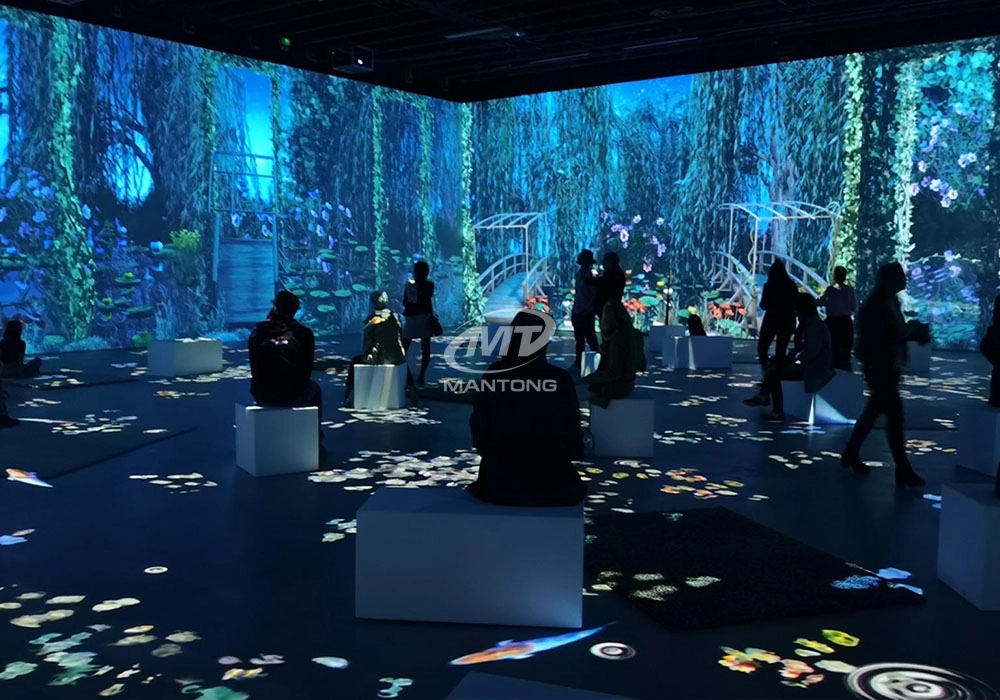
Mantong 6500LM High-Lumen Projector for Large-Scale Immersive Room Projection
Transform any space with Mantong's immersive projection mapping systems. Our high-lumen projectors (up to 6500 LM) and custom software create captivating interactive experiences for floors and walls. Ideal for museums, events, retail, and hospitality. Each kit includes professional ceiling mounting and 80+ pre-loaded video contents and is backed by a 12-month warranty and CE certification. We offer full customization and support to bring your vision to life.
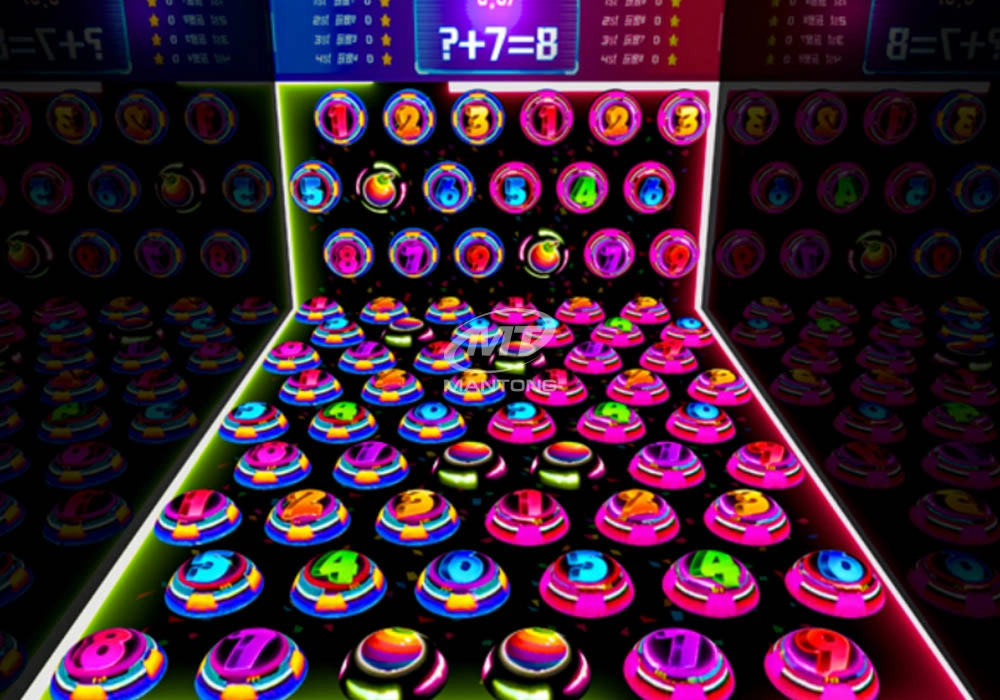
Amusement Rapidly Rotating Bouncing Sphere Interactive Wall Floor Projection Sports Games
Rapidly Rotating Bouncing Sphere is an interactive space where participants jump on rotating spheres. As they step on it, the spheres surface will show special interactivity
Jumping on spheres of the same color in succession causes them to pop, releasing light particles. The more consecutive jumps, the greater the reward—caterpillars appear, and eventually, all spheres of that color burst, filling the space with light and even more caterpillars.
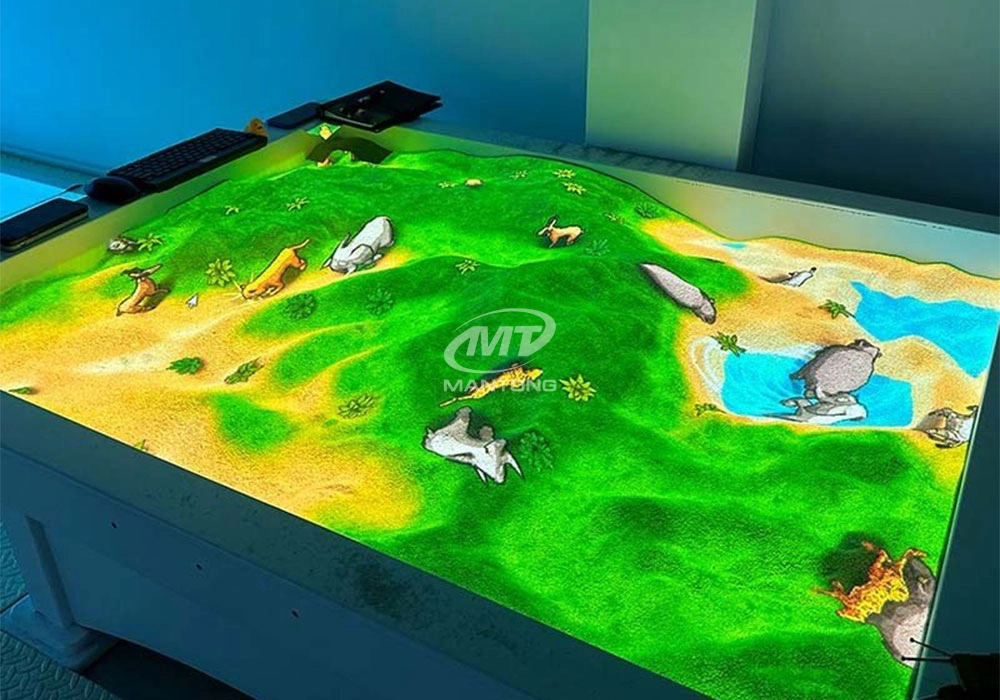
Interactive Sandbox Projection Mapping Games For Kids Play Park
Bring imagination to life with interactive sandbox projection mapping games designed for kids’ play parks. Using cutting-edge projection technology and real-time motion sensing, children can dig, build, and explore virtual worlds directly in the sand. Educational, engaging, and endlessly fun — it’s the perfect blend of play and learning.
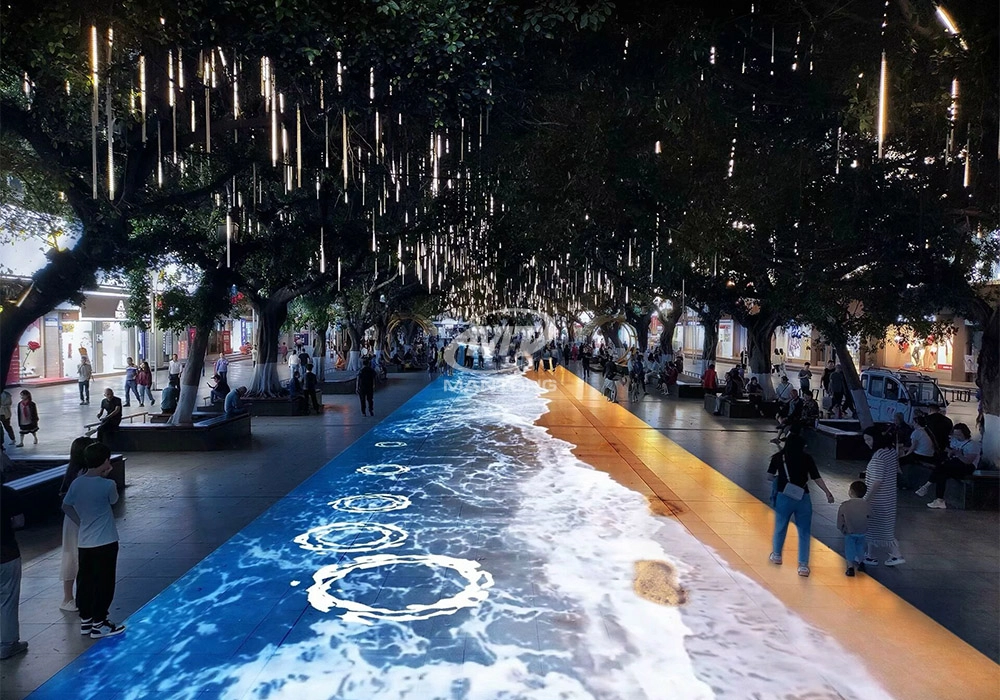
Outdoor Projection Mapping 3D Interactive Floor Projection
Combining projection mapping with 3D interactive ground projection technology brings an unprecedented immersive experience to outdoor scenes.

Kaida Business Center, Shixin Road, Panyu District,Guangzhou City, Guangdong Province, China.
ManTong
ManTong
ManTong