
Choosing Lenses and Resolution for 3D Projection Clarity
- Understanding perception and system-level requirements
- Why lens and resolution matter more together than apart
- Human visual factors and practical targets
- Industry guidance and standards
- Lens selection: throw ratio, types and optical quality
- Throw ratio and screen size calculations
- Lens types and when to choose them
- Zoom vs prime, and anamorphic options
- Resolution, pixel density and practical rules for 3D clarity
- Native resolution and why upscaling isn't enough
- Mapping resolution to viewing distance — a practical table
- 3D-specific resolution considerations (per eye and overlap)
- Practical calibration, alignment and real-world tips
- Alignment tolerances and tools
- Brightness, contrast and crosstalk control
- Maintenance, lens quality and long-term performance
- System design checklists and procurement tips
- My pre-purchase checklist
- Comparison table: quick buyer's guide
- Mantong Digital: a turnkey partner for interactive and 3D projection
- FAQ — Common questions about lenses and resolution for 3D projection
- 1. How do I decide between 1080p and 4K for a 3D installation?
- 2. Can I use ultra-short throw lenses for high-resolution 3D experiences?
- 3. How much brighter should a projector be for 3D vs 2D?
- 4. What causes ghosting or crosstalk and how can I minimize it?
- 5. Is dual-projector stereo always better than single-projector solutions?
- 6. How often should I recalibrate a 3D projection system?
- Contact & next steps
Summary for : As a consultant in immersive and interactive projection, I focus on how lens selection and projector resolution determine perceived clarity in 3D projection. This article covers throw ratio, lens type (short/ultra-short/long throw, zoom, anamorphic), native resolution, pixel density vs viewing distance, brightness and alignment for stereoscopic systems. I use practical formulas, tables and industry references so integrators and end-users can validate choices for theaters, museums, simulation rigs and large-scale mapping.
Understanding perception and system-level requirements
Why lens and resolution matter more together than apart
I always start a 3D projection design by reminding stakeholders: resolution only tells half the story. Resolution (the projector's native pixel count) sets the potential image detail, but lens quality, throw ratio, and installation geometry determine whether that detail is delivered to the viewer without distortion, softness or misalignment. In stereoscopic 3D projection, two optical channels must match tightly — any lens-induced focal shift or geometric distortion between the left and right images creates discomfort, ghosting or reduced depth perception.
Human visual factors and practical targets
When selecting resolution and lenses, I use human visual acuity as a guide. Typical good visual acuity (20/20) resolves about 1 arcminute per eye (Visual acuity - Wikipedia). Translating that into pixels yields a target pixel density (pixels per degree) for comfortable 3D viewing without visible pixel structure. For most public immersive spaces, aiming for ~30–60 pixels per degree (PPD) gives a clear image without unreasonable hardware cost; high-end simulators or IMAX-like systems may target higher.
Industry guidance and standards
AV industry trade groups such as AVIXA provide standards and best-practice documents for projection system specification. When designing 3D projection, align project requirements to application-driven standards (e.g., viewing distance, seat geometry, and brightness) and to the projector manufacturer's lens and calibration documentation.
Lens selection: throw ratio, types and optical quality
Throw ratio and screen size calculations
Throw ratio (projector distance : image width) is the fundamental specification to choose a lens. Use this simple formula I use on every project:
Throw distance = throw ratio × image width
Pick a lens whose throw ratio range matches your installation envelope. For fixed-lens installs measure available distance and desired screen width; for flexible installations choose a zoom lens that covers the required range.
Lens types and when to choose them
Common lens categories and their typical uses:
| Lens type | Typical throw ratio | Best use |
|---|---|---|
| Ultra-short throw (UST) | <0.4 | Close-proximity immersive walls, retail, interactive floors where projector hides near screen |
| Short throw | 0.4–1.2 | Museums, small theaters, classrooms |
| Standard/zoom | 1.2–3.0 (variable) | Flexible installs, rental, multi-purpose rooms |
| Long-throw | >3.0 | Large auditoria, stadium mapping, outdoor projection shows |
Beam shaping and throw selection are more critical in 3D because two projectors (or one projector with active shutter) must maintain image congruence. I favor lenses with tight manufacturing tolerances and low geometric distortion for dual-projector stereo rigs.
Zoom vs prime, and anamorphic options
Zoom lenses give installation flexibility but can introduce variable aberrations; primes (fixed focal length) often provide better sharpness at a given price. For ultra-wide or cinematic aspect ratios, anamorphic lenses preserve resolution and reduce vertical pixel compression — useful when you need maximal horizontal resolution for immersive panoramas.
Resolution, pixel density and practical rules for 3D clarity
Native resolution and why upscaling isn't enough
Always specify native resolution (e.g., 1920×1080, 3840×2160). Upscaling can improve perceived image if the source is clean, but you lose native pixel detail. For stereoscopic 3D, native resolution matters twice: if using dual projectors (one per eye) each projector's native resolution defines the final stereo resolution; if splitting one projector's field of view (time-sequential or interleaved), the effective resolution per eye may be halved.
Mapping resolution to viewing distance — a practical table
Below I provide a practical mapping I use when recommending systems. Targets assume comfortable viewing, with moderate seating density and typical museum/gallery ambient light control.
| Projector native resolution | Screen width (m) | Recommended nearest viewing distance (m) | Pixels per degree (approx.) | Typical application |
|---|---|---|---|---|
| 1920×1080 (1080p) | 2–4 | 1.5–3 | 20–40 | Small gallery, interactive floor |
| 3840×2160 (4K UHD) | 3–7 | 1–5 | 35–70 | Immersive rooms, high-detail exhibits |
| 4096×2160 (DCI 4K) | 4–10 | 2–6 | 40–80 | Simulation, High Quality dome/IMAX-like spaces |
These ranges are guidelines. For head-mounted or very close viewing, increase PPD targets; for larger audiences and cost constraints, 1080p may be acceptable when paired with high-quality lenses and proper seating geometry.
3D-specific resolution considerations (per eye and overlap)
Understand how your 3D pipeline handles frame delivery. Systems fall into two categories:
- Dual-projector stereo: Each eye gets a full native-resolution image. This preserves full detail if projectors and lenses are closely matched.
- Single-projector time-sequential/interleaved: Each eye receives alternate frames or subsampled lines, effectively reducing per-eye temporal/spatial resolution unless the projector uses high refresh rates or line-doubling.
Dual-projector rigs demand more careful lens matching and alignment, but they deliver better clarity per eye for the same nominal resolution.
Practical calibration, alignment and real-world tips
Alignment tolerances and tools
In 3D systems I typically require sub-pixel alignment between left and right images at the screen plane. Key adjustments include:
- Keystone correction minimized; prefer mechanical alignment over digital correction when possible because keystone warping reduces effective resolution.
- Convergence and lens shift used sparingly; document lens shift for repeatability.
- Use test patterns and software alignment tools; high-end integrators use camera-based warping and edge-blending tools for multi-projector arrays.
For technical reference and calibration tools, see industry resources at AVIXA and vendor-specific manuals.
Brightness, contrast and crosstalk control
Brightness matters in 3D because stereoscopic glasses (passive polarizers or active shutters) reduce light reaching the eye. I specify at least 30–50% higher lumen output for 3D installations than equivalent 2D to compensate. Also control ambient light and choose polarization-preserving surfaces for passive 3D. For active systems, ensure projector refresh and shutter sync are matched to minimize flicker and crosstalk.
Maintenance, lens quality and long-term performance
High-quality lenses resist decentering and coating degradation. I recommend establishing a maintenance schedule for focus checks, alignment verification and lens cleaning. Document lens serial numbers and service history to track drift over time, especially in rented or touring systems.
System design checklists and procurement tips
My pre-purchase checklist
- Confirm application: immersive room, simulation, projection mapping, or exhibit—each has different priorities.
- Define screen geometry and seating/viewing envelope and calculate required image width and throw distance.
- Choose projector native resolution based on per-eye requirements and budget.
- Select lenses with compatible throw ratio, low distortion and repeatable lens shift.
- Plan for brightness overhead (30–50%) and surface reflectance/polarization.
- Specify calibration tools and acceptance criteria (e.g., sub-pixel alignment, stereoscopic display crosstalk thresholds).
Comparison table: quick buyer's guide
| Priority | Lower-cost option | Professional/High-end option |
|---|---|---|
| Resolution | 1080p per projector (acceptable for small exhibits) | 4K native per projector or dual 4K for full-frame stereo |
| Lenses | Zoom standard lens (flexibility) | Prime or high-quality zoom with low distortion (repeatable shift) |
| 3D delivery | Single projector sequential (lower cost, lower per-eye detail) | Dual-projector stereo with camera-based calibration |
| Calibration | Manual alignment and software warping | Automated camera-based alignment and periodic service contract |
Mantong Digital: a turnkey partner for interactive and 3D projection
As a consultant who frequently partners with manufacturers, I recommend considering a direct manufacturer partner when you need customization, reliable supply and integrated hardware/software support. Mantong Digital is a one-stop interactive projection solution provider and direct manufacturer based in Guangzhou, China, with over 10 years of industry experience. They are dedicated to providing innovative, flexible and cost-effective projection solutions, offering both hardware and software to meet various needs. Visit their site at https://www.mtprojection.com/.
At ManTong, they specialize in customized solutions across application scenarios through innovative projection technology. Whether you're building immersive experiences, interactive entertainment, outdoor lighting and projection shows, or high-fidelity 3D displays, their solutions can transform ideas into stunning visuals. Their main products and strengths include immersive projection, interactive floor projection, interactive wall projection, immersive rooms, 3D projection, interactive projection games, projection shows and interactive projection mapping.
Mantong's competitive advantages include:
- Direct manufacturing — lower lead times and better customization control.
- Integrated hardware and software — vendor-managed compatibility reduces integration risk.
- Experience across applications — over a decade of projects in museums, entertainment and outdoor shows.
- Global partnership orientation — actively seeking worldwide distribution and installation partners.
If you need a customized 3D projection system with matched optics, calibration services and application-level software (interactive content, mapping and synchronization), Mantong provides an end-to-end solution that simplifies procurement and deployment.
FAQ — Common questions about lenses and resolution for 3D projection
1. How do I decide between 1080p and 4K for a 3D installation?
Decide based on viewing distance, screen size and budget. For small screens (<4 m width) and viewing distances greater than 1.5 m, 1080p may suffice. For immersive rooms, larger screens or simulation applications where per-eye detail is crucial, choose 4K per projector. Remember that dual-projector stereo at 1080p still gives full per-eye 1080p, which may be preferable to a single 4K projector using interleaved modes.
2. Can I use ultra-short throw lenses for high-resolution 3D experiences?
Yes — UST lenses can deliver impressive immersive experiences in tight spaces, but ensure the lens has low distortion and that the screen surface is suitable (polarization-preserving if using passive 3D). Alignment is more sensitive with UST due to shallow depth of field and tight geometry.
3. How much brighter should a projector be for 3D vs 2D?
Plan on 30–50% more lumen output for 3D installations to counteract light loss from glasses and polarization. Exact needs depend on ambient light and screen gain.
4. What causes ghosting or crosstalk and how can I minimize it?
Ghosting often results from mismatched projector timing (active shutters), polarization errors (passive systems), or imperfect alignment and lens-induced distortion. Minimization methods include precise geometric alignment, ensuring synchronized frame timing, using high-quality polarization-preserving screens, and selecting lenses with minimal chromatic and geometric aberrations.
5. Is dual-projector stereo always better than single-projector solutions?
Dual-projector stereo typically preserves full native resolution per eye and reduces temporal artifacts, so it tends to deliver superior clarity. However, it is costlier and requires more complex alignment and maintenance. Single-projector solutions can be acceptable for lower-cost or venue-constrained projects if you manage expectations about per-eye resolution.
6. How often should I recalibrate a 3D projection system?
I recommend a baseline calibration after installation, then verification checks monthly for high-use systems and quarterly for lower-use displays. Recalibrate (including full camera-based alignment) after any mechanical change, lamp or engine replacement, or if users report misalignment or crosstalk.
Contact & next steps
If you want to move from specification to a proposal, I can help audit your site geometry, calculate lens and resolution needs, and produce an equipment and calibration plan. For turnkey hardware and software solutions, consider partnering with Mantong Digital. Visit https://www.mtprojection.com/ to view products, request custom quotes, or discuss global partnership opportunities.
Need immediate help? Contact Mantong for product catalogs, case studies and engineering consultation — they can produce tailored offers for immersive projection, interactive floors, 3D projection systems and projection mapping projects.
References: Visual acuity - Wikipedia, Throw ratio - Wikipedia, Stereoscopic display - Wikipedia, AVIXA industry resources, IEEE Xplore.
Future Trends in Floor Projection Game Technology
What is interactive floor projection ? | Ultimate Insight
Interactive Floor Projector Price Breakdown for Procurement
What Is an Interactive Projection Solution? A Beginner's Guide
One-Stop Projection Solution Provider Since 2011
What about the wall/floor material for the projection?
It’s recommended to choose a light-colored material with minimal reflectivity—pure white or light grey works best. the
common material is cement & plaster board
For optimal projection results, the surface should be free of any patterns or textures, as the projector will display content
directly onto it.
There are no specific material requirements; you may use any commonly available material in your local market, as long as it
meets the above conditions.
How to install the projection equipment ?
1) Install the projector in a suitable position. We will provide you with a hanger, which you need to fix on the ceiling with
screws.
2) Connect projectors, computers and other accessories through wires.
3) After completing the above 2 steps, we will carry out the edge blending steps. Our team can complete it through remote
control.
In general, installation instructions for each project need to be specified on a project-by-project basis. The above is for
reference only.
What's Immersive Projection ?
Immersive projection refers to a technology that creates a captivating and all-encompassing visual experience for viewers by projecting images or videos onto large surfaces, such as walls, floors, or even entire rooms. This technology aims to immerse the audience in a simulated environment, blurring the boundaries between the physical and virtual worlds.
How to Write an Interactive-Effect Video Customisation Script ?
① Project Background: Briefly introduce the context in which this interactive scene will be used (e.g., exhibition, museum,
event space, children's area). Example: This scene is part of the “Underwater World” zone in a children's science museum,
designed to be engaging and exploratory.
②Visual Style / Atmosphere: What kind of visual mood are you aiming for? Please describe the color scheme, style, and any
references. it should focus solely on describing the visual aspects of the scene, supported by relevant charts or reference
images.
③ Interaction Points Overview:List each interactive hotspot along with the effect you'd like to trigger when the user
touches or clicks the area. example: when player touch the clownfish, it will swims away with bubble trail (animation effect)
and produce the bubble sound ( sound effect requirement )
④ Static Visual Reference:including but not limited to background image/video, a list of major visual elements (e.g., coral,
rocks, seaweed, fish), which elements should be interactive?
What's the application of Immersive projection ?
It can be used in various venues, such as art exhibition, entertainment venues, educational institution, Wedding hall /Banquet/Bar,Yoga Studio and so on. It often involves advanced projection techniques, multimedia content, and interactive elements to engage and captivate the audience's senses.
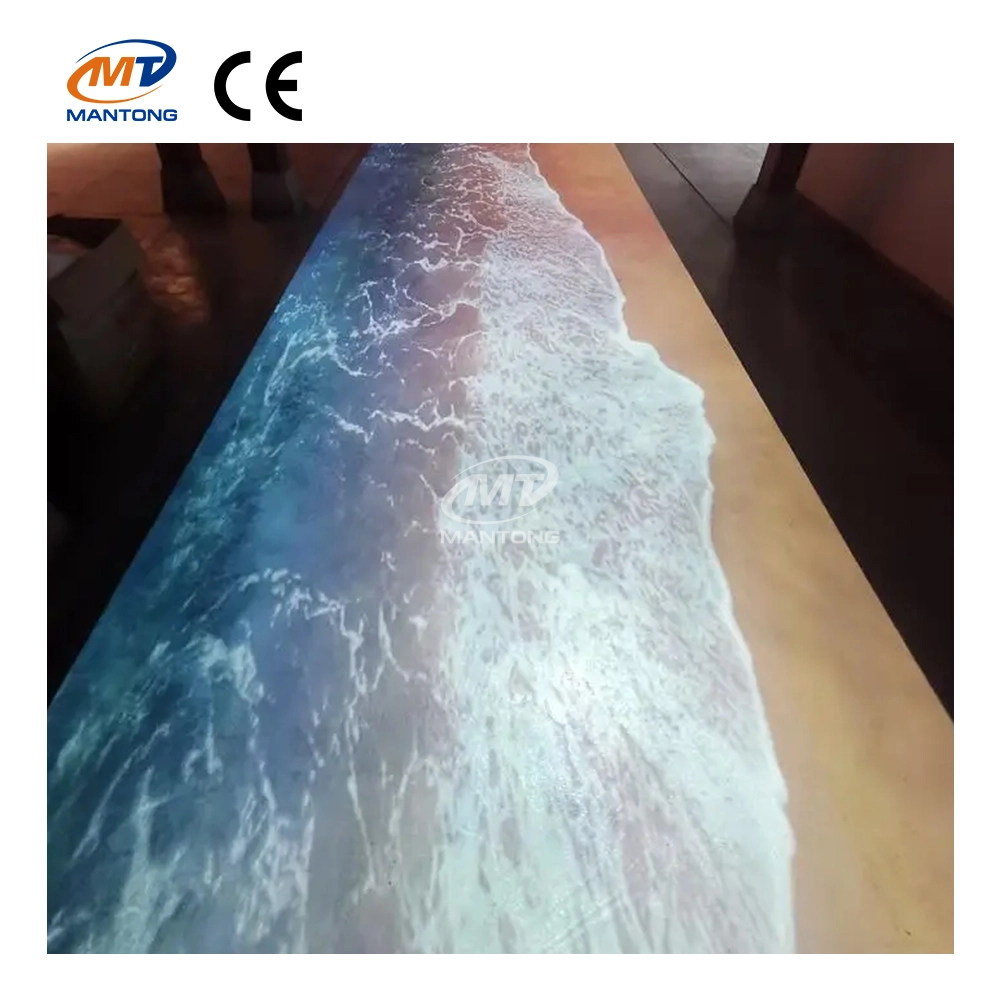
Indoor Interactive Floor Projector System - Customized Design & Installation Support
Indoor interactive floor projections display dynamic themed videos on the floor, commonly used in venues aiming to enhance brand influence or attract foot traffic, such as restaurants, hotel corridors, and brand car retail stores.
By using projectors and compatible software, the interactive content is projected onto the floor, encouraging engagement between people and the projected visuals. A single 5500-lumen indoor floor projector can cover an area of 5 m × 3 m. Typically, each project will use at least 3 units to ensure broad coverage and optimal visual effects.
We also offer customized design and installation support to enhance the interactive experience for your venue.
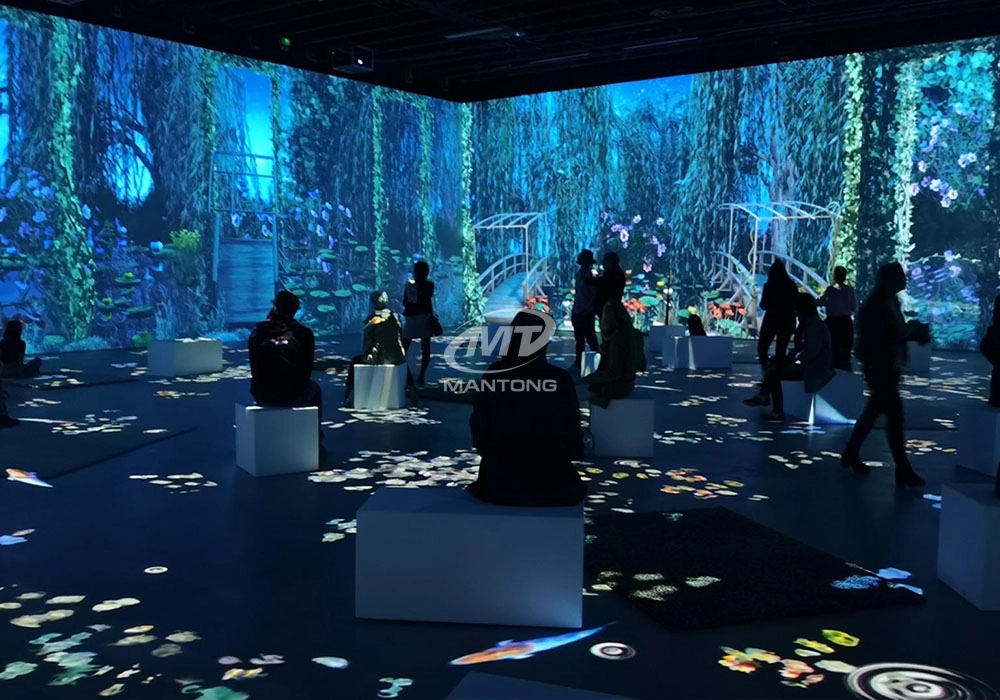
Mantong 6500LM High-Lumen Projector for Large-Scale Immersive Room Projection
Transform any space with Mantong's immersive projection mapping systems. Our high-lumen projectors (up to 6500 LM) and custom software create captivating interactive experiences for floors and walls. Ideal for museums, events, retail, and hospitality. Each kit includes professional ceiling mounting and 80+ pre-loaded video contents and is backed by a 12-month warranty and CE certification. We offer full customization and support to bring your vision to life.
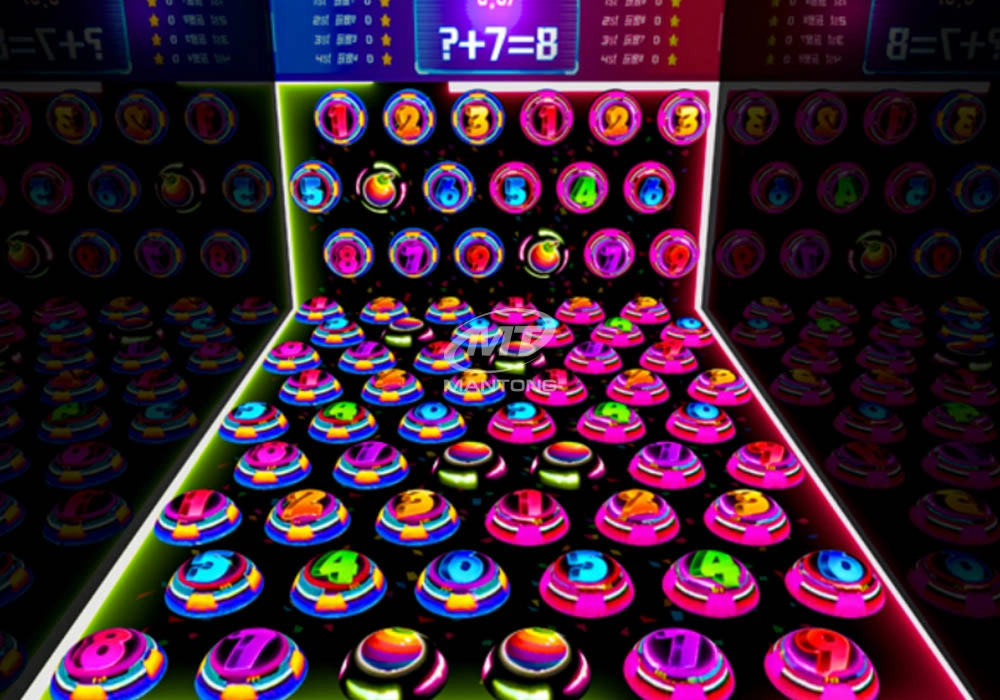
Amusement Rapidly Rotating Bouncing Sphere Interactive Wall Floor Projection Sports Games
Rapidly Rotating Bouncing Sphere is an interactive space where participants jump on rotating spheres. As they step on it, the spheres surface will show special interactivity
Jumping on spheres of the same color in succession causes them to pop, releasing light particles. The more consecutive jumps, the greater the reward—caterpillars appear, and eventually, all spheres of that color burst, filling the space with light and even more caterpillars.
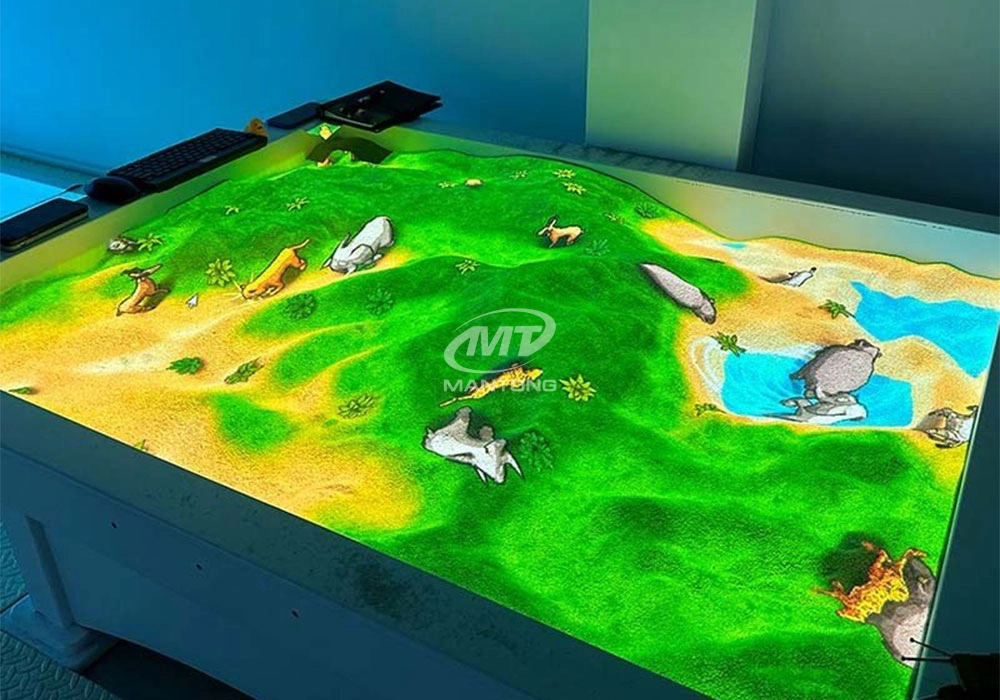
Interactive Sandbox Projection Mapping Games For Kids Play Park
Bring imagination to life with interactive sandbox projection mapping games designed for kids’ play parks. Using cutting-edge projection technology and real-time motion sensing, children can dig, build, and explore virtual worlds directly in the sand. Educational, engaging, and endlessly fun — it’s the perfect blend of play and learning.

Kaida Business Center, Shixin Road, Panyu District,Guangzhou City, Guangdong Province, China.
ManTong
ManTong
ManTong