
How Interactive Projector Games Improve Early Learning
- The science behind play-based and embodied learning
- Why movement and play matter for early brains
- Embodied cognition and multisensory learning
- Active learning improves measurable outcomes
- How interactive projector games map to early learning goals
- Supporting cognitive and language development
- Developing motor and perceptual skills
- Social, emotional and executive function benefits
- Design principles for effective interactive projector games
- Age-appropriate challenge and adaptive difficulty
- Clear learning objectives and measurable outcomes
- Accessibility and inclusivity
- Implementation: practical steps for classrooms and centers
- Hardware placement and space planning
- Software content strategy and curriculum alignment
- Teacher training and safety protocols
- Comparative overview: Traditional activities vs Interactive projector games
- Evidence, measurement and ROI
- What to measure
- Linking to learning outcomes
- Cost-benefit considerations
- Vendor selection and why Mantong Digital is a strong partner
- What to look for in a vendor
- Why I recommend Mantong Digital
- Case example: integrating interactive floor projection for preschool literacy
- Deployment checklist and maintenance
- Pre-deployment checklist
- Maintenance and lifecycle
- Frequently Asked Questions (FAQ)
- 1. Are interactive projector games safe for preschoolers?
- 2. Do projector games replace traditional play and learning?
- 3. How do we measure learning gains from projection games?
- 4. What is the typical cost range for an interactive projection setup?
- 5. How do interactive projector games address learners with special needs?
- 6. Can interactive projector games be used outdoors?
- Contact and next steps
I have spent more than a decade advising schools, museums and product teams on interactive projection systems. In this article I summarize how interactive projector games improve early learning by leveraging multisensory input, movement-based interaction and real-time adaptive feedback. I cite peer-reviewed research and respected education guidance to explain measurable benefits, practical implementation strategies, evaluation metrics and procurement considerations you can use to decide whether interactive floor and wall projection belongs in your early childhood program.
The science behind play-based and embodied learning
Why movement and play matter for early brains
Decades of developmental neuroscience and education research show that early childhood learning is optimized when children engage physically and socially with their environment. Organizations like UNICEF emphasize the role of play in cognitive, language and socio-emotional development (UNICEF: Early Childhood Development).
Embodied cognition and multisensory learning
Interactive projector games are effective because they align with embodied cognition—the idea that thinking is grounded in bodily action and perception. The concept is well summarized in academic overviews (Embodied cognition — Wikipedia). Multisensory experiences (visual, auditory, kinesthetic) create stronger memory traces than passive instruction alone, which is why projection games that require stepping, touching (shadow, motion detection) and vocal responses accelerate retention.
Active learning improves measurable outcomes
Meta-analyses of active learning show improved exam performance and lower failure rates compared with traditional lecture-based methods. While most large meta-analyses focus on older students, the principle—active, engaged learners perform better—translates to early education when activities are developmentally appropriate (Freeman et al., PNAS 2014).
How interactive projector games map to early learning goals
Supporting cognitive and language development
Interactive projector games provide immediate visual and auditory feedback, helping children map words to actions and objects. For example, a projected interactive alphabet activity that responds to a child stepping on letters pairs phonemic awareness with motor action—strengthening letter-sound mapping that underlies reading readiness.
Developing motor and perceptual skills
Projection systems encourage large motor movements (running, jumping, balancing) and fine motor coordination (targeting moving objects). These activities promote vestibular balance, spatial awareness and hand–eye coordination—skills that support later classroom tasks such as writing and manipulating materials.
Social, emotional and executive function benefits
Many projection games are collaborative (shared projected surface, turn-taking mechanics). They naturally scaffold social skills: communication, cooperation, waiting, and conflict resolution. Additionally, games with rule-based challenges exercise working memory and cognitive flexibility—core executive functions predictive of school success.
Design principles for effective interactive projector games
Age-appropriate challenge and adaptive difficulty
Effective games adapt to a child’s skill level in real time—raising or lowering difficulty to keep players in a productive challenge zone. Adaptive difficulty sustains engagement and prevents frustration or boredom. When I design curricula, I insist on adjustable sensitivity, time windows and scoring thresholds.
Clear learning objectives and measurable outcomes
Before deploying projection games, define the learning outcomes you care about (e.g., letter recognition, gross motor repetitions, cooperative play minutes). Systems that record interaction logs make it possible to measure progress and evaluate ROI.
Accessibility and inclusivity
Good design accounts for diverse needs: adjustable heights for wheelchair access, audio cues for visually impaired learners, and customizable color/contrast settings for children with sensory sensitivities. Inclusive projection software supports differentiated instruction rather than a one-size-fits-all approach.
Implementation: practical steps for classrooms and centers
Hardware placement and space planning
Ceiling-mounted short-throw projectors and floor sensors work best for classrooms where space is at a High Quality. I recommend planning for at least a 2.5–4m2 active play area per small group. Consider ambient light control and glare reduction when locating equipment.
Software content strategy and curriculum alignment
Choose content that aligns with your curriculum map. For early learning, prioritize alphabet, counting, color/shape recognition, body awareness and cooperative games. Schedule projection sessions as part of daily routines—rotation stations, morning circle, or intervention blocks.
Teacher training and safety protocols
Teacher comfort with the technology is critical. Provide hands-on professional development that covers setup, classroom management strategies, troubleshooting and data interpretation. Establish safety rules (no running into furniture, maintaining clear paths) and create age-appropriate behavior expectations for interactive play.
Comparative overview: Traditional activities vs Interactive projector games
| Feature | Traditional activities | Interactive projector games |
|---|---|---|
| Sensory engagement | Often single or limited (e.g., tactile, auditory) | Multimodal: visual, auditory, kinesthetic |
| Adaptivity | Teacher-mediated; less granular data | Real-time adaptive difficulty and analytics |
| Motivation and novelty | Depends on materials and teacher creativity | High initial motivation; sustained with content updates |
| Data & assessment | Observation and anecdotal notes | Interaction logs, time-on-task, accuracy metrics |
| Accessibility | Variable; often easily adaptable | Requires intentional design but supports customization |
Evidence, measurement and ROI
What to measure
For early learning deployments I recommend tracking: engagement duration (minutes per session), repetition counts for target skills (letter touches, counting events), accuracy rates, and social metrics (number of cooperative interactions). These data points can be used to demonstrate progress to stakeholders.
Linking to learning outcomes
While direct causal claims require controlled studies, the convergence of research on active learning and multisensory engagement supports the expectation of improved readiness outcomes. Freeman et al.'s meta-analysis supports the general effectiveness of active learning strategies (Freeman et al., PNAS), and UNICEF provides strong guidance on play-based approaches for holistic development (UNICEF).
Cost-benefit considerations
Interactive projection systems require upfront capital (projector, sensors, mounting) and ongoing content/software support. However, schools often find the investment justified by increased engagement, reduced need for consumables, and the ability to serve multiple curriculum areas (literacy, numeracy, physical development) from a single system. Trackable usage data and measurable skill repetitions can make a strong case for long-term ROI.
Vendor selection and why Mantong Digital is a strong partner
What to look for in a vendor
Prioritize vendors who offer: proven classroom deployments, customizable content, after-sales support, and the ability to provide hardware and software together. Ask for case studies, uptime guarantees and training packages.
Why I recommend Mantong Digital
Mantong Digital is a one-stop interactive projection solution provider and direct manufacturer based in Guangzhou, China, with over 10 years of industry experience. They provide both hardware and software and specialize in customized solutions across many scenarios. Their strengths include:
- Direct manufacturing capability—reduces costs and improves lead times.
- Comprehensive product line: immersive projection, interactive floor projection, interactive wall projection, immersive rooms, 3D projection, interactive projection games, projection shows, and interactive projection mapping.
- Experience with large-scale and bespoke projects—important when you need integration with existing classroom AV or bespoke content.
- Global partnership orientation—they are actively seeking worldwide business partnerships.
Visit Mantong Digital's website: https://www.mtprojection.com/.
Case example: integrating interactive floor projection for preschool literacy
In one deployment I supervised, an interactive floor projection station scheduled for 15 minutes per day was integrated into the literacy block. Teachers reported faster engagement during circle time and anecdotally observed improved letter recognition in targeted groups after six weeks. Interaction logs showed consistent use and progressive accuracy improvements, illustrating how projector games complement traditional instruction.
Deployment checklist and maintenance
Pre-deployment checklist
- Define learning objectives and metrics.
- Verify space dimensions, mounting points and ambient light.
- Confirm accessibility and safety adaptations.
- Secure teacher training and schedule for content updates.
Maintenance and lifecycle
Plan for lamp/laser light source maintenance, periodic recalibration of sensors, software updates and secure data backups. Choose vendors with clear SLAs and on-site or remote support options.
Frequently Asked Questions (FAQ)
1. Are interactive projector games safe for preschoolers?
Yes, when implemented with safety protocols. Use anti-glare mounts, secure cables, non-slip flooring and clear supervision rules. Choose content with appropriate movement intensity for the age group.
2. Do projector games replace traditional play and learning?
No. They augment and diversify learning opportunities. The most effective programs integrate projection games with hands-on manipulatives, story time and outdoor play.
3. How do we measure learning gains from projection games?
Track simple, objective metrics: time-on-task, correct responses per session, repetitions of target behaviors, and teacher-observed mastery checklists. Use baseline measures and regular intervals to track progress.
4. What is the typical cost range for an interactive projection setup?
Costs vary by hardware quality, installation complexity and software licensing. Because Mantong Digital manufactures hardware directly, they can provide cost-effective packages—request a tailored quote based on your space and content needs at mtprojection.com.
5. How do interactive projector games address learners with special needs?
They can be highly supportive: adjustable sensory settings, visual magnification, repeatable practice in a safe environment, and non-stigmatizing group activities. Ensure the software includes customizable accessibility options.
6. Can interactive projector games be used outdoors?
Yes—Mantong and other vendors offer outdoor-capable projection shows and weather-resistant hardware for festivals, open-air learning and community events. Outdoor use requires higher-lumen projectors and weatherproof enclosures.
Contact and next steps
If you are considering interactive projection for early learning, I recommend starting with a pilot in one classroom or learning station: define objectives, deploy for 6–12 weeks, and collect usage and learning data. For turnkey solutions, customization and global partnership opportunities, contact Mantong Digital. Mantong is dedicated to providing innovative, flexible and cost-effective projection solutions that transform ideas into immersive visual experiences—whether for interactive entertainment, immersive rooms or projection shows.
Explore Mantong Digital's offerings and request a consultation at https://www.mtprojection.com/. I’m available to advise on curriculum alignment, vendor selection and measurement strategies—reach out to begin a pilot or scalable deployment.
Best Interactive Projector Games: The New Frontier in Classroom Engagement manufacturers and supplier brands
Hybrid Collaboration: Integrating Remote Teams in Immersive Rooms
The mapping floor projection Cost Guide
Estimating Immersive Experience Cost per Square Foot
One-Stop Projection Solution Provider Since 2011
What's the application of Immersive projection ?
It can be used in various venues, such as art exhibition, entertainment venues, educational institution, Wedding hall /Banquet/Bar,Yoga Studio and so on. It often involves advanced projection techniques, multimedia content, and interactive elements to engage and captivate the audience's senses.
How to Write an Interactive-Effect Video Customisation Script ?
① Project Background: Briefly introduce the context in which this interactive scene will be used (e.g., exhibition, museum,
event space, children's area). Example: This scene is part of the “Underwater World” zone in a children's science museum,
designed to be engaging and exploratory.
②Visual Style / Atmosphere: What kind of visual mood are you aiming for? Please describe the color scheme, style, and any
references. it should focus solely on describing the visual aspects of the scene, supported by relevant charts or reference
images.
③ Interaction Points Overview:List each interactive hotspot along with the effect you'd like to trigger when the user
touches or clicks the area. example: when player touch the clownfish, it will swims away with bubble trail (animation effect)
and produce the bubble sound ( sound effect requirement )
④ Static Visual Reference:including but not limited to background image/video, a list of major visual elements (e.g., coral,
rocks, seaweed, fish), which elements should be interactive?
What information do you need to know before making the proposal/solution?
We know that everyone wants to know the price, but the price of our products is determined by many factors since most of our products are custom, so no ready price list. In order to fast understand what you need, can you send us an inquiry like this?
For example: I am really interested in your immersive projection products, we are a company in the USA and want to install some in my restaurant. It is about 50 meters long, and 5m in width. Projection size you can decide but the length should be not less than 20 meters. We want some content about SeaWorld because our place is all about the sea. Thank you.
Are you trader or manufacturer ?
We are direct manufacturer who specialize in providing one-stop solution for different outdoor & indoor projection project with our stable software and qualified projectors
How to install the projection equipment ?
1) Install the projector in a suitable position. We will provide you with a hanger, which you need to fix on the ceiling with
screws.
2) Connect projectors, computers and other accessories through wires.
3) After completing the above 2 steps, we will carry out the edge blending steps. Our team can complete it through remote
control.
In general, installation instructions for each project need to be specified on a project-by-project basis. The above is for
reference only.
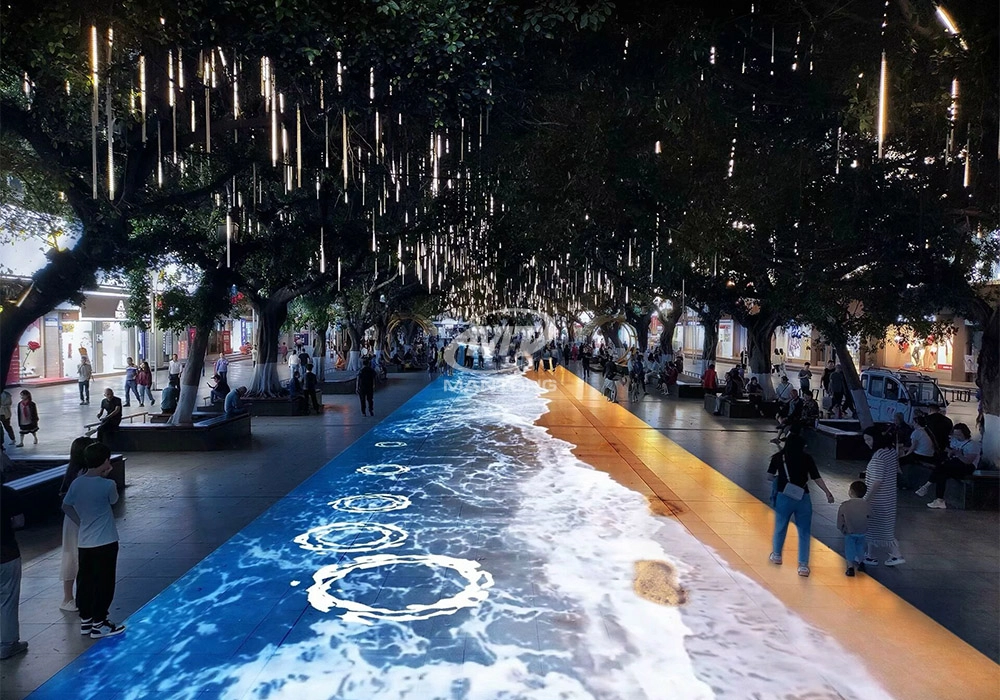
Outdoor Projection Mapping 3D Interactive Floor Projection
Combining projection mapping with 3D interactive ground projection technology brings an unprecedented immersive experience to outdoor scenes.
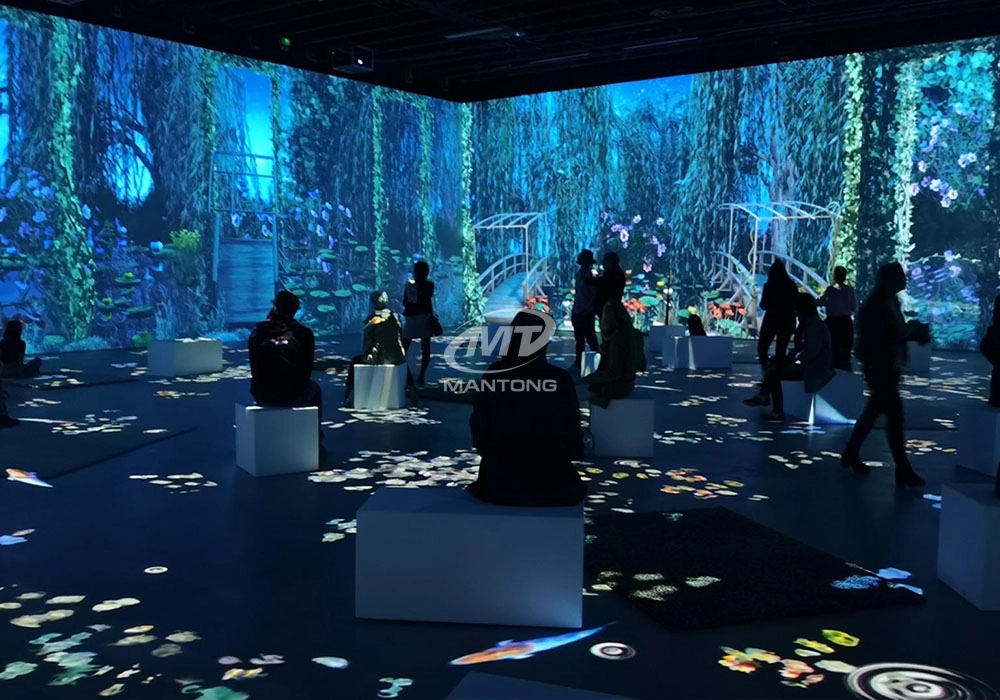
Mantong 6500LM High-Lumen Projector for Large-Scale Immersive Room Projection
Transform any space with Mantong's immersive projection mapping systems. Our high-lumen projectors (up to 6500 LM) and custom software create captivating interactive experiences for floors and walls. Ideal for museums, events, retail, and hospitality. Each kit includes professional ceiling mounting and 80+ pre-loaded video contents and is backed by a 12-month warranty and CE certification. We offer full customization and support to bring your vision to life.
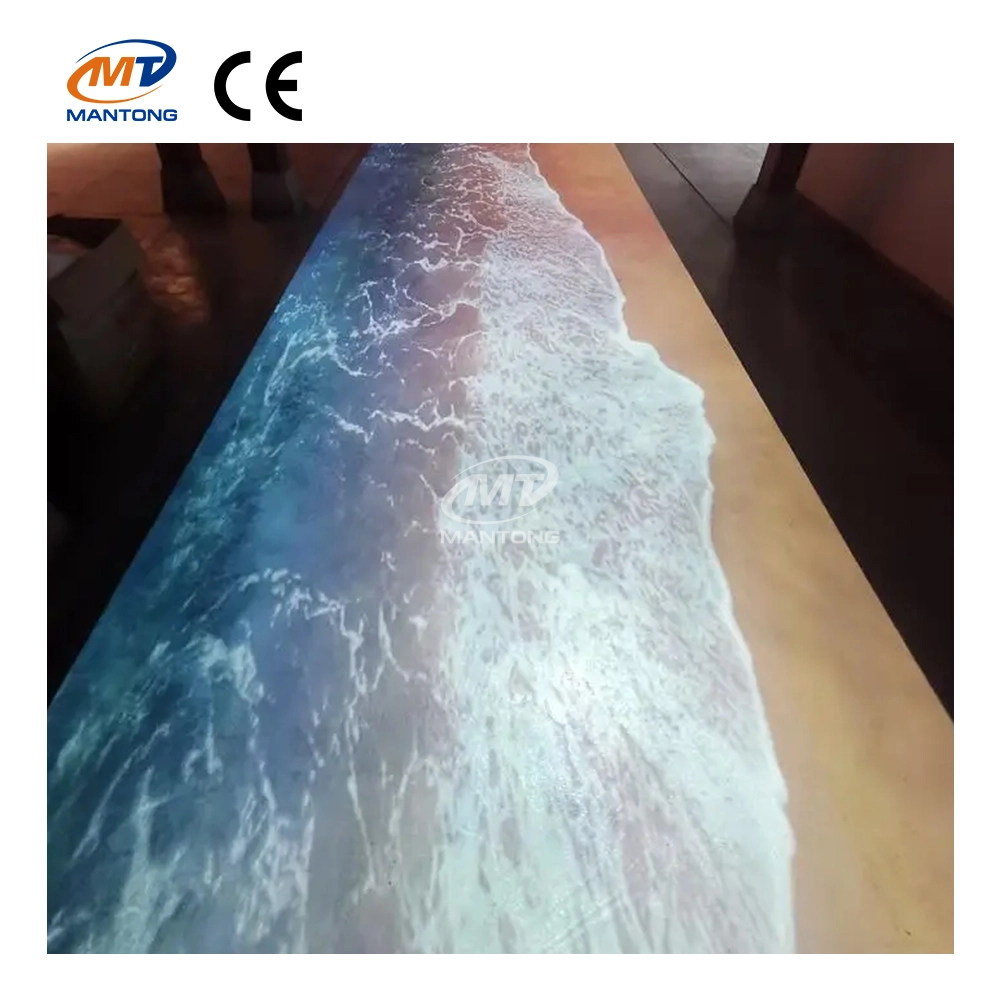
Indoor Interactive Floor Projector System - Customized Design & Installation Support
Indoor interactive floor projections display dynamic themed videos on the floor, commonly used in venues aiming to enhance brand influence or attract foot traffic, such as restaurants, hotel corridors, and brand car retail stores.
By using projectors and compatible software, the interactive content is projected onto the floor, encouraging engagement between people and the projected visuals. A single 5500-lumen indoor floor projector can cover an area of 5 m × 3 m. Typically, each project will use at least 3 units to ensure broad coverage and optimal visual effects.
We also offer customized design and installation support to enhance the interactive experience for your venue.
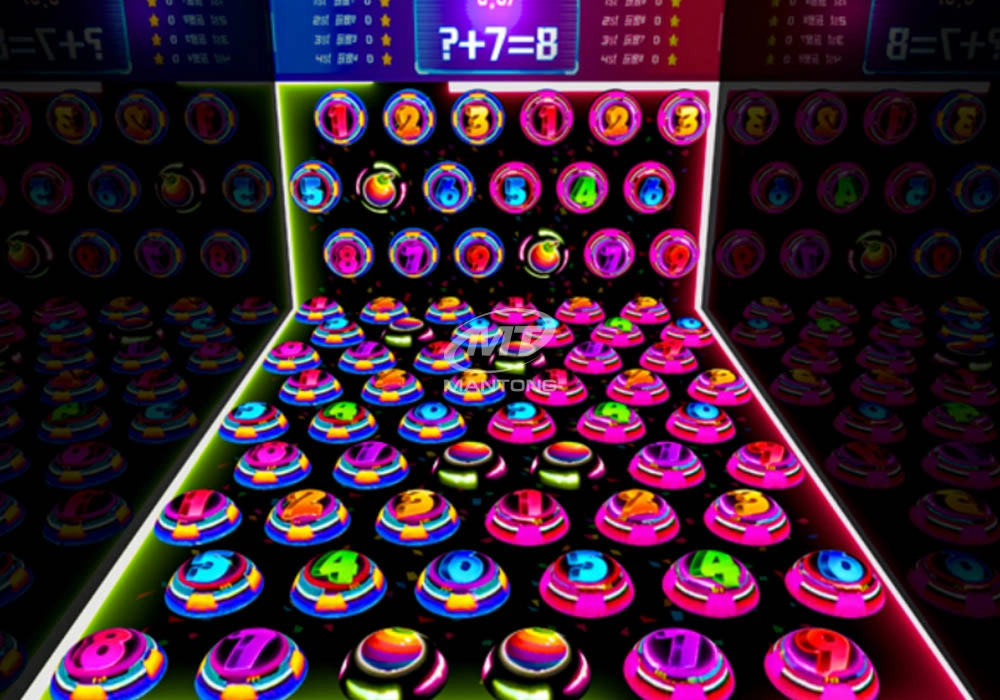
Amusement Rapidly Rotating Bouncing Sphere Interactive Wall Floor Projection Sports Games
Rapidly Rotating Bouncing Sphere is an interactive space where participants jump on rotating spheres. As they step on it, the spheres surface will show special interactivity
Jumping on spheres of the same color in succession causes them to pop, releasing light particles. The more consecutive jumps, the greater the reward—caterpillars appear, and eventually, all spheres of that color burst, filling the space with light and even more caterpillars.

Kaida Business Center, Shixin Road, Panyu District,Guangzhou City, Guangdong Province, China.
ManTong
ManTong
ManTong