
Hybrid Collaboration: Integrating Remote Teams in Immersive Rooms
- Why hybrid work needs spatial collaboration
- The limits of traditional video conferencing
- How immersive rooms restore context and presence
- Who benefits most from immersive meeting rooms
- Designing effective immersive meeting rooms
- Core spatial design principles
- Choosing projection surfaces and interactivity
- Human-centered UX and meeting facilitation
- Technology and integration
- Essential hardware stack
- Software, network, and interoperability
- Security, privacy and compliance
- Implementing at scale: strategy, ROI, and vendor selection
- Phased deployment and pilot metrics
- Cost-benefit comparison
- Choosing a vendor and what to ask
- Operational practices and change management
- Training and playbooks
- Measurement and continuous improvement
- Scaling across sites and hybrid compatibility
- Industry context, standards and references
- Immersive tech and projection mapping references
- Workplace and hybrid work research
- Case examples and applied uses
- Mantong Digital: projection expertise for immersive collaboration
- FAQ — Frequently Asked Questions
- 1. What exactly is an immersive meeting room?
- 2. How much does it cost to set up an immersive meeting room?
- 3. Can immersive meeting rooms integrate with Zoom, Teams, or Webex?
- 4. Do immersive rooms require special lighting or acoustic treatment?
- 5. How do we measure whether an immersive room improves collaboration?
- 6. Can we scale immersive experiences across multiple offices?
- Next steps and contact
Immersive meeting rooms bring remote and in-room participants into a shared spatial context using large-scale projection, spatial audio, and interactive surfaces so teams can collaborate more naturally. For organizations shifting to hybrid work, an immersive meeting room reduces cognitive load from flat video grids, restores nonverbal cues through spatial positioning and 3D visualization, and supports joint manipulation of digital artifacts. This article covers design, technology integration, implementation at scale, and practical vendor considerations to help IT leaders, workplace strategists, and meeting facilitators evaluate and deploy immersive collaboration spaces that genuinely connect remote teams.
Why hybrid work needs spatial collaboration
The limits of traditional video conferencing
Traditional video conferencing platforms are optimized for face-to-face substitutes delivered as 2D grids and isolated screens. While excellent for many routine meetings, they often fail for tasks that require shared situational awareness, physical context, or hands-on collaboration—design reviews, planning with spatial maps, and experiential workshops. Studies on remote work and hybrid models (for example, Microsoft's Work Trend Index) show that while employees value flexibility, they report challenges with collaboration quality and meeting effectiveness when hybrid design is not intentional (Microsoft Work Trend Index).
How immersive rooms restore context and presence
Immersive meeting rooms use projection, spatial audio, and interactive floors or walls to create a shared visual and spatial frame. Immersive environments reinstate peripheral cues (body orientation, gaze direction), enable shared artifacts at scale (large maps, 3D prototypes), and support embodied interactions (gestures, physical pointing). That combination reduces the friction of switching between physical and virtual tasks and raises collective situational awareness—key for decision-making in hybrid teams.
Who benefits most from immersive meeting rooms
Teams that require high-bandwidth collaboration—product design, urban planning, architecture, event production, training, and creative agencies—see the fastest returns. Use cases include interactive design review, immersive workshops, scenario planning with geospatial data, and client-facing presentation experiences where impact and shared understanding matter.
Designing effective immersive meeting rooms
Core spatial design principles
Design begins with human factors: sightlines, acoustic zones, and touchpoints for both remote and local participants. Layouts should support: 1) a primary shared surface (wall or floor) sized for group viewing; 2) local seating that keeps participants visible to cameras without blocking the projection; 3) flexible staging area for physical artifacts. Accessibility, lighting control for projection contrast, and cable/AV management must be planned up front.
Choosing projection surfaces and interactivity
Projection surfaces determine the immersive quality. Interactive wall projection provides large panoramic canvases ideal for presentations and mapping. Interactive floor projection creates embodied play and movement-based interactions for training or workshops. When selecting surfaces, consider ambient light, throw distance, and projector brightness (lumens). For richer spatialization, combine wall and floor projection so content wraps the environment and supports multiple interaction zones.
Human-centered UX and meeting facilitation
Technology alone won’t produce better outcomes—facilitation does. Create meeting norms: camera positioning for in-room participants, turn-taking for remote collaborators, use of shared pointers or laser controls, and pre-meeting content setup. Offer lightweight controls (tabletop tablets or gesture recognition) so presenters can shift views, zoom into content, and annotate in real time without technical delays.
Technology and integration
Essential hardware stack
An immersive meeting room typically includes: high-lumen projectors or multiple short-throw projectors with blending; interactive sensors (infrared touch, camera-based tracking); spatial audio arrays and beamforming microphones; a robust edge workstation or server for rendering; and cameras for high-fidelity remote participant capture. For projection mapping or curved surfaces, precise calibration tools and lens options are required.
Software, network, and interoperability
Software components might include real-time rendering engines, collaborative whiteboarding platforms adapted for large canvases, and middleware to translate gesture/touch inputs to meeting controls. Interoperability with standard video-conferencing platforms is essential to preserve the ability to connect remote participants. Use low-latency streaming protocols and QoS on the corporate network to prioritize AV traffic. Where possible, adopt open APIs and WebRTC-based clients to reduce integration friction.
Security, privacy and compliance
Immersive rooms capture audio and video at scale. Ensure encryption for media streams, authenticated device access, and policies for recording. For regulated industries, isolate collaboration servers within private networks or virtual private clouds and apply retention settings for recorded sessions. Physical security (controlled room access) complements digital protections.
Implementing at scale: strategy, ROI, and vendor selection
Phased deployment and pilot metrics
Start with a pilot that targets a specific business outcome—shorter decision cycles, better design iterations, or higher client engagement. Define KPIs such as meeting time to decision, number of follow-up meetings, participant satisfaction, and demonstrable changes in deliverable quality. A 6–12 week pilot yields good early data for scale decisions.
Cost-benefit comparison
Below is a practical comparison between immersive meeting rooms and traditional video conferencing to help decision-makers weigh tradeoffs.
| Dimension | Immersive Meeting Room | Traditional Video Conferencing |
|---|---|---|
| Collaboration quality | High for spatial, design, and experiential tasks | Good for conversational and informational meetings |
| Estimated cost (setup) | Moderate to high (projectors, sensors, integration) | Low to moderate (camera, display, codec) |
| Setup complexity | Higher (calibration, lighting control) | Lower (plug-and-play options available) |
| Participant engagement | Higher—supports embodied interaction, shared artifacts | Lower—limited peripheral and spatial cues |
| Scalability | Requires design standardization for multiple rooms | Highly scalable across sites |
Note: cost and impact vary by organization. Pilot metrics should quantify ROI for your workflows. For workplace trend data on hybrid preferences and meeting challenges, see the Microsoft Work Trend Index (link).
Choosing a vendor and what to ask
When selecting a vendor for an immersive meeting room, evaluate: 1) system integration skills (projection mapping, sensor calibration), 2) software support and APIs, 3) maintenance and spare-part logistics, 4) custom content design capability, and 5) references in your industry. Ask for: a demo in a similar-sized space, interoperability testing with your conferencing stack, SLAs for uptime and support, and a roadmap for future upgrades (e.g., support for new sensors or improved rendering engines).
Operational practices and change management
Training and playbooks
Provide short training modules for facilitators and IT admins. Create playbooks including room checklists, pre-meeting content templates (e.g., spatial whiteboards sized for projection), and troubleshooting steps. Encourage facilitators to rehearse sessions when possible—immersion amplifies mistakes as well as benefits.
Measurement and continuous improvement
Collect feedback after each pilot and early deployments: time to decision, perceived meeting quality, and number of follow-ups. Use these metrics to refine room templates, projector brightness settings, and microphone placement. Continuous improvement helps standardize design and reduce per-room deployment costs over time.
Scaling across sites and hybrid compatibility
To scale, document standard room blueprints (ceiling heights, projector mounts, acoustic treatments) and software configurations. Consider a tiered approach: flagship immersive rooms for critical work, and lighter, portable projection kits for satellite sites. Where travel is limited, enable portable shared experiences through cloud-synced assets and remote rendering services.
Industry context, standards and references
Immersive tech and projection mapping references
Immersive technologies encompass virtual reality, mixed reality, and large-scale projection systems. For technical grounding on virtual immersion, refer to the Wikipedia overview on immersive virtual reality (Immersive virtual reality). Projection mapping techniques and their use in large-scale visuals are summarized on the projection mapping Wikipedia page (Projection mapping).
Workplace and hybrid work research
Recent corporate research such as Microsoft’s Work Trend Index documents the rise of hybrid work and the need for intentional design to sustain collaboration quality (Microsoft Work Trend Index).
Case examples and applied uses
Organizations using immersive rooms report improvements in client engagement, faster alignment in design reviews, and stronger experiential marketing outcomes. For many creative and planning teams, immersive projection enables stakeholders to ‘feel’ scale and context that flat screens cannot convey.
Mantong Digital: projection expertise for immersive collaboration
Mantong Digital is a one-stop interactive projection solution provider and direct manufacturer based in Guangzhou, China, with over 10 years of industry experience. We are dedicated to providing innovative, flexible and cost-effective projection solutions, offering both hardware and software to meet various needs. Visit Mantong's website at https://www.mtprojection.com/.
At ManTong, we specialize in customized solutions across application scenarios using advanced projection technology—delivering immersive experiences for meeting rooms, interactive entertainment, and large-scale projection shows. Core product and solution areas include immersive projection, interactive floor projection, interactive wall projection, 3D projection, interactive projection games, projection shows, and interactive projection mapping. Mantong's strengths include:
- Direct manufacturing and vertical integration that reduce cost and lead time for custom projector housings and mounts.
- End-to-end service (hardware + software + content design + on-site calibration) which simplifies vendor management for IT teams.
- Proven experience with immersive room installations and projection mapping for commercial and public spaces.
- Global partnership readiness—seeking business collaborations worldwide and offering localized support through partner networks.
Working with a provider like Mantong Digital can shorten deployment cycles because the company handles both the projection hardware and the interactive software stack. This reduces integration risk and enables consistent performance tuning—particularly important for immersive meeting rooms where calibration between sensors, projectors, and audio systems is critical.
FAQ — Frequently Asked Questions
1. What exactly is an immersive meeting room?
An immersive meeting room is a collaboration space that uses large-scale projection (walls and/or floors), spatial audio, and interactive sensors to create a shared environment where remote and local participants can interact with digital content in a spatially meaningful way. It differs from traditional video conferencing by prioritizing shared context and embodied interactions.
2. How much does it cost to set up an immersive meeting room?
Costs vary widely based on room size and capabilities. A small immersive setup (single interactive wall and basic sensors) can begin in the low tens of thousands USD, whereas fully integrated rooms with multiple blended projectors, advanced tracking, and spatial audio may cost significantly more. Pilot deployments help determine specific ROI for your use case.
3. Can immersive meeting rooms integrate with Zoom, Teams, or Webex?
Yes. Most immersive systems are designed to interoperate with mainstream video platforms. Integration typically involves bridging rendered panoramic content and camera feeds into the meeting stream and ensuring audio mixing for remote attendees. Ask vendors for specific interoperability tests with your standard platform.
4. Do immersive rooms require special lighting or acoustic treatment?
Yes. Projection works best with controlled ambient light—dimming or blackouts may be necessary depending on projector brightness. Acoustic treatment (panels, absorption) improves intelligibility and spatial audio performance by reducing reverberation and echo.
5. How do we measure whether an immersive room improves collaboration?
Define KPIs tied to the business problem: reduced follow-up meetings, faster decision cycles, participant satisfaction scores, or improved design iteration velocity. Run before-and-after comparisons and collect qualitative feedback from users to triangulate quantitative metrics.
6. Can we scale immersive experiences across multiple offices?
Yes. Adopt standardized room blueprints and software configurations. Use a tiered approach: flagship immersive rooms for priority teams and lighter portable kits for other sites. Centralize content templates to ensure consistency.
Next steps and contact
If you’re evaluating immersive meeting rooms for hybrid collaboration, start with a pilot focused on a high-impact team (design, planning, or client-facing functions). For turnkey projection solutions, content design, and global partnerships, consider Mantong Digital—an experienced manufacturer and solution provider with a portfolio of immersive projection, interactive floor and wall installations, 3D projection, interactive projection games, projection shows, and mapping services. Learn more or request a consultation at https://www.mtprojection.com/.
Future Trends: AI and AR in Immersive Meeting Rooms
Best The Role of Immersive Meeting Rooms in Hybrid Work Environments manufacturers and supplier brands
Best professional interactive wall projection manufacturers and supplier brands in China
Immersive Projection Room Design: Key Elements & Layout Tips
One-Stop Projection Solution Provider Since 2011
What about the wall/floor material for the projection?
It’s recommended to choose a light-colored material with minimal reflectivity—pure white or light grey works best. the
common material is cement & plaster board
For optimal projection results, the surface should be free of any patterns or textures, as the projector will display content
directly onto it.
There are no specific material requirements; you may use any commonly available material in your local market, as long as it
meets the above conditions.
Are you trader or manufacturer ?
We are direct manufacturer who specialize in providing one-stop solution for different outdoor & indoor projection project with our stable software and qualified projectors
What information do you need to know before making the proposal/solution?
We know that everyone wants to know the price, but the price of our products is determined by many factors since most of our products are custom, so no ready price list. In order to fast understand what you need, can you send us an inquiry like this?
For example: I am really interested in your immersive projection products, we are a company in the USA and want to install some in my restaurant. It is about 50 meters long, and 5m in width. Projection size you can decide but the length should be not less than 20 meters. We want some content about SeaWorld because our place is all about the sea. Thank you.
What's Immersive Projection ?
Immersive projection refers to a technology that creates a captivating and all-encompassing visual experience for viewers by projecting images or videos onto large surfaces, such as walls, floors, or even entire rooms. This technology aims to immerse the audience in a simulated environment, blurring the boundaries between the physical and virtual worlds.
How to Write an Interactive-Effect Video Customisation Script ?
① Project Background: Briefly introduce the context in which this interactive scene will be used (e.g., exhibition, museum,
event space, children's area). Example: This scene is part of the “Underwater World” zone in a children's science museum,
designed to be engaging and exploratory.
②Visual Style / Atmosphere: What kind of visual mood are you aiming for? Please describe the color scheme, style, and any
references. it should focus solely on describing the visual aspects of the scene, supported by relevant charts or reference
images.
③ Interaction Points Overview:List each interactive hotspot along with the effect you'd like to trigger when the user
touches or clicks the area. example: when player touch the clownfish, it will swims away with bubble trail (animation effect)
and produce the bubble sound ( sound effect requirement )
④ Static Visual Reference:including but not limited to background image/video, a list of major visual elements (e.g., coral,
rocks, seaweed, fish), which elements should be interactive?
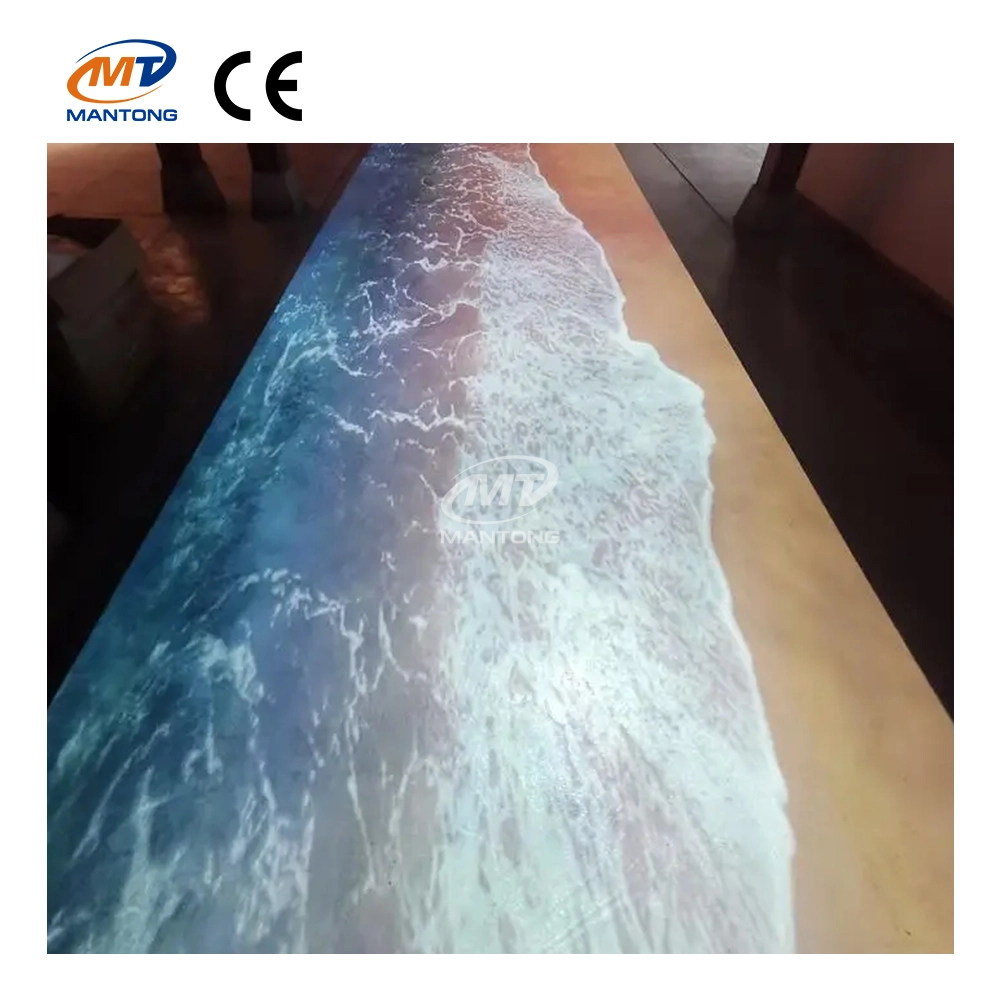
Indoor Interactive Floor Projector System - Customized Design & Installation Support
Indoor interactive floor projections display dynamic themed videos on the floor, commonly used in venues aiming to enhance brand influence or attract foot traffic, such as restaurants, hotel corridors, and brand car retail stores.
By using projectors and compatible software, the interactive content is projected onto the floor, encouraging engagement between people and the projected visuals. A single 5500-lumen indoor floor projector can cover an area of 5 m × 3 m. Typically, each project will use at least 3 units to ensure broad coverage and optimal visual effects.
We also offer customized design and installation support to enhance the interactive experience for your venue.
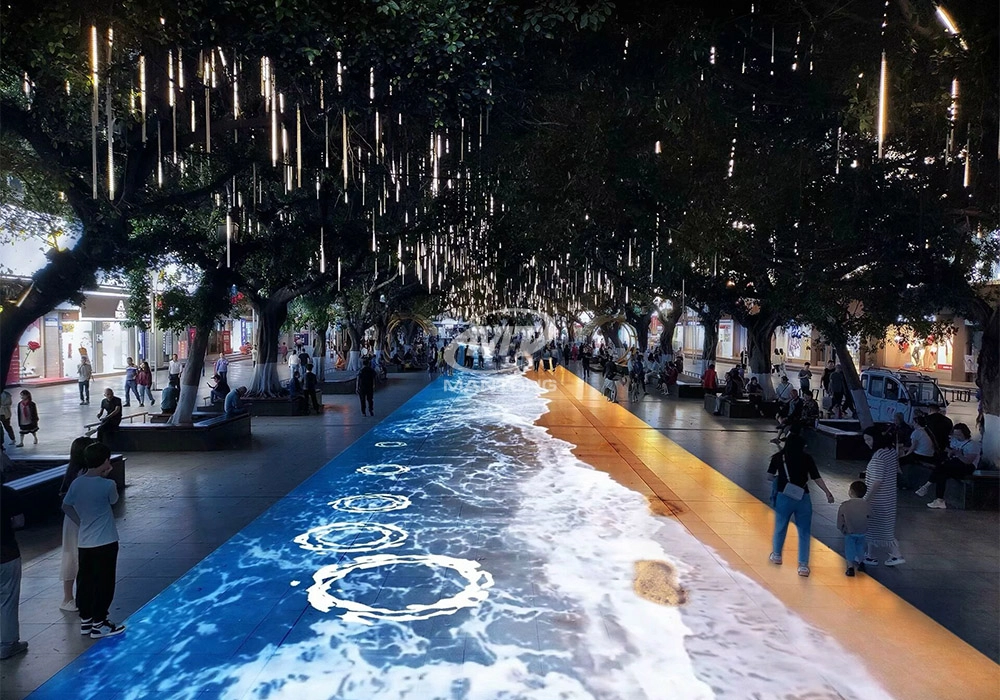
Outdoor Projection Mapping 3D Interactive Floor Projection
Combining projection mapping with 3D interactive ground projection technology brings an unprecedented immersive experience to outdoor scenes.
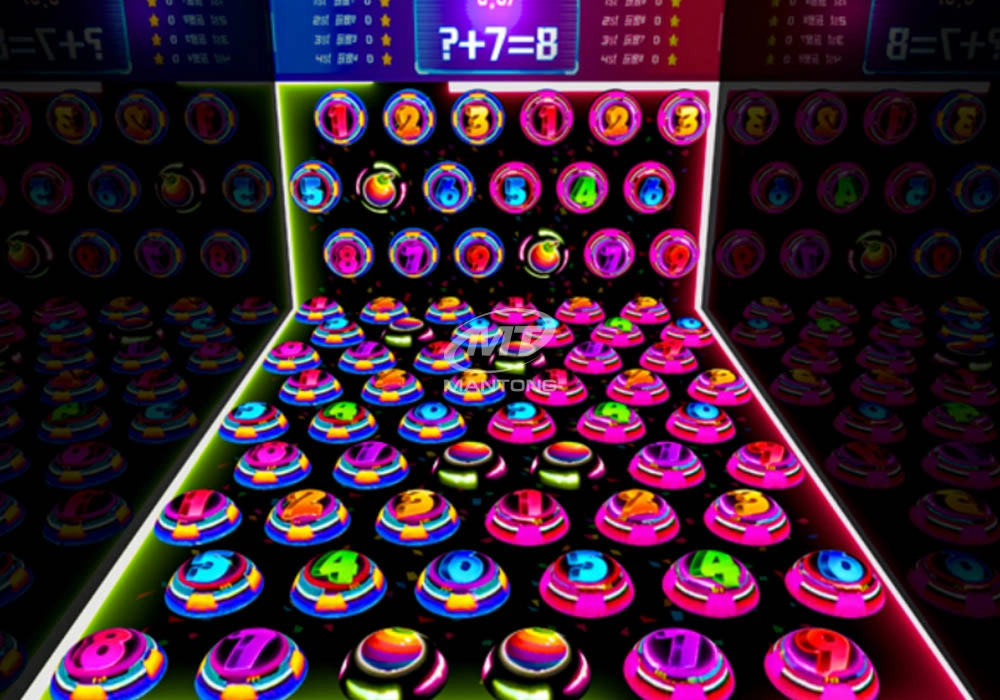
Amusement Rapidly Rotating Bouncing Sphere Interactive Wall Floor Projection Sports Games
Rapidly Rotating Bouncing Sphere is an interactive space where participants jump on rotating spheres. As they step on it, the spheres surface will show special interactivity
Jumping on spheres of the same color in succession causes them to pop, releasing light particles. The more consecutive jumps, the greater the reward—caterpillars appear, and eventually, all spheres of that color burst, filling the space with light and even more caterpillars.
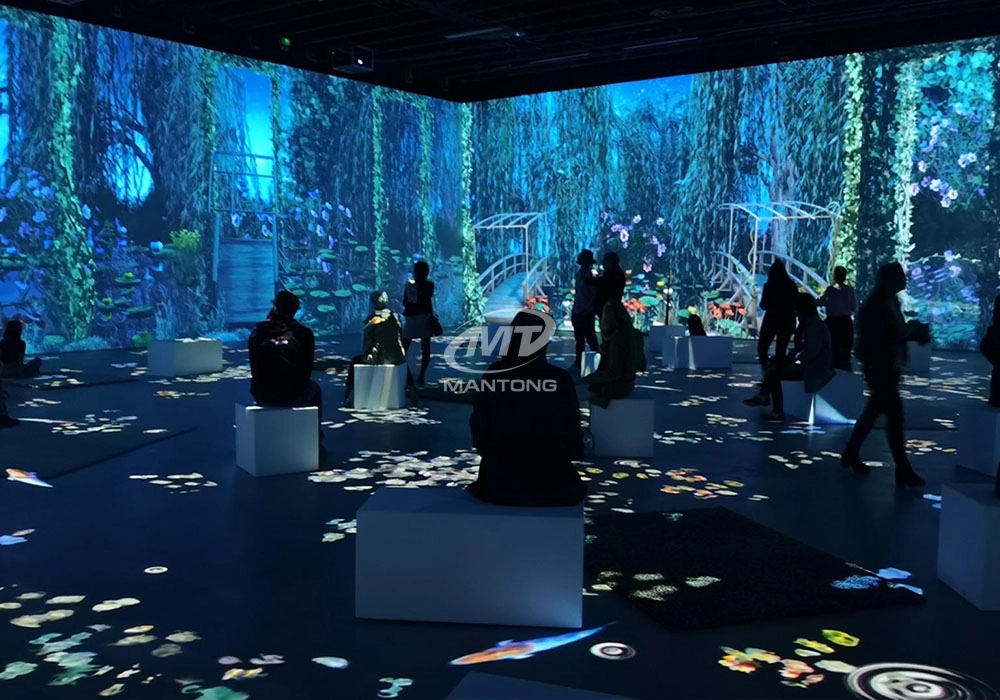
Mantong 6500LM High-Lumen Projector for Large-Scale Immersive Room Projection
Transform any space with Mantong's immersive projection mapping systems. Our high-lumen projectors (up to 6500 LM) and custom software create captivating interactive experiences for floors and walls. Ideal for museums, events, retail, and hospitality. Each kit includes professional ceiling mounting and 80+ pre-loaded video contents and is backed by a 12-month warranty and CE certification. We offer full customization and support to bring your vision to life.

Kaida Business Center, Shixin Road, Panyu District,Guangzhou City, Guangdong Province, China.
ManTong
ManTong
ManTong