
Immersive Projection Room Design: Key Elements & Layout Tips
- Designing Impactful Immersive Spaces
- Why an immersive projection room matters for venues and brands
- Core technical elements of an immersive projection room
- Projector technology comparison for immersive projection rooms
- Room layout, sightlines and projection geometry for immersive projection rooms
- Acoustics, HVAC and environmental control in immersive projection rooms
- Projection mapping and content pipeline for immersive projection rooms
- Interactivity and tracking options for immersive projection rooms
- Safety, maintenance and lifecycle planning for immersive projection rooms
- Budgeting and phased deployment for immersive projection rooms
- Why choose ManTong Digital for immersive projection room projects
- FAQ — Common questions about immersive projection rooms
- 1. What is the ideal brightness (lumens) for an immersive projection room?
- 2. Should I use laser or lamp projectors for a permanent installation?
- 3. How do I make multi-projector seams invisible?
- 4. What sensors are best for interactive floor projection games?
- 5. How much space do I need for a 270° wrap-around immersive projection room?
- 6. How do I ensure color consistency across different projectors and over time?
- Contact and next steps
- References
Designing Impactful Immersive Spaces
Why an immersive projection room matters for venues and brands
An immersive projection room is a purpose-designed space that uses high-quality projection, sound and interactivity to surround visitors with synchronized visual and audio content. For museums, retail, themed attractions and corporate experience centers, an immersive projection room increases dwell time, enhances message retention and creates memorable shareable moments. When planning an immersive projection room, design decisions should be driven by three business goals: visitor experience, operational reliability and measurable outcomes (engagement, conversions, return visits).
Core technical elements of an immersive projection room
Successful immersive projection rooms combine hardware, software and environment control. Key components include:
- Projectors: brightness (lumens), resolution, contrast, lens options and light source (laser vs lamp) determine image quality and running costs.
- Projection surfaces: screens, painted walls, or tensioned fabrics impact color fidelity and gain—choose surfaces engineered for the projector type and viewing angles.
- Edge blending and warping systems: for multi-projector seams and curved or irregular surfaces, use robust blending/warping via media servers or projector-side geometry correction.
- Media server and playback: supports high-resolution content, synchronization, timecode and triggers. Popular engines include real-time platforms (Unity/Unreal) and dedicated media servers (Resolume, disguise).
- Audio system: spatial or immersive audio complements visuals—design acoustic treatment and speaker placement early in the layout phase.
- Sensors and interaction: depth cameras, LIDAR, infrared trackers or floor sensors enable interactive floor projection and interactive wall projection experiences.
- Control & automation: centralized control for scheduling, diagnostics, and failover reduces downtime and simplifies operations.
Projector technology comparison for immersive projection rooms
Choosing the right projector technology is crucial. The table below summarizes typical differences between DLP, LCD and LCoS (Reflective) technologies as applied to immersive projection rooms.
| Technology | Typical Strengths | Typical Weaknesses | Best Use in immersive projection room |
|---|---|---|---|
| DLP | High contrast, sharp image, compact optics | Potential rainbow artifacts on some models; varying color wheel designs | Large-scale multi-projector installations with high contrast needs |
| LCD | Vivid colors, no rainbow effect, typically lower cost | Lower contrast than DLP; panel alignment considerations | Mid-size rooms where color saturation is prioritized |
| LCoS (e.g., SXRD/LCOS) | Excellent image smoothness and color accuracy; high native contrast | Generally higher cost; can be bulkier | High Quality immersive rooms demanding the best image fidelity |
Sources for projector technology summaries include manufacturer and technical references (see references).
Room layout, sightlines and projection geometry for immersive projection rooms
Layout planning should begin with desired visitor flow and primary sightline. Key layout tips:
- Define focal points: choose whether the room emphasizes a single stage, 360° wrap, multi-wall sequences or a mixed layout (floor + walls).
- Projector placement: ceiling-mounted projectors reduce obstructions. Consider throw distance, lens shift and keystone limits. For ultra-short-throw setups, allow space for heat dissipation and maintenance access.
- Seating and standing zones: map out safe circulation areas while minimizing shadows from visitors when floors are part of the experience.
- Ambient light control: design blackout capabilities (curtains, vestibules) and specify light traps to preserve image contrast. Even low levels of uncontrolled ambient light will wash out projected blacks.
- Service access: provide dedicated catwalks or ceiling access for alignment, lamp/laser maintenance and lens changes.
For wrap-around 270–360° projection, use overlapping projection zones with carefully planned edge blending. When floor projection is integral, coordinate floor surface durability and slip-resistance with projection gain specifications.
Acoustics, HVAC and environmental control in immersive projection rooms
Visual immersion fails if audio is poor or HVAC noise intrudes. Plan acoustics and environmental systems as part of the design:
- Acoustic treatment: use absorbers, diffusers and bass traps to manage reverberation times (target RT60 depending on content — 0.6–1.0s is common for mixed speech/music rooms).
- Speaker placement: for spatial audio, integrate left/right/front arrays, overhead or object-based systems (e.g., Dolby Atmos) depending on budget and content strategy.
- HVAC noise control: specify quiet ducts, vibration isolation for projectors and separate mechanical rooms where possible.
Projection mapping and content pipeline for immersive projection rooms
Projection mapping turns irregular geometry into mapped visuals. For rooms involving mapping or complex warping, define a content pipeline early:
- Surface scanning: capture geometry using laser scanning or photogrammetry to build accurate meshes for warping.
- Color and gamma management: perform projector characterization (3D LUTs) to ensure color consistency across blended projectors.
- Content resolution planning: target native projector resolution and account for pixel density at typical viewing distance. Avoid excessive upscaling which reduces sharpness.
- Real-time vs pre-rendered: choose between pre-rendered cinematic content for filmic impact or real-time engines (Unity/Unreal) for interactive or generative work.
Using a media server that supports networked sync (Genlock, LTC timecode, NTP) ensures multi-device timing and repeatable shows.
Interactivity and tracking options for immersive projection rooms
Interactivity transforms spectators into participants. Common interactive systems include:
- Floor sensors: pressure mats, capacitive sensors or camera-based tracking enable interactive floor projection games and experiences.
- Depth cameras and body tracking: devices like Azure Kinect or stereo camera systems provide skeletal tracking for wall/room interactions.
- Proximity and LIDAR sensors: robust for dark environments and large spaces, useful for crowd-based interactions.
- Wearables and mobile integration: Bluetooth beacons and mobile apps can personalize content per visitor.
Design for latency budgets: for tactile interactivity (e.g., floor-stepping games), target end-to-end latency under ~80 ms; visual feedback below 40 ms is ideal for perceived immediacy.
Safety, maintenance and lifecycle planning for immersive projection rooms
Long-term reliability depends on maintainability. Recommendations:
- Prefer laser light sources for 24/7 operation and reduced service intervals; lamps require scheduled replacements and inventory of spares.
- Document maintenance zones: labeling, safe access, and lockable service panels reduce technician time and safety risks.
- Implement remote monitoring: integrate projector telemetry (temperature, lamp hours) into a central dashboard for predictive maintenance.
- Plan for software updates and content versioning with rollback capability to prevent downtime during releases.
Budgeting and phased deployment for immersive projection rooms
Break the project into phases to spread cost and validate design choices:
- Proof-of-concept: build a 1:1 mockup of the critical viewing volume to validate brightness, color and interaction.
- Pilot installation: launch a limited-capacity version to collect user data, fine-tune content and train operators.
- Full deployment & scale: roll out the complete system once KPIs are met. Include warranties and training in the contract.
This approach reduces risk and helps align expectations across stakeholders.
Why choose ManTong Digital for immersive projection room projects
ManTong Digital is a one-stop interactive projection solution provider and direct manufacturer based in Guangzhou, China, with over 10 years of industry experience. We are dedicated to providing innovative, flexible and cost-effective projection solutions, offering both hardware and software to meet various needs. At ManTong, we specialize in providing customized solutions for a wide range of application scenarios through innovative projection technology. Whether it's immersive experiences, interactive entertainment or outdoor lighting and projection shows, our solutions can transform your ideas into stunning visual effects. Our projection technology provides customized solutions for a variety of scenarios, delivering immersive and interactive visual experiences.
Key ManTong advantages and products:
- Manufacturer and solution provider: direct control over hardware and firmware shortens lead times and simplifies customization.
- Product breadth: immersive projection, interactive floor projection, interactive wall projection, immersive room solutions, 3D projection, interactive projection games, projection shows and interactive projection mapping.
- Technical competence: combined hardware+software approach with experience in multi-projector blending, interactive sensors and real-time content integration.
- Cost-effectiveness: factory-direct pricing and flexible solution packages tailored to venue scale and operational needs.
- Global partnership focus: actively seeking business partnerships worldwide to support local deployment and service.
To discuss a project or view product specifications, visit ManTong Digital: https://www.mtprojection.com/ or contact their team for a consultation and custom design quote.
FAQ — Common questions about immersive projection rooms
1. What is the ideal brightness (lumens) for an immersive projection room?
Answer: It depends on screen size, ambient light and desired contrast. For controlled dark rooms, allocate 3000–7000 ANSI lumens per 10–12 m2 of viewing surface per projector as a starting point; larger venues and partially lit rooms require higher lumens or multiple stacked projectors. Perform a mockup test with the intended content and surface to confirm.
2. Should I use laser or lamp projectors for a permanent installation?
Answer: Laser projectors are recommended for permanent, high-usage installations due to longer life, more stable color and lower maintenance. Lamp projectors can be cost-effective for small-scale or low-duty applications but require lamp inventory and more frequent service.
3. How do I make multi-projector seams invisible?
Answer: Use geometric calibration, soft edge blending and color-matching via a media server or projector network. Physical alignment should be followed by electronic radiometric calibration (3D LUTs) to equalize color and gamma across projectors.
4. What sensors are best for interactive floor projection games?
Answer: Camera-based depth sensors (Azure Kinect, stereo cameras) are flexible and allow complex tracking, while pressure or capacitive sensors are robust for simple footstep detection. Choose based on desired interaction complexity and maintenance capabilities.
5. How much space do I need for a 270° wrap-around immersive projection room?
Answer: Space depends on content and projector optics, but a practical minimum for a compelling 270° experience is around 50–80 m2 with a room height of 3.0–4.0 m. Work with a designer to model sightlines, throw distances and projector clustering before committing to a footprint.
6. How do I ensure color consistency across different projectors and over time?
Answer: Implement regular color calibration routines using a colorimeter/spectroradiometer and apply 3D LUTs via the media server or projector calibration tool. Schedule periodic recalibrations and monitor projector telemetry for early drift detection.
Contact and next steps
Ready to design or upgrade an immersive projection room? For tailored solutions, turnkey system supply, or to discuss partnership opportunities, consult ManTong Digital — factory-direct experience with immersive projection, interactive floor and wall projection, 3D projection and projection mapping. Visit https://www.mtprojection.com/ to view products, case studies and to request a quote.
References
- Projection mapping — Wikipedia. https://en.wikipedia.org/wiki/Projection_mapping. Accessed 2025-12-11.
- Digital light processing — Wikipedia. https://en.wikipedia.org/wiki/Digital_light_processing. Accessed 2025-12-11.
- Liquid-crystal_display_projector — Wikipedia. https://en.wikipedia.org/wiki/Liquid-crystal_display_projector. Accessed 2025-12-11.
- LCoS — Wikipedia. https://en.wikipedia.org/wiki/Reflective_liquid-crystal_on_silicon. Accessed 2025-12-11.
- Epson — Choosing a projector: brightness, resolution and throw. https://epson.com/ (product & support pages on projector selection). Accessed 2025-12-11.
- Unity — real-time development platform. https://unity.com/. Accessed 2025-12-11.
- Unreal Engine — real-time 3D creation tool. https://www.unrealengine.com/. Accessed 2025-12-11.
- Azure Kinect DK — Microsoft. https://learn.microsoft.com/en-us/azure/kinect-dk/. Accessed 2025-12-11.
- ManTong Digital official website. https://www.mtprojection.com/. Accessed 2025-12-11.
Interactive Floor Projection Installation: Site Survey Checklist
Best How Interactive Projector Games Are Changing Entertainment Spaces manufacturers and supplier brands
Best How an Immersive Meeting Room Can Improve Remote Communication Efficiency manufacturers and supplier brands
Average Cost Per Square Foot for Floor Projection Systems
One-Stop Projection Solution Provider Since 2011
Are you trader or manufacturer ?
We are direct manufacturer who specialize in providing one-stop solution for different outdoor & indoor projection project with our stable software and qualified projectors
What's the application of Immersive projection ?
It can be used in various venues, such as art exhibition, entertainment venues, educational institution, Wedding hall /Banquet/Bar,Yoga Studio and so on. It often involves advanced projection techniques, multimedia content, and interactive elements to engage and captivate the audience's senses.
How to install the projection equipment ?
1) Install the projector in a suitable position. We will provide you with a hanger, which you need to fix on the ceiling with
screws.
2) Connect projectors, computers and other accessories through wires.
3) After completing the above 2 steps, we will carry out the edge blending steps. Our team can complete it through remote
control.
In general, installation instructions for each project need to be specified on a project-by-project basis. The above is for
reference only.
What's Immersive Projection ?
Immersive projection refers to a technology that creates a captivating and all-encompassing visual experience for viewers by projecting images or videos onto large surfaces, such as walls, floors, or even entire rooms. This technology aims to immerse the audience in a simulated environment, blurring the boundaries between the physical and virtual worlds.
What about the wall/floor material for the projection?
It’s recommended to choose a light-colored material with minimal reflectivity—pure white or light grey works best. the
common material is cement & plaster board
For optimal projection results, the surface should be free of any patterns or textures, as the projector will display content
directly onto it.
There are no specific material requirements; you may use any commonly available material in your local market, as long as it
meets the above conditions.
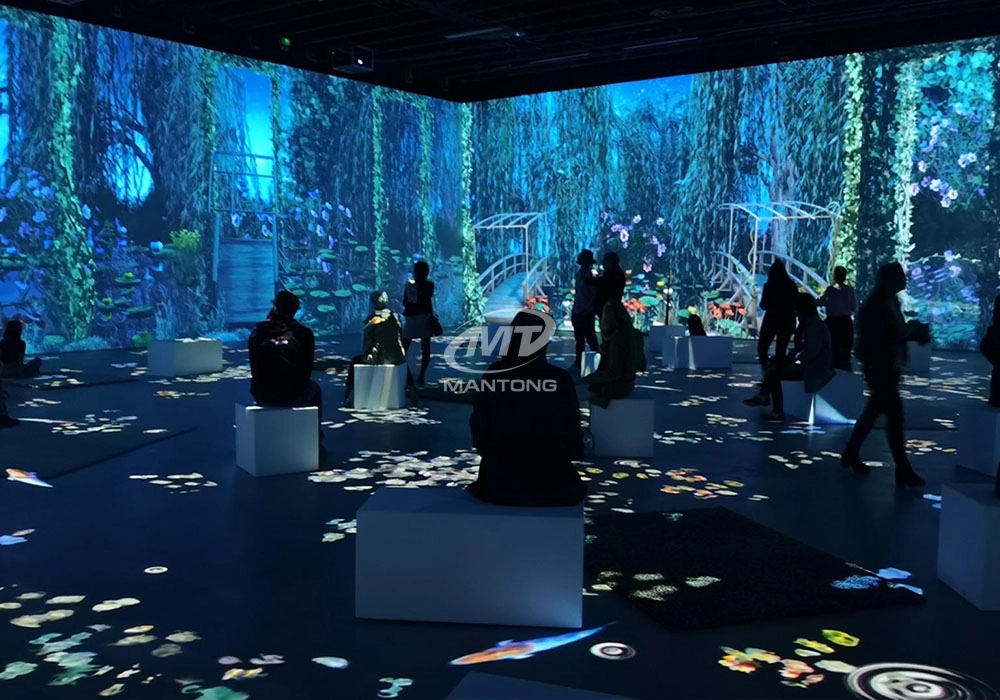
Mantong 6500LM High-Lumen Projector for Large-Scale Immersive Room Projection
Transform any space with Mantong's immersive projection mapping systems. Our high-lumen projectors (up to 6500 LM) and custom software create captivating interactive experiences for floors and walls. Ideal for museums, events, retail, and hospitality. Each kit includes professional ceiling mounting and 80+ pre-loaded video contents and is backed by a 12-month warranty and CE certification. We offer full customization and support to bring your vision to life.
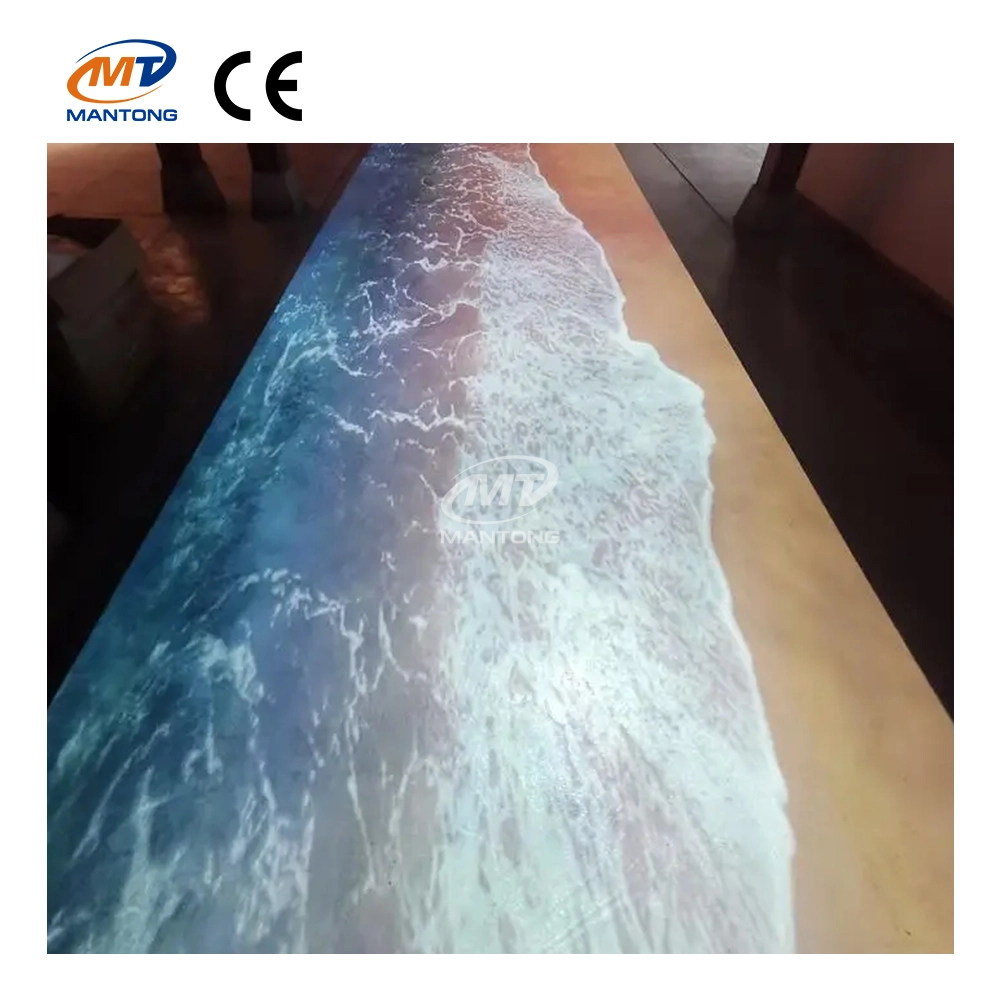
Indoor Interactive Floor Projector System - Customized Design & Installation Support
Indoor interactive floor projections display dynamic themed videos on the floor, commonly used in venues aiming to enhance brand influence or attract foot traffic, such as restaurants, hotel corridors, and brand car retail stores.
By using projectors and compatible software, the interactive content is projected onto the floor, encouraging engagement between people and the projected visuals. A single 5500-lumen indoor floor projector can cover an area of 5 m × 3 m. Typically, each project will use at least 3 units to ensure broad coverage and optimal visual effects.
We also offer customized design and installation support to enhance the interactive experience for your venue.
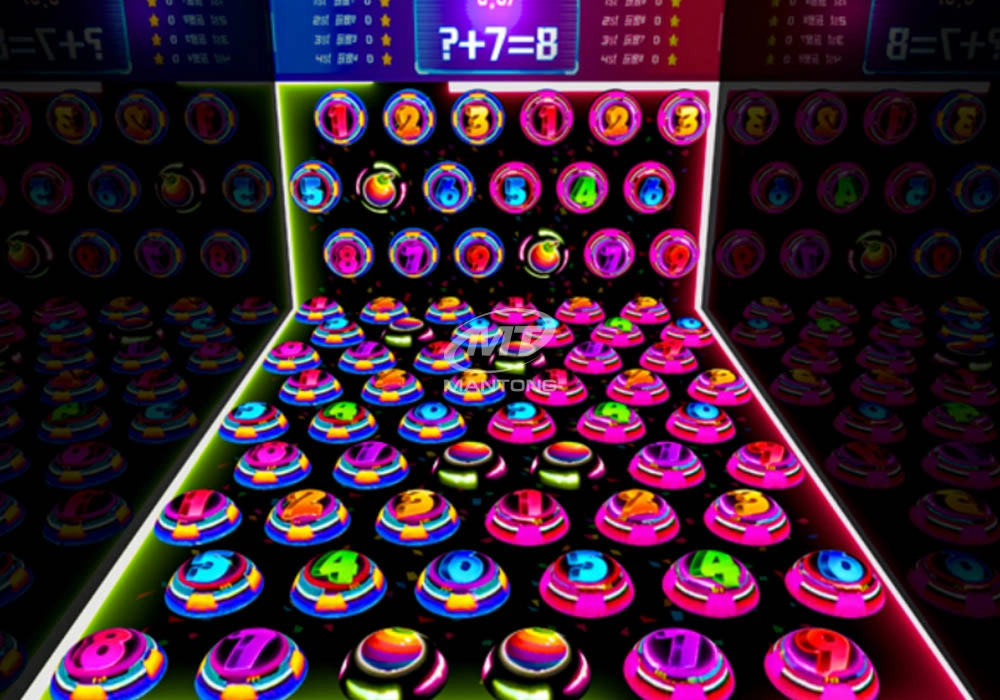
Amusement Rapidly Rotating Bouncing Sphere Interactive Wall Floor Projection Sports Games
Rapidly Rotating Bouncing Sphere is an interactive space where participants jump on rotating spheres. As they step on it, the spheres surface will show special interactivity
Jumping on spheres of the same color in succession causes them to pop, releasing light particles. The more consecutive jumps, the greater the reward—caterpillars appear, and eventually, all spheres of that color burst, filling the space with light and even more caterpillars.
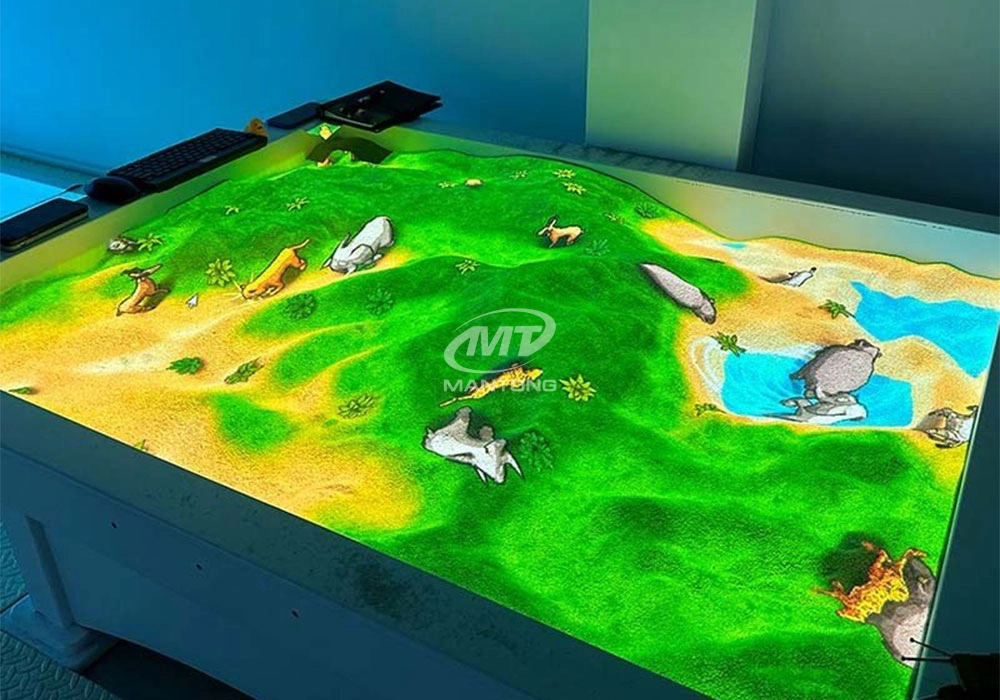
Interactive Sandbox Projection Mapping Games For Kids Play Park
Bring imagination to life with interactive sandbox projection mapping games designed for kids’ play parks. Using cutting-edge projection technology and real-time motion sensing, children can dig, build, and explore virtual worlds directly in the sand. Educational, engaging, and endlessly fun — it’s the perfect blend of play and learning.

Kaida Business Center, Shixin Road, Panyu District,Guangzhou City, Guangdong Province, China.
ManTong
ManTong
ManTong