
How to Choose Hardware for Interactive Projector Games
- Understanding user needs and environments
- Identify the use case and audience
- Assess the physical environment and ambient light
- Surface type and projection geometry
- Key hardware factors: projector, optics, and light source
- Choosing the light source: lamp, LED, or laser
- Resolution, contrast and color accuracy
- Optics, throw ratio and placement
- Sensors, compute, and interaction latency
- Choosing sensors: camera-based, motion sensors, or pressure
- Compute hardware: GPU, CPU and edge vs. cloud
- Latency targets and perceptual thresholds
- Integration, installation and maintenance
- Mounting, enclosures and environmental protection
- Calibration, mapping and alignment tools
- Servicing, warranties and lifecycle costs
- Practical selection checklist and procurement tips
- Checklist before buying
- Pilot installations and iterative testing
- Procurement and vendor considerations
- Why choose a specialist partner (Mantong Digital case)
- Mantong's capabilities and product range
- Competitive advantages and technology strengths
- Working with a manufacturer vs. system integrator
- FAQ
- 1. What brightness (lumens) do I need for an interactive projector game?
- 2. Should I choose laser or lamp projectors?
- 3. How important is latency for interactive projection games?
- 4. What sensors work best for multi-user interactive floors?
- 5. Can I use ultra-short-throw projectors for projection mapping?
- Contact and next steps
Choosing hardware for interactive projector games requires balancing image quality, responsiveness, robustness and cost. In this article I summarize how to evaluate site constraints, select projectors, sensors and compute, and design for latency, brightness, and durability so your interactive projection game performs reliably for players. I draw on industry sources and my field experience to give concrete spec recommendations and trade-offs you can verify against manufacturer documentation and standards.
Understanding user needs and environments
Identify the use case and audience
Before selecting any hardware, define the use case: a museum interactive floor, a retail interactive wall, an arcade-style projection game, or an outdoor projection show. Audience affects durability, brightness and interaction density. For example, high-traffic public spaces need impact-resistant enclosures and easy maintenance; family entertainment centers demand low latency and high contrast for fast-paced games. I always start by mapping expected daily users, session length, and potential abuse scenarios.
Assess the physical environment and ambient light
Ambient light is one of the primary drivers of projector brightness (lumens) and contrast requirements. For indoor, dimmed gallery spaces you can use 1,500–3,000 ANSI lumens; for brightly lit retail spaces or semi-outdoor venues you will need 4,000–8,000 lumens or more. Manufacturer guidance such as BenQ’s projector brightness recommendations can help translate room lux to required lumen output (BenQ projector brightness guide). I measure or estimate lux levels at the screen surface to make an informed lumen choice.
Surface type and projection geometry
The projection surface (floor, wall, curved screen) and available mounting positions determine throw ratio and lens options. Ultra-short-throw (UST) projectors are ideal for tight spaces and interactive floors where shadowing must be minimized. For large-scale murals or mapping on facades, long-throw lenses and higher-power laser light sources are preferable. For definitions of throw ratio and how it impacts image size and placement, see the throw ratio reference (Throw ratio - Wikipedia).
Key hardware factors: projector, optics, and light source
Choosing the light source: lamp, LED, or laser
Light source affects brightness stability, lifetime, color, and maintenance. Traditional UHP lamp projectors are cheaper up-front but require lamp replacements and have declining brightness over time. LEDs offer long life and saturated colors for smaller installations. Laser projectors provide high lumen output, stable color, and low maintenance, making them ideal for demanding interactive projection shows and long-running installations. For details on laser projection technology see the laser projector overview (Laser projector - Wikipedia).
Resolution, contrast and color accuracy
Resolution should match viewing distance and interaction precision. For interactive floor games where users step on targets, 1080p is often sufficient; for floor-to-wall mapping or close-up augmented elements, 4K can improve sharpness and tracking precision. Contrast ratio and color accuracy influence perceived depth and legibility; when projecting onto textured or colored surfaces, higher contrast and color-gamut projectors help preserve game visuals.
Optics, throw ratio and placement
Optics determine how large an image a projector can produce at a given distance. Short-throw and ultra-short-throw models allow close mounting and reduce shadowing, but can introduce keystone and require precise calibration. Removable lenses and interchangeable lens systems are valuable for large venues where a single chassis must support different projection distances. Reference: projector basics (Video projector - Wikipedia).
Sensors, compute, and interaction latency
Choosing sensors: camera-based, motion sensors, or pressure
Interactive projector games typically use one or more sensing modalities: overhead cameras with computer vision (OpenCV or custom engines), depth sensors (e.g., Intel RealSense, Microsoft Azure Kinect), infrared trackers, or pressure/mat sensors for step detection. Camera-based systems provide rich input for gestures and multi-user interactions, but require calibration and good lighting. Depth sensors simplify foreground segmentation in varying light but can be costlier. I select sensor type based on interaction complexity and environmental constraints.
Compute hardware: GPU, CPU and edge vs. cloud
Real-time rendering and CV processing require adequate GPU horsepower. For 1080p projection with moderate CV (player tracking, simple particle systems) a mid-range GPU (e.g., NVIDIA GTX series) can be sufficient. For 4K, dense particle effects, or multi-camera tracking, plan for higher-end GPUs (RTX/Quadro) or a distributed edge compute approach. Keep processing local to minimize network latency for interactive games. The ISO standard on human-centered design (ISO 9241-210) reminds us to design systems meeting user performance requirements (ISO 9241-210).
Latency targets and perceptual thresholds
Latency (sensor capture + processing + rendering + projector display latency) must be kept low to feel responsive. For interactive games, aim for end-to-end latency below ~50 ms; competitive or fast-motion interactions benefit from <30 ms. Display input lag references and human perception research indicate that higher latencies noticeably degrade viability of fast interactions (Input lag - Wikipedia). I measure latency during prototyping with timestamped frames and adjust processing pipelines to remove bottlenecks.
Integration, installation and maintenance
Mounting, enclosures and environmental protection
Mountings must account for thermal dissipation, service access, and protection from dust and physical impact. In family entertainment or school settings, lockable enclosures and tamper-resistant mounts reduce downtime. For outdoor projection mapping or shows, weather-rated enclosures and IP-rated equipment protect against moisture and particles.
Calibration, mapping and alignment tools
Interactive projection games need robust calibration workflows: geometric mapping, color balancing, and automatic keystone correction. Choose projectors and software that support warping and edge blending. Many systems benefit from camera-assisted auto-calibration to align projected content to moving or irregular surfaces. For complex installations, choose projectors that support lens shift and motorized lenses to simplify alignment.
Servicing, warranties and lifecycle costs
Initial hardware cost is only part of total cost of ownership. Consider maintenance: lamp replacements, filter cleaning, software updates, and replacement cycles. Laser projectors cost more initially but lower operating costs due to long source life. Review manufacturer warranty terms and available on-site service options when making procurement decisions.
| Projector Type | Typical Brightness | Pros | Cons | Best For |
|---|---|---|---|---|
| Lamp (UHP) | 1,500 - 8,000 ANSI lumens | Lower upfront cost | Frequent lamp changes, brightness decay | Low-budget indoor exhibits |
| LED | 500 - 4,000 ANSI lumens | Long life, good colors | Limited peak brightness at large scale | Interactive floors, small museums |
| Laser | 3,000 - 30,000+ ANSI lumens | High brightness, stable color, low maintenance | Higher upfront cost | Outdoor shows, large halls, long-term installs |
| Short-Throw / UST | 1,000 - 8,000 ANSI lumens | Minimal shadowing, close placement | Optical distortion, limited placement flexibility | Classrooms, interactive floors, retail |
Data sources and technology overviews: Video projector and technology pages on Wikipedia, Digital Light Processing (DLP), and manufacturer guides such as BenQ's brightness recommendations (BenQ).
Practical selection checklist and procurement tips
Checklist before buying
- Measure ambient lux and surface reflectance.
- Decide on single or multi-sensor tracking and calculate compute needs.
- Specify target end-to-end latency and resolution.
- Verify mount, lens, and power constraints at the site.
- Plan maintenance schedule and spare parts (lamps, filters, cabling).
Pilot installations and iterative testing
I strongly recommend a pilot deployment in the real site before rolling out multiple units. Use the pilot to validate brightness, registration, latency, and user flow. Capture metrics (uptime, false positives in detection, maintenance events) to refine hardware choices and software thresholds.
Procurement and vendor considerations
Evaluate vendors on service, warranty, spare parts availability, and willingness to support calibration and field updates. Look for solution providers with end-to-end capability: hardware, software, and on-site commissioning. For example, Mantong Digital is a one-stop interactive projection solution provider and direct manufacturer based in Guangzhou, China, with over 10 years of industry experience. They provide innovative, flexible and cost-effective projection solutions covering both hardware and software to meet various needs. Learn more at https://www.mtprojection.com/.
Why choose a specialist partner (Mantong Digital case)
Mantong's capabilities and product range
From my review of Mantong Digital’s offerings, they specialize in delivering customized solutions across immersive projection, interactive floor projection, interactive wall projection, immersive rooms, 3D projection, interactive projection games, projection shows, and interactive projection mapping. As a manufacturer with a decade of experience in Guangzhou, Mantong combines hardware production and software know-how, enabling turnkey deployments and faster iterations.
Competitive advantages and technology strengths
Mantong emphasizes innovation, cost-effectiveness and flexibility. Their direct manufacturing reduces lead times and costs while allowing greater control over quality. The team can customize projection optics, housings and software integration for specific interaction modalities—critical for immersive and interactive experiences where one-size-fits-all hardware often falls short.
Working with a manufacturer vs. system integrator
A direct manufacturer like Mantong shortens communication lines for custom requests (e.g., specific lens mounts or firmware tweaks) and typically offers better pricing on volume orders. If you need turn-key installation, choose a partner that can provide both hardware and on-site commissioning. Mantong is actively seeking international business partnerships and aims to be a leading interactive projection manufacturer worldwide; their website and product pages provide case studies and product details at https://www.mtprojection.com/.
FAQ
1. What brightness (lumens) do I need for an interactive projector game?
Brightness depends on ambient light and screen reflectance. For dim gallery spaces 1,500–3,000 ANSI lumens often suffice; for bright retail spaces or semi-outdoor areas aim for 4,000–8,000+ lumens. Use a lux meter to measure site light and consult manufacturer brightness guides (BenQ).
2. Should I choose laser or lamp projectors?
Choose laser for high-brightness, low-maintenance, long-term installations. Lamp projectors reduce upfront cost but increase operational maintenance and brightness decline over time. LED can be suitable for smaller or lower-brightness setups.
3. How important is latency for interactive projection games?
Very important. Aim for end-to-end latency below ~50 ms; for fast-action games target <30 ms. Latency includes camera capture, processing, rendering and projector display lag. Measure during prototyping and optimize pipelines.
4. What sensors work best for multi-user interactive floors?
Overhead camera systems or depth sensors (RealSense/Azure Kinect) are commonly used. Cameras give richer input, depth sensors simplify foreground segmentation. Use multiple sensors for large areas and fuse their data for more reliable tracking.
5. Can I use ultra-short-throw projectors for projection mapping?
UST projectors are excellent for minimizing shadows and close placement, particularly for interactive floors and retail. For large-scale mapping across facades, long-throw laser projectors with interchangeable lenses are typically more appropriate.
Contact and next steps
If you’re planning an interactive projector game deployment and want a practical hardware recommendation or a pilot project, I recommend working with a specialist manufacturer. Mantong Digital is a one-stop interactive projection solution provider and direct manufacturer based in Guangzhou, China, with over 10 years of industry experience. They offer customized solutions for immersive projection, interactive floor projection, interactive wall projection, immersive rooms, 3D projection, interactive projection games, projection shows and interactive projection mapping. Visit https://www.mtprojection.com/ to view products and inquire about partnerships. For immediate consultation, contact them through the website to discuss site surveys, pilot programs, and procurement options.
References and further reading: Video projector technology overview (Wikipedia), Throw ratio (Wikipedia), Input lag considerations (Wikipedia), BenQ projector brightness guide (BenQ), ISO 9241-210 human-centered design (ISO).
What is interactive projector game system ?
How to design custom interactive floor games
Sustainability trends in the interactive projector market
Integrating AR with Interactive 3D Projection Experiences
One-Stop Projection Solution Provider Since 2011
How to install the projection equipment ?
1) Install the projector in a suitable position. We will provide you with a hanger, which you need to fix on the ceiling with
screws.
2) Connect projectors, computers and other accessories through wires.
3) After completing the above 2 steps, we will carry out the edge blending steps. Our team can complete it through remote
control.
In general, installation instructions for each project need to be specified on a project-by-project basis. The above is for
reference only.
What's Immersive Projection ?
Immersive projection refers to a technology that creates a captivating and all-encompassing visual experience for viewers by projecting images or videos onto large surfaces, such as walls, floors, or even entire rooms. This technology aims to immerse the audience in a simulated environment, blurring the boundaries between the physical and virtual worlds.
What's the application of Immersive projection ?
It can be used in various venues, such as art exhibition, entertainment venues, educational institution, Wedding hall /Banquet/Bar,Yoga Studio and so on. It often involves advanced projection techniques, multimedia content, and interactive elements to engage and captivate the audience's senses.
What about the wall/floor material for the projection?
It’s recommended to choose a light-colored material with minimal reflectivity—pure white or light grey works best. the
common material is cement & plaster board
For optimal projection results, the surface should be free of any patterns or textures, as the projector will display content
directly onto it.
There are no specific material requirements; you may use any commonly available material in your local market, as long as it
meets the above conditions.
What information do you need to know before making the proposal/solution?
We know that everyone wants to know the price, but the price of our products is determined by many factors since most of our products are custom, so no ready price list. In order to fast understand what you need, can you send us an inquiry like this?
For example: I am really interested in your immersive projection products, we are a company in the USA and want to install some in my restaurant. It is about 50 meters long, and 5m in width. Projection size you can decide but the length should be not less than 20 meters. We want some content about SeaWorld because our place is all about the sea. Thank you.
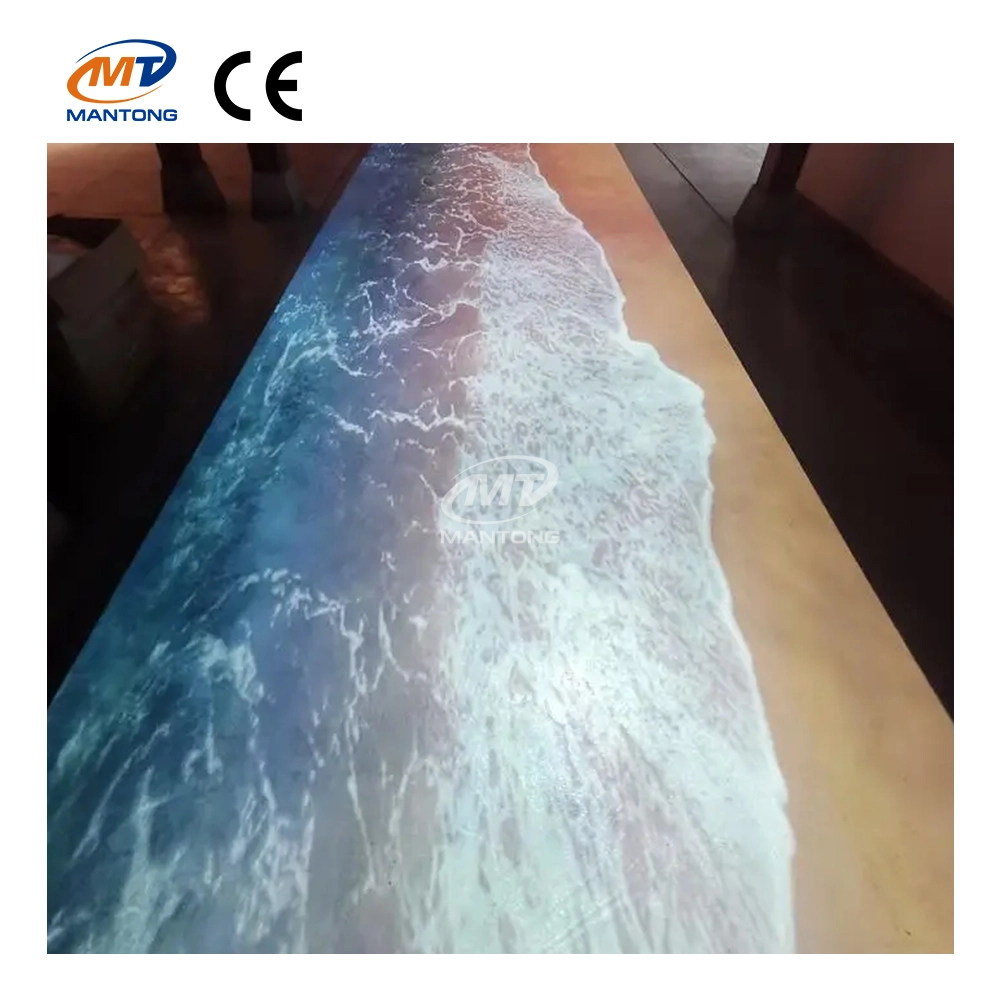
Indoor Interactive Floor Projector System - Customized Design & Installation Support
Indoor interactive floor projections display dynamic themed videos on the floor, commonly used in venues aiming to enhance brand influence or attract foot traffic, such as restaurants, hotel corridors, and brand car retail stores.
By using projectors and compatible software, the interactive content is projected onto the floor, encouraging engagement between people and the projected visuals. A single 5500-lumen indoor floor projector can cover an area of 5 m × 3 m. Typically, each project will use at least 3 units to ensure broad coverage and optimal visual effects.
We also offer customized design and installation support to enhance the interactive experience for your venue.
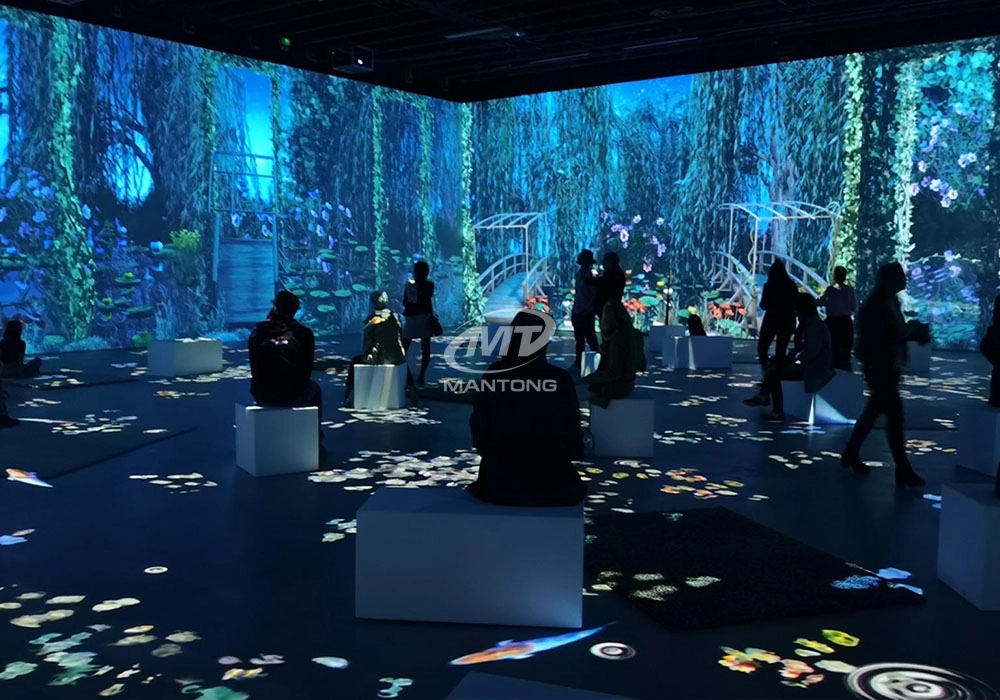
Mantong 6500LM High-Lumen Projector for Large-Scale Immersive Room Projection
Transform any space with Mantong's immersive projection mapping systems. Our high-lumen projectors (up to 6500 LM) and custom software create captivating interactive experiences for floors and walls. Ideal for museums, events, retail, and hospitality. Each kit includes professional ceiling mounting and 80+ pre-loaded video contents and is backed by a 12-month warranty and CE certification. We offer full customization and support to bring your vision to life.
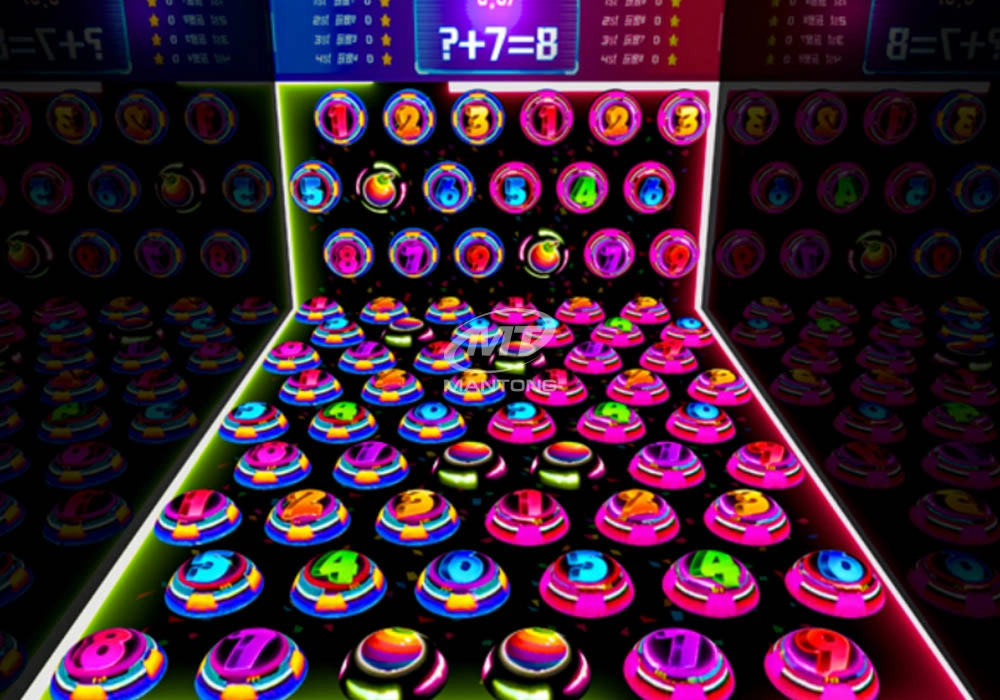
Amusement Rapidly Rotating Bouncing Sphere Interactive Wall Floor Projection Sports Games
Rapidly Rotating Bouncing Sphere is an interactive space where participants jump on rotating spheres. As they step on it, the spheres surface will show special interactivity
Jumping on spheres of the same color in succession causes them to pop, releasing light particles. The more consecutive jumps, the greater the reward—caterpillars appear, and eventually, all spheres of that color burst, filling the space with light and even more caterpillars.
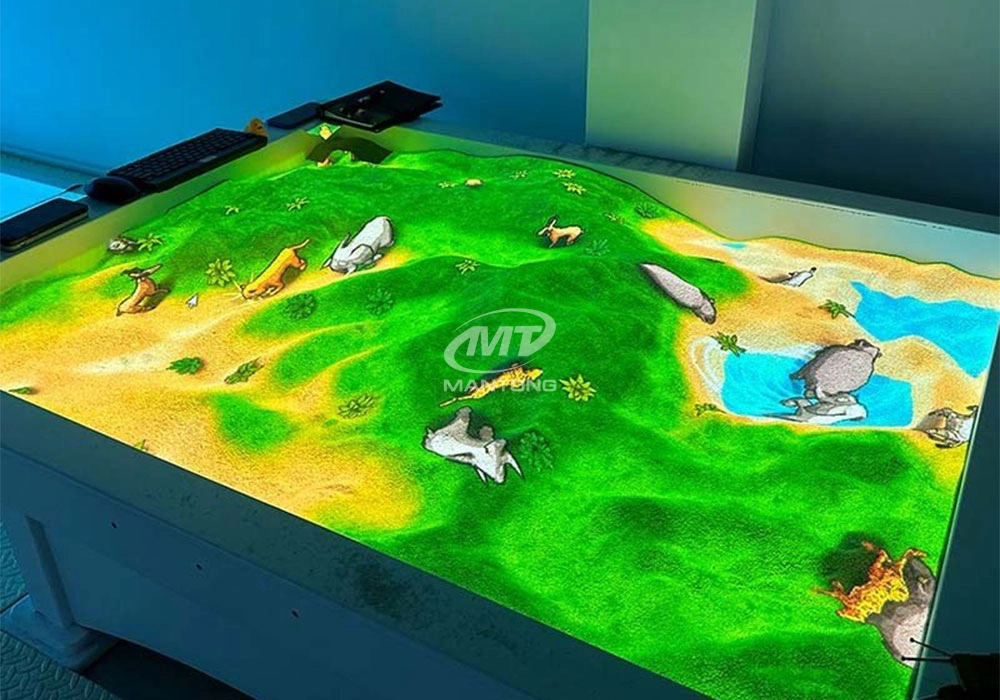
Interactive Sandbox Projection Mapping Games For Kids Play Park
Bring imagination to life with interactive sandbox projection mapping games designed for kids’ play parks. Using cutting-edge projection technology and real-time motion sensing, children can dig, build, and explore virtual worlds directly in the sand. Educational, engaging, and endlessly fun — it’s the perfect blend of play and learning.

Kaida Business Center, Shixin Road, Panyu District,Guangzhou City, Guangdong Province, China.
ManTong
ManTong
ManTong