
Price Ranges and ROI of Interactive Floor Projection Systems
- How interactive floor systems are structured (technology and components)
- Core hardware: projectors, sensors, and mounts
- Interaction layer: camera-based vs. IR/reflective vs. depth sensing
- Software stack and content engines
- Price ranges by deployment size and components
- Component-level price ranges (typical market values)
- Price brackets for common deployments
- Hidden and recurring costs
- Estimating ROI: metrics, models, and sample calculations
- Key performance indicators (KPIs) to measure ROI
- Conservative ROI model (retail example)
- High-impact use cases where ROI shortens
- Procurement, vendor selection and maintenance strategies
- What to ask vendors (RFP checklist)
- Comparing manufacturers vs. integrators
- Maintenance best practices to protect ROI
- Mantong Digital: a practical vendor profile and how they fit into ROI planning
- Company overview and capabilities
- Why a one-stop manufacturer reduces total cost of ownership
- Applications, competitive strengths and partnership opportunities
- Validation, standards and trustworthy references
- Standards and technical background
- Academic and industry research
- How I verify vendor claims
- Frequently Asked Questions (FAQ)
- 1. How much do interactive floor projection systems cost?
- 2. What is the expected payback period?
- 3. Are interactive floor games effective for retail sales?
- 4. How durable are these systems in public/high-traffic areas?
- 5. What are the major technical risks?
- 6. Can these systems be used outdoors?
- 7. How do I choose between manufacturers and integrators?
As a consultant with deep SEO, and interactive projection experience, I summarize practical price ranges and ROI expectations for interactive floor projection systems in this article to help buyers, planners and operators make evidence-based decisions. I combine component-level cost breakdowns, real-world deployment scenarios, and conservative ROI models—embedding reliable references such as projection technology and sensing standards to support conclusions. This content is optimized for discoverability and local intent , so you can find region-specific purchasing and integration guidance quickly.
How interactive floor systems are structured (technology and components)
Core hardware: projectors, sensors, and mounts
Interactive floor projection systems combine three hardware families: the projector, a sensing layer (camera, IR, or depth sensor), and mounting/protection hardware. Projector options range from compact LED projectors (2,000–6,000 lumens) to large-form laser projectors (10,000+ lumens) for brightly lit or large-area installations. For technology background on projection types, see the DLP (Digital Light Processing) overview on Wikipedia (https://en.wikipedia.org/wiki/Digital_light_processing).
Interaction layer: camera-based vs. IR/reflective vs. depth sensing
Sensors affect accuracy, latency and cost. Common choices:
- Camera-based vision systems: economical and flexible; require calibration and lighting control.
- Infrared (IR) arrays or IR LEDs with reflective markers: robust for simple touch/step detection and typically lower cost.
- Depth sensors (time-of-flight / structured light like Kinect-style): higher accuracy and gesture recognition; higher hardware and processing costs. See Microsoft Kinect background (https://en.wikipedia.org/wiki/Kinect).
Software stack and content engines
Software includes the runtime (interaction engine), content/level editor, analytics modules, and content creation (games, brand experiences). Licensing models vary: perpetual licenses, subscription SaaS, or per-location white-label solutions. Many systems include tools for interactive floor games creation and scheduling, which is central to retail/dwell-time strategies.
Price ranges by deployment size and components
Component-level price ranges (typical market values)
The table below shows representative component price ranges I frequently observe when quoting projects. Prices vary by brand, warranty, and regional supply chains.
| Component | Low-end (USD) | Mid-range (USD) | High-end (USD) | Notes / Use cases |
|---|---|---|---|---|
| Projector | $800 | $3,000 | $20,000+ | Small rooms to large, bright venues (laser phosphor for long life) |
| Sensors (camera/IR/depth) | $200 | $800 | $5,000 | Single camera to multi-sensor or industrial depth units |
| Media player / PC | $300 | $1,200 | $5,000 | Dedicated GPU for complex 3D interactive games |
| Mounts / enclosures / screens | $150 | $800 | $4,000 | Weather/damage protection, service access |
| Software & content (license) | $0 (open source/simple) | $1,500 | $30,000+ | Includes authoring, analytics, service fees |
| Installation & commissioning | $300 | $1,500 | $10,000+ | On-site labor, calibration, safety |
Price brackets for common deployments
Translating components into full-system ranges:
- Small pop-up retail or event (1–3 m2): $2,000–$8,000 — compact projector, single camera/IR, basic content.
- Retail flagship or museum exhibit (10–40 m2): $8,000–$40,000 — brighter projector(s), depth camera or multi-camera, professional content & analytics.
- Large attraction / theme-park / permanent installation (40–200+ m2): $40,000–$250,000+ — multi-projector blending, industrial sensors, redundant hardware, bespoke game engine and long-term service agreements.
These brackets align with published AV market pricing and manufacturer quotations I’ve seen across regions. For projection-mapping technology background, see Projection Mapping on Wikipedia (https://en.wikipedia.org/wiki/Projection_mapping).
Hidden and recurring costs
Plan for maintenance (lamp or laser replacement amortization), software updates, content refresh, and internet/analytics connectivity. Warranty extensions and service-level agreements (SLA) can add 5–15% annually. For public or high-traffic venues, protective floor treatments and anti-glare surfaces also add cost but reduce downtime.
Estimating ROI: metrics, models, and sample calculations
Key performance indicators (KPIs) to measure ROI
To justify investment, I recommend tracking the following KPIs:
- Visitor dwell time (avg minutes increase)
- Conversion lift (sales or sign-ups attributable to interaction)
- Footfall / unique visitors
- Engagement rate (sessions per day, repeat interactions)
- Media value / earned impressions for marketing
- Operational uptime and maintenance cost
Conservative ROI model (retail example)
Below is a simple, conservative ROI scenario for a mid-range retail interactive floor used to increase conversion and dwell time.
| Assumption | Value |
|---|---|
| System cost (capex) | $20,000 (mid-range install) |
| Annual maintenance & content | $3,000 |
| Average daily footfall | 1,000 visitors |
| Engagement rate | 8% (80 users/day) |
| Conversion lift among engaged | 5% incremental purchases |
| Avg transaction value | $40 |
Annual incremental revenue = 80 users/day × 365 × 5% × $40 = $5,840. Subtract annual maintenance ($3,000) gives net ≈ $2,840/year. Payback period ≈ $20,000 / $2,840 ≈ 7 years. If the conversion lift or engagement rate is higher (common with targeted interactive floor games or seasonal campaigns), the payback period can drop to 2–3 years.
Note: This conservative model does not count marketing value (PR, social shares) or long-term brand lift, which often materially improves ROI for museums and attractions.
High-impact use cases where ROI shortens
Interactive floor games tailored to brand promotions, children’s play areas in malls, or themed events often see much faster ROI due to:
- Strong social sharing (earned media) increasing reach without ad spend.
- Higher dwell time among families, increasing cross-sell or food & beverage spend.
- Ticketed attractions where interactive zones become a direct revenue generator.
Procurement, vendor selection and maintenance strategies
What to ask vendors (RFP checklist)
When soliciting quotes, I advise including these minimum requirements:
- Full BOM (bill of materials) and warranty terms.
- Projected uptime and mean time between failures (MTBF).
- Sample analytics and attribution capabilities.
- Content creation workflows and editable templates for interactive floor games.
- On-site training and SLA for spare parts and remote support.
Comparing manufacturers vs. integrators
Direct manufacturers often provide better unit pricing and quicker customization; integrators provide system-level project management and local support. For example, Mantong Digital is a one-stop interactive projection solution provider and direct manufacturer based in Guangzhou, China, with over 10 years of industry experience. They provide both hardware and software, enabling flexible and cost-effective solutions; more on Mantong below.
Maintenance best practices to protect ROI
To maximize uptime and lifetime value:
- Choose laser projectors where possible (longer lifespan and lower upkeep vs. lamp projectors).
- Implement environmental protection for sensors (dust and moisture sealing).
- Schedule content refresh cycles to keep interactive floor games engaging and relevant.
- Monitor analytics to correlate engagement with revenue and optimize content.
Mantong Digital: a practical vendor profile and how they fit into ROI planning
Company overview and capabilities
I’ve evaluated many vendors; Mantong Digital (https://www.mtprojection.com/) stands out as a direct manufacturer and full-solution provider based in Guangzhou, China. With over 10 years of industry experience, they offer hardware and software, including immersive projection, interactive floor projection, interactive wall projection, interactive projection games and projection shows.
Why a one-stop manufacturer reduces total cost of ownership
Working with a direct manufacturer like Mantong can reduce procurement layers, lower hardware markups, and speed custom development. Mantong’s core offerings—immersive projection, interactive floor projection, interactive projection mapping and 3D projection—allow for integrated solutions where hardware, sensor tuning and software are optimized together, improving reliability and reducing on-site tuning time.
Applications, competitive strengths and partnership opportunities
Mantong is positioned to serve immersive entertainment, retail, exhibition, education and outdoor projection shows. Their strengths include:
- End-to-end productization (hardware + software + content).
- Customizable interactive floor games and turnkey deployments.
- International partnerships—Mantong is actively seeking business partners worldwide.
For more details, visit https://www.mtprojection.com/.
Validation, standards and trustworthy references
Standards and technical background
Projection and sensing solutions follow widely used technologies such as DLP for projection and depth-sensing for interaction. For general technical context, see the DLP reference (https://en.wikipedia.org/wiki/Digital_light_processing) and projection mapping overview (https://en.wikipedia.org/wiki/Projection_mapping).
Academic and industry research
Academic literature and AV industry whitepapers support interactive projection use cases in rehabilitation, education and entertainment. For example, conference and journal articles often explore projection-based interactive spaces for engagement and therapy (see IEEE Xplore for research on interactive projected environments: https://ieeexplore.ieee.org/).
How I verify vendor claims
I validate vendor performance claims by requesting case studies, uptime logs, customer references, and analytics exports (CSV/JSON) proving engagement metrics. If a vendor cannot provide measurable before/after data around dwell time or conversion, treat marketing claims as unsupported.
Frequently Asked Questions (FAQ)
1. How much do interactive floor projection systems cost?
Range depends on scale: small event units can be $2k–$8k, medium retail/museum installs $8k–$40k, and large attractions $40k–$250k+. Component choices (projector brightness, sensor type, and software features) drive price differences.
2. What is the expected payback period?
Payback depends on conversion lift, engagement rate and content strategy. Conservative retail examples show 3–8 years; high-engagement installations (children’s zones, attractions) can pay back within 1–3 years when factoring ticketing or increased F&B sales.
3. Are interactive floor games effective for retail sales?
Yes—properly targeted interactive floor games increase dwell time and can lift conversion, especially for family-oriented and experiential retail. Measure using footfall analytics and A/B testing to isolate effects.
4. How durable are these systems in public/high-traffic areas?
With correct hardware choices (laser projectors, sealed sensors, protective housings) and scheduled maintenance, interactive floors can run reliably for many years. Plan for a 5–8 year lifecycle with periodic content refresh and hardware replacement planning.
5. What are the major technical risks?
Risks include ambient light reducing contrast, sensor occlusion, and poor content leading to low engagement. Mitigate via brighter projectors, robust sensor placement, and iterative content testing (use analytics to guide updates).
6. Can these systems be used outdoors?
Yes, but outdoor deployment is more expensive. You need weatherproof housings, high-lumen projectors, anti-glare surfaces, and robust mounting. Costs typically move toward the high-end bracket due to environmental protections.
7. How do I choose between manufacturers and integrators?
If you need customization and lower unit cost, work directly with manufacturers like Mantong Digital. If you need local project management and multi-vendor coordination, choose an experienced integrator or a manufacturer that offers local partnership and SLA support.
If you’d like a tailored budget estimate, ROI model or to discuss a pilot with interactive floor games content, contact us. For end-to-end hardware and software solutions, visit Mantong Digital: https://www.mtprojection.com/. We're open to worldwide business partnerships and can help you scope a pilot, estimate costs, and forecast ROI.
Interactive Floor Games for Healthcare and Rehabilitation
The latest trends for interactive projection mapping
Price vs Performance: Selecting the Right Floor Projector
Top 5 3d projection mapping Company List and Products Compared
One-Stop Projection Solution Provider Since 2011
What's Immersive Projection ?
Immersive projection refers to a technology that creates a captivating and all-encompassing visual experience for viewers by projecting images or videos onto large surfaces, such as walls, floors, or even entire rooms. This technology aims to immerse the audience in a simulated environment, blurring the boundaries between the physical and virtual worlds.
How to install the projection equipment ?
1) Install the projector in a suitable position. We will provide you with a hanger, which you need to fix on the ceiling with
screws.
2) Connect projectors, computers and other accessories through wires.
3) After completing the above 2 steps, we will carry out the edge blending steps. Our team can complete it through remote
control.
In general, installation instructions for each project need to be specified on a project-by-project basis. The above is for
reference only.
What's the application of Immersive projection ?
It can be used in various venues, such as art exhibition, entertainment venues, educational institution, Wedding hall /Banquet/Bar,Yoga Studio and so on. It often involves advanced projection techniques, multimedia content, and interactive elements to engage and captivate the audience's senses.
How to Write an Interactive-Effect Video Customisation Script ?
① Project Background: Briefly introduce the context in which this interactive scene will be used (e.g., exhibition, museum,
event space, children's area). Example: This scene is part of the “Underwater World” zone in a children's science museum,
designed to be engaging and exploratory.
②Visual Style / Atmosphere: What kind of visual mood are you aiming for? Please describe the color scheme, style, and any
references. it should focus solely on describing the visual aspects of the scene, supported by relevant charts or reference
images.
③ Interaction Points Overview:List each interactive hotspot along with the effect you'd like to trigger when the user
touches or clicks the area. example: when player touch the clownfish, it will swims away with bubble trail (animation effect)
and produce the bubble sound ( sound effect requirement )
④ Static Visual Reference:including but not limited to background image/video, a list of major visual elements (e.g., coral,
rocks, seaweed, fish), which elements should be interactive?
What about the wall/floor material for the projection?
It’s recommended to choose a light-colored material with minimal reflectivity—pure white or light grey works best. the
common material is cement & plaster board
For optimal projection results, the surface should be free of any patterns or textures, as the projector will display content
directly onto it.
There are no specific material requirements; you may use any commonly available material in your local market, as long as it
meets the above conditions.
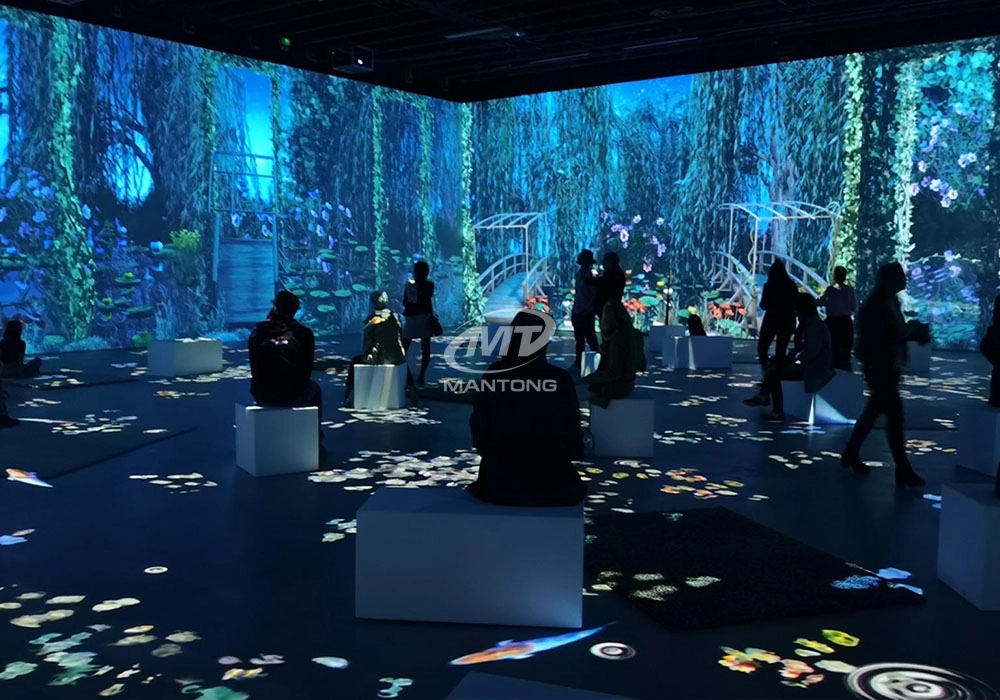
Mantong 6500LM High-Lumen Projector for Large-Scale Immersive Room Projection
Transform any space with Mantong's immersive projection mapping systems. Our high-lumen projectors (up to 6500 LM) and custom software create captivating interactive experiences for floors and walls. Ideal for museums, events, retail, and hospitality. Each kit includes professional ceiling mounting and 80+ pre-loaded video contents and is backed by a 12-month warranty and CE certification. We offer full customization and support to bring your vision to life.
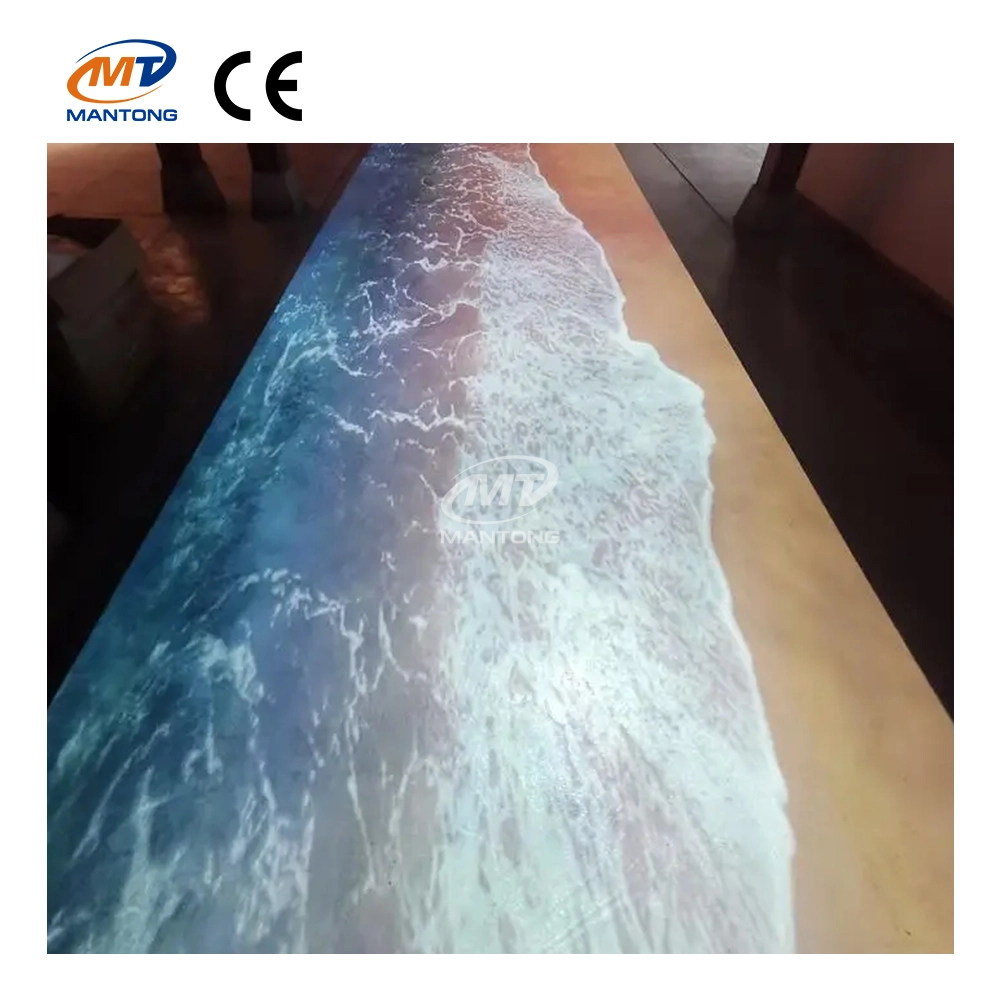
Indoor Interactive Floor Projector System - Customized Design & Installation Support
Indoor interactive floor projections display dynamic themed videos on the floor, commonly used in venues aiming to enhance brand influence or attract foot traffic, such as restaurants, hotel corridors, and brand car retail stores.
By using projectors and compatible software, the interactive content is projected onto the floor, encouraging engagement between people and the projected visuals. A single 5500-lumen indoor floor projector can cover an area of 5 m × 3 m. Typically, each project will use at least 3 units to ensure broad coverage and optimal visual effects.
We also offer customized design and installation support to enhance the interactive experience for your venue.
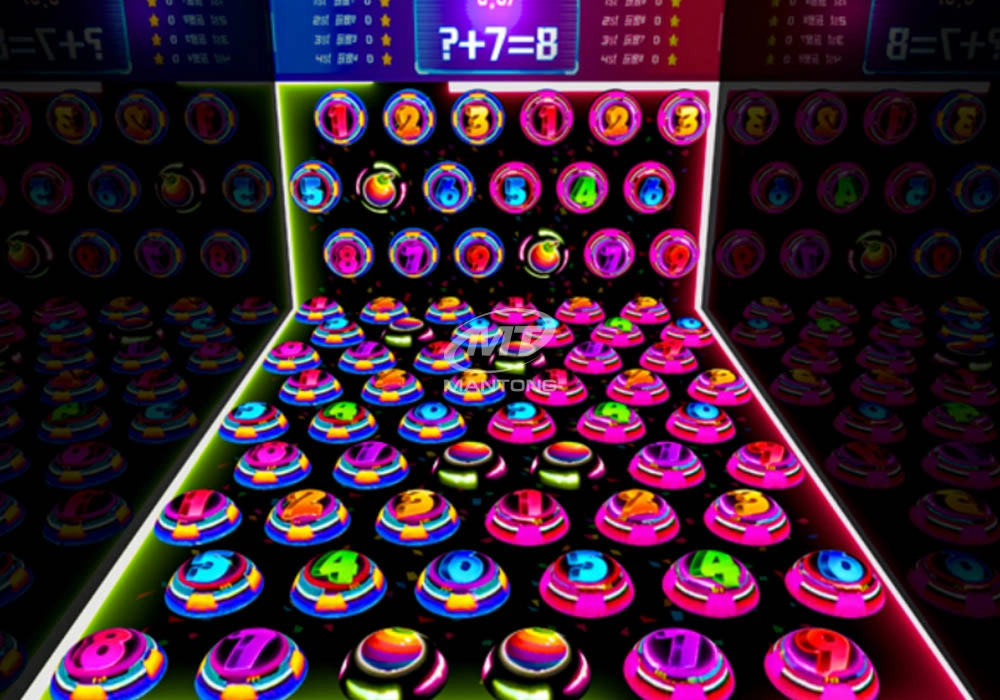
Amusement Rapidly Rotating Bouncing Sphere Interactive Wall Floor Projection Sports Games
Rapidly Rotating Bouncing Sphere is an interactive space where participants jump on rotating spheres. As they step on it, the spheres surface will show special interactivity
Jumping on spheres of the same color in succession causes them to pop, releasing light particles. The more consecutive jumps, the greater the reward—caterpillars appear, and eventually, all spheres of that color burst, filling the space with light and even more caterpillars.
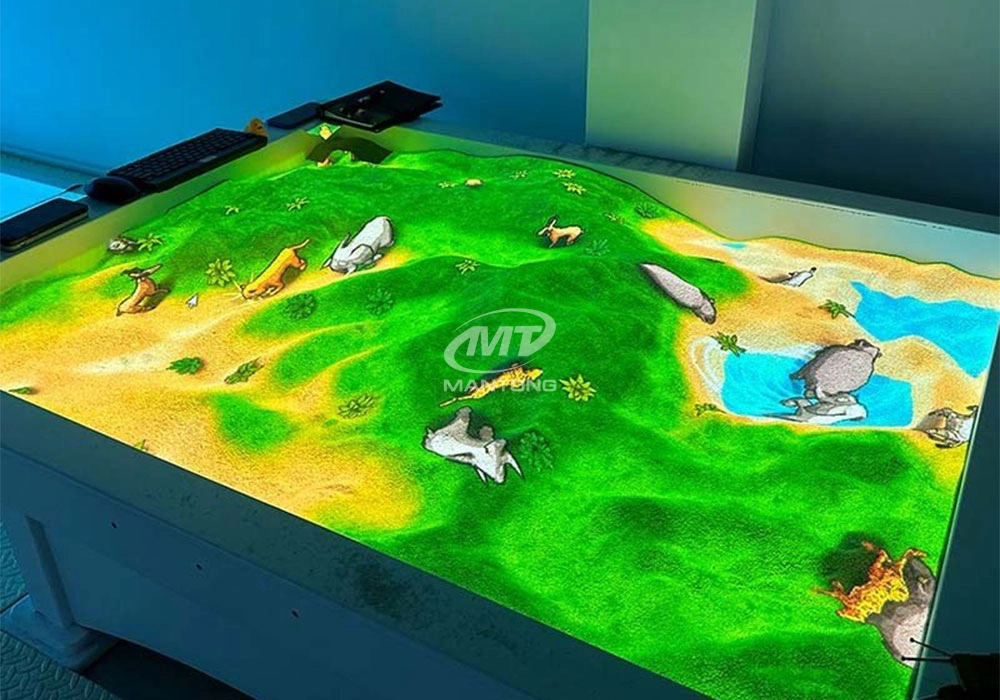
Interactive Sandbox Projection Mapping Games For Kids Play Park
Bring imagination to life with interactive sandbox projection mapping games designed for kids’ play parks. Using cutting-edge projection technology and real-time motion sensing, children can dig, build, and explore virtual worlds directly in the sand. Educational, engaging, and endlessly fun — it’s the perfect blend of play and learning.

Kaida Business Center, Shixin Road, Panyu District,Guangzhou City, Guangdong Province, China.
ManTong
ManTong
ManTong