
Buyer's Guide: Interactive Floor Projector for Home Installations
- How to choose the right interactive floor projector for your home
- Why homeowners choose an interactive floor projector for home experiences
- Key specifications to evaluate when buying an interactive floor projector for home
- Sensor and interaction technology: what works best at home
- Comparing projector types and sensor setups (table)
- Software ecosystem: platforms, content, and customization
- Installation and mounting: practical tips for home deployment
- Safety, privacy and maintenance
- Budget guide and typical price ranges
- Case study examples: common home installation scenarios
- Mantong Digital: turnkey solutions from a direct manufacturer
- Checklist before you buy an interactive floor projector for home
- Installation and post-purchase tips to maximize value
- Frequently Asked Questions (FAQ)
- 1. What is the difference between an interactive floor projector for home and a regular home projector?
- 2. Do I need a dark room for an interactive floor projection?
- 3. Is it safe to use cameras or depth sensors in a home with children?
- 4. Can I install an interactive floor projector on my own?
- 5. How much should I expect to spend for a reliable home interactive floor system?
- 6. Can I create my own interactive content?
- Contact and next steps
- References
How to choose the right interactive floor projector for your home
Why homeowners choose an interactive floor projector for home experiences
Interactive floor projectors turn ordinary floors into playful, educational, or immersive surfaces. Homeowners install them for family entertainment, sensory play for children, accessibility and therapy, home gyms, parties, and ambient décor. Understanding the primary use case (gaming vs educational vs ambient art) is the first step in selecting an interactive floor projector for home installations because it determines required brightness, latency, sensor type, and software complexity.
Key specifications to evaluate when buying an interactive floor projector for home
When evaluating units, focus on specifications that directly affect the real-world experience:
- Brightness (ANSI lumens): For low-light living rooms 800–2,500 ANSI lumens can be adequate; for brighter rooms or daylight use, aim higher. Brightness affects color saturation and image clarity on different floor surfaces.
- Resolution: 1080p (Full HD) is the practical minimum for detailed interactive content; 4K is desirable for large areas and ultra-sharp visuals but increases cost.
- Throw ratio and lens type: Short-throw and ultra-short-throw (UST) projectors let you position the projector close to the floor or a wall-to-floor corner and reduce floor-mounted obstructions and shadows.
- Contrast ratio: Higher contrast improves perceived depth of visuals, important for immersive effects.
- Input lag and frame rate: Low latency (<30 ms) and 60 Hz (or higher) are important for responsive interactive games and motion-tracking experiences.
- Connectivity: HDMI, USB, network (Ethernet/Wi-Fi), and support for streaming or local media sources.
- Physical form factor and cooling/noise: Quiet operation is vital in homes; look for low fan noise ratings.
- Durability and lamp life: For lamp-based projectors consider lamp hours and replacement cost; laser projectors offer longer life and more consistent brightness.
Embed the keyword naturally: choosing an interactive floor projector for home means balancing brightness, throw distance and interaction responsiveness for the spaces you use most.
Sensor and interaction technology: what works best at home
Interaction is primarily handled by one or more sensor systems. Common options:
- Depth cameras (Time-of-Flight, structured light) — e.g., Azure Kinect or Intel RealSense: provide accurate 3D tracking and are robust for multi-user scenarios.
- Stereo/2D cameras with computer vision — cost-effective for gesture and motion detection but can struggle in poor lighting.
- Infrared (IR) floor mats or IR camera + projector pair — reliable for touch and foot detection without needing a full depth sensor.
- Ultrasonic or radar — less common in consumer setups; useful where privacy or lighting conditions are constrained.
Choice depends on budget and use: depth cameras provide the best accuracy for interactive games and installations where multiple people interact simultaneously; IR solutions are durable and often simpler to integrate for singular-purpose installations.
Comparing projector types and sensor setups (table)
| Category | Pros | Cons | Best home uses |
|---|---|---|---|
| Short-throw (0.4–1.0 throw ratio) | Reduces shadows, flexible placement, compact | Can cost more than standard throw; may have lens distortion | Living rooms, playrooms, small open spaces |
| Ultra-short-throw (UST, <0.4) | Mounts very close to projection surface, minimal shadows, sleek install | Higher price; sensitive to placement precision | Bedrooms, home theaters, mounted on cabinet or ceiling near wall/floor corner |
| Lamp-based projectors | Lower initial cost | Higher maintenance, lamp replacements, brightness drop over time | Budget home setups with controlled lighting |
| Laser projectors | Long life, stable brightness, better color | Higher upfront cost | High Quality home installations, high-use areas |
| Depth camera sensor (ToF/structured light) | Accurate multi-user tracking, robust | Higher cost, requires processing power | Games, therapy, multi-person interaction |
| IR camera / IR floor sensors | Reliable for touch events, lower compute needs | Limited to 2D detection; less precise for gestures | Foot-triggered games, interactive art, simple education tools |
(Data and typical specs summarized from projector manufacturer guides and technical reviews; see references.)
Software ecosystem: platforms, content, and customization
Software is where the interactive floor projector for home becomes useful. Consider:
- Pre-built content library: Does the vendor include games, educational modules, or visualizers?
- Customization tools: Is there a user-friendly editor or SDK to create bespoke interactions?
- Platform compatibility: Windows, macOS, Android boxes, or integrated media players?
- Updates and support: Frequency of content updates and level of technical support.
If you want bespoke experiences (custom family games, branding, or therapy modules), prioritize systems that expose APIs or offer developer kits. For turnkey plug-and-play use, a rich content library and simple control UI matter more.
Installation and mounting: practical tips for home deployment
- Positioning: For floor projection, ceiling-mounted short-throw or UST projectors near a wall-to-floor corner provide the cleanest footprint. Floor-mounted projectors should be avoided where feet traffic could disrupt optics.
- Calibration: Many systems include automatic keystone correction and floor mapping. Allow time for calibration during installation and retest after furniture changes.
- Power and cabling: Plan cable routing and consider an in-wall or surface raceway for cleanliness and safety.
- Surface considerations: Smooth, neutral-colored floors (light grey or white) produce the best results. Reflective, patterned, or very dark floors reduce contrast and tracking accuracy.
- Ambient light control: Use curtains, blinds, or dimmable lighting to improve image contrast during daytime use.
Safety, privacy and maintenance
- Heat and ventilation: Projectors generate heat—mount them where airflow is adequate and away from toys or textiles.
- Eye safety: Avoid pointing high-brightness projectors directly into eye level. Use projector settings to limit output when children are present.
- Data privacy: Systems with cameras should have clear privacy modes (physically disable cameras or local-only processing) and secure firmware updates.
- Maintenance: Clean filters and optics on schedule. If using lamp-based projectors, budget for lamp replacements every 2,000–5,000 hours (depending on mode) — laser models reduce this cost variable.
Budget guide and typical price ranges
- Budget setups ($500–$1,500): Basic short-throw projectors (1080p), simple IR sensor or camera, limited content libraries. Good for casual home use.
- Mid-range ($1,500–$5,000): Higher brightness, 1080p/4K-capable units, depth sensors or advanced IR, richer software and quieter operation.
- High Quality ($5,000+): Laser-based UST projectors, professional-grade depth sensors, custom software with support and installation services. Ideal for immersive rooms or dedicated home experience spaces.
Choose based on frequency of use, required reliability and whether you want off-the-shelf content or custom development.
Case study examples: common home installation scenarios
- Family playroom: A mid-range short-throw 1080p projector with IR floor detection and a pre-built library of movement games provides affordable, low-maintenance fun.
- Home therapy / special needs: A depth camera-based system with customized software for sensory stimulation and tracking progress is preferred; partner with providers who can deliver tailored content.
- Immersive art or ambient décor: Use a laser UST projector and 4K content for crisp visuals; lower latency is less critical than image quality and color fidelity.
Mantong Digital: turnkey solutions from a direct manufacturer
Mantong Digital is a one-stop interactive projection solution provider and direct manufacturer based in Guangzhou, China, with over 10 years of industry experience. We are dedicated to providing innovative, flexible and cost-effective projection solutions, offering both hardware and software to meet various needs.
At ManTong, we specialize in providing customized solutions for a wide range of application scenarios through innovative projection technology. Whether it's immersive experiences, interactive entertainment or outdoor lighting and projection shows, our solutions can transform your ideas into stunning visual effects. Our projection technology provides customized solutions for a variety of scenarios, delivering immersive and interactive visual experiences.
We are now looking for business partnerships worldwide. Our vision is to become the world's leading interactive projection manufacturer. Our website is https://www.mtprojection.com/.
ManTong advantages and core offerings:
- Direct manufacturing: Short lead times and cost control through direct production in Guangzhou.
- Customization capability: Hardware+software integration for immersive projection, interactive floor projection, interactive wall projection, immersive rooms, 3D projection, interactive projection games, projection shows and interactive projection mapping.
- Proven track record: Over a decade delivering solutions across entertainment venues, museums, retail and private installations.
- End-to-end service: Consultation, design, hardware manufacturing, software development, installation, and after-sales support.
If you prioritize working with a partner who can deliver both the projector hardware and the bespoke interaction software for a home installation, ManTong is positioned to provide turnkey solutions tailored to residential needs.
Checklist before you buy an interactive floor projector for home
- Define primary use case: games, education, therapy, ambient art, or mixed use.
- Measure and photograph intended space: note ceiling height, fixtures, ambient light, and floor surface.
- Decide on portability vs. permanent installation.
- Choose sensor type based on accuracy needs and privacy preferences.
- Verify software options: built-in content, SDK availability, update policy.
- Confirm warranty, local support, and spare part availability.
Installation and post-purchase tips to maximize value
- Perform a staged deployment: test a single room before scaling to multiple spaces.
- Invest in professional calibration for High Quality setups to reduce alignment issues and increase longevity.
- Keep firmware up to date and register your device for warranty and security alerts.
- Build a content refresh plan: rotate or add new game packs and visuals to keep the family engaged.
Frequently Asked Questions (FAQ)
1. What is the difference between an interactive floor projector for home and a regular home projector?
An interactive floor projector for home combines projection hardware with sensors and interactive software. Regular home projectors only display video; interactive systems detect motion, touch or gestures and respond in real time.
2. Do I need a dark room for an interactive floor projection?
Not always. Moderate ambient light is workable if you choose higher brightness (ANSI lumens) and a neutral, non-reflective floor. For the best contrast and color saturation, reducing direct daylight remains recommended.
3. Is it safe to use cameras or depth sensors in a home with children?
Yes, provided you implement privacy safeguards: local-only processing (no cloud streaming), physical camera covers or disable switches, and clear data handling policies from the vendor. Choose systems that prioritize on-device processing.
4. Can I install an interactive floor projector on my own?
Many consumer-grade units are DIY-friendly, especially portable setups. For ceiling-mounted short-throw or ultra-short-throw installations, or if integrating depth sensors and custom software, professional installation is recommended.
5. How much should I expect to spend for a reliable home interactive floor system?
Expect a range: basic systems can start near $500–$1,500; reliable mid-range setups typically land in the $1,500–$5,000 band; High Quality custom solutions exceed $5,000, especially when including professional installation and custom software.
6. Can I create my own interactive content?
Yes—if the system offers an SDK or content editor. ManTong and other providers often offer developer kits or white-label software to create custom content for education, therapy, or branded experiences.
Contact and next steps
If you’d like advice tailored to your home layout and budget, or want to explore turnkey hardware and software packages, contact ManTong Digital. Visit https://www.mtprojection.com/ to review product lines, request a quote, or discuss partnership and custom solutions. ManTong offers consultation, design and global shipping for interactive floor projectors for home installations.
References
- ProjectorCentral — Throw Distance & Projection Calculator (technical overview). https://www.projectorcentral.com/throw-distance-calculator-projection-throw.htm (Accessed 2025-06-10).
- Digital Light Processing — Wikipedia (DLP technology basics). https://en.wikipedia.org/wiki/Digital_light_processing (Accessed 2025-06-10).
- Lumen (photometry) — Wikipedia (description of lumens and luminous flux). https://en.wikipedia.org/wiki/Lumen_(unit) (Accessed 2025-06-10).
- Azure Kinect DK — Microsoft documentation (depth camera capabilities). https://learn.microsoft.com/en-us/azure/kinect-dk/ (Accessed 2025-06-10).
- Projection mapping — Wikipedia (applications and technology overview). https://en.wikipedia.org/wiki/Projection_mapping (Accessed 2025-06-10).
- ManTong Digital — Official website (product offerings and company profile). https://www.mtprojection.com/ (Accessed 2025-06-10).
Top 10 interactive projection technology Manufacturers and Supplier Brands
Top interactive floor games for schools and classrooms
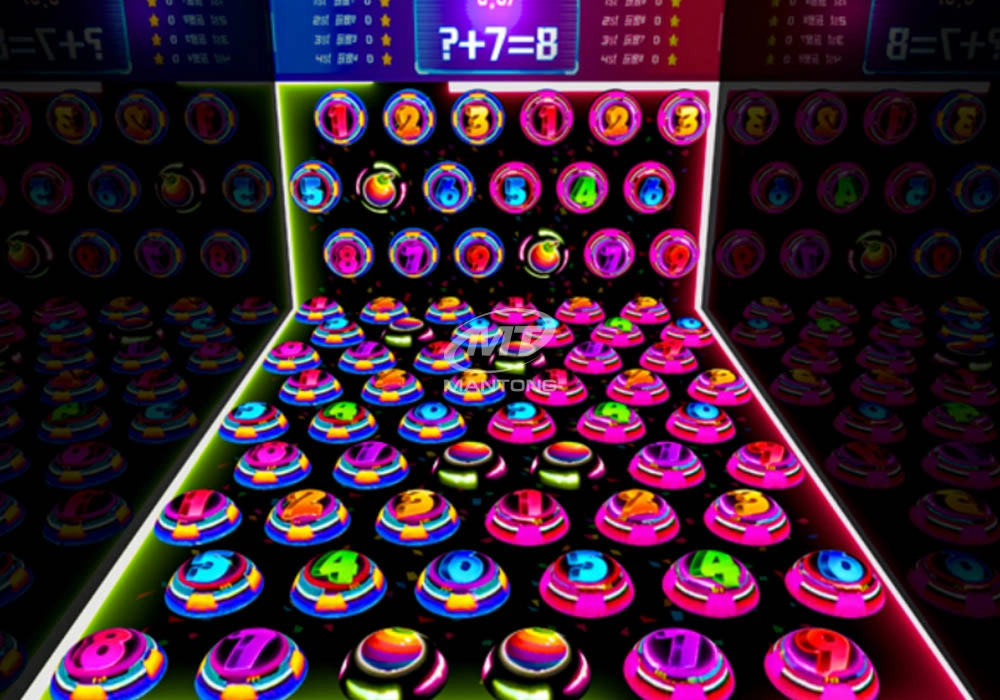
Interactive Rotating Bouncing Sphere — Wall & Floor Projection for Sports and Entertainment
Why Immersive Projection Rooms Are the Next Big Trend in Interactive Marketing
One-Stop Projection Solution Provider Since 2011
How to Write an Interactive-Effect Video Customisation Script ?
① Project Background: Briefly introduce the context in which this interactive scene will be used (e.g., exhibition, museum,
event space, children's area). Example: This scene is part of the “Underwater World” zone in a children's science museum,
designed to be engaging and exploratory.
②Visual Style / Atmosphere: What kind of visual mood are you aiming for? Please describe the color scheme, style, and any
references. it should focus solely on describing the visual aspects of the scene, supported by relevant charts or reference
images.
③ Interaction Points Overview:List each interactive hotspot along with the effect you'd like to trigger when the user
touches or clicks the area. example: when player touch the clownfish, it will swims away with bubble trail (animation effect)
and produce the bubble sound ( sound effect requirement )
④ Static Visual Reference:including but not limited to background image/video, a list of major visual elements (e.g., coral,
rocks, seaweed, fish), which elements should be interactive?
What about the wall/floor material for the projection?
It’s recommended to choose a light-colored material with minimal reflectivity—pure white or light grey works best. the
common material is cement & plaster board
For optimal projection results, the surface should be free of any patterns or textures, as the projector will display content
directly onto it.
There are no specific material requirements; you may use any commonly available material in your local market, as long as it
meets the above conditions.
What's Immersive Projection ?
Immersive projection refers to a technology that creates a captivating and all-encompassing visual experience for viewers by projecting images or videos onto large surfaces, such as walls, floors, or even entire rooms. This technology aims to immerse the audience in a simulated environment, blurring the boundaries between the physical and virtual worlds.
What information do you need to know before making the proposal/solution?
We know that everyone wants to know the price, but the price of our products is determined by many factors since most of our products are custom, so no ready price list. In order to fast understand what you need, can you send us an inquiry like this?
For example: I am really interested in your immersive projection products, we are a company in the USA and want to install some in my restaurant. It is about 50 meters long, and 5m in width. Projection size you can decide but the length should be not less than 20 meters. We want some content about SeaWorld because our place is all about the sea. Thank you.
Are you trader or manufacturer ?
We are direct manufacturer who specialize in providing one-stop solution for different outdoor & indoor projection project with our stable software and qualified projectors
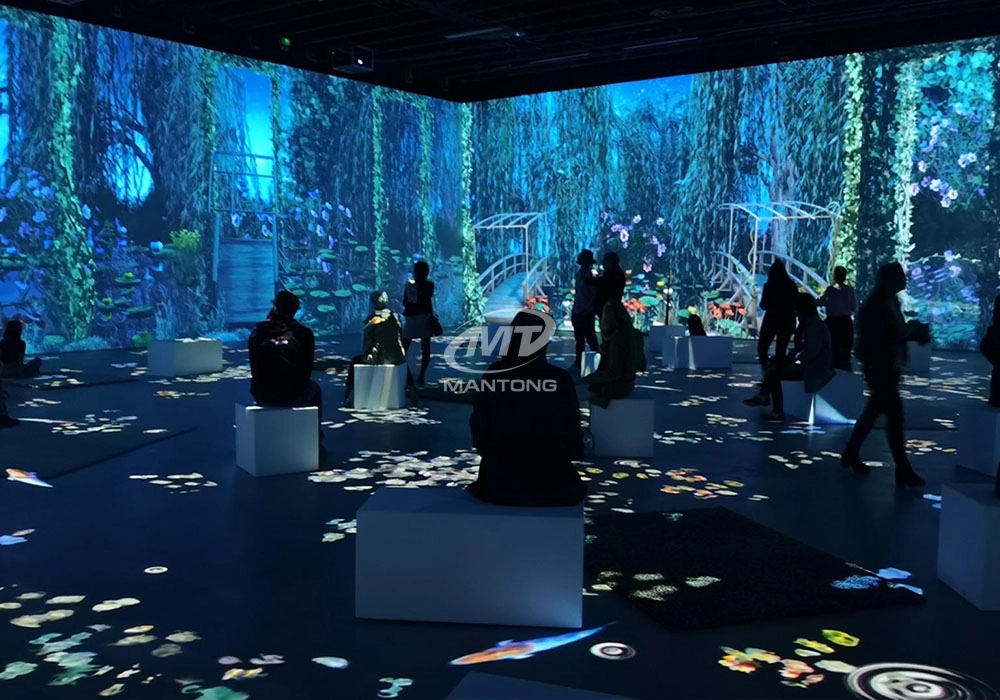
Mantong 6500LM High-Lumen Projector for Large-Scale Immersive Room Projection
Transform any space with Mantong's immersive projection mapping systems. Our high-lumen projectors (up to 6500 LM) and custom software create captivating interactive experiences for floors and walls. Ideal for museums, events, retail, and hospitality. Each kit includes professional ceiling mounting and 80+ pre-loaded video contents and is backed by a 12-month warranty and CE certification. We offer full customization and support to bring your vision to life.
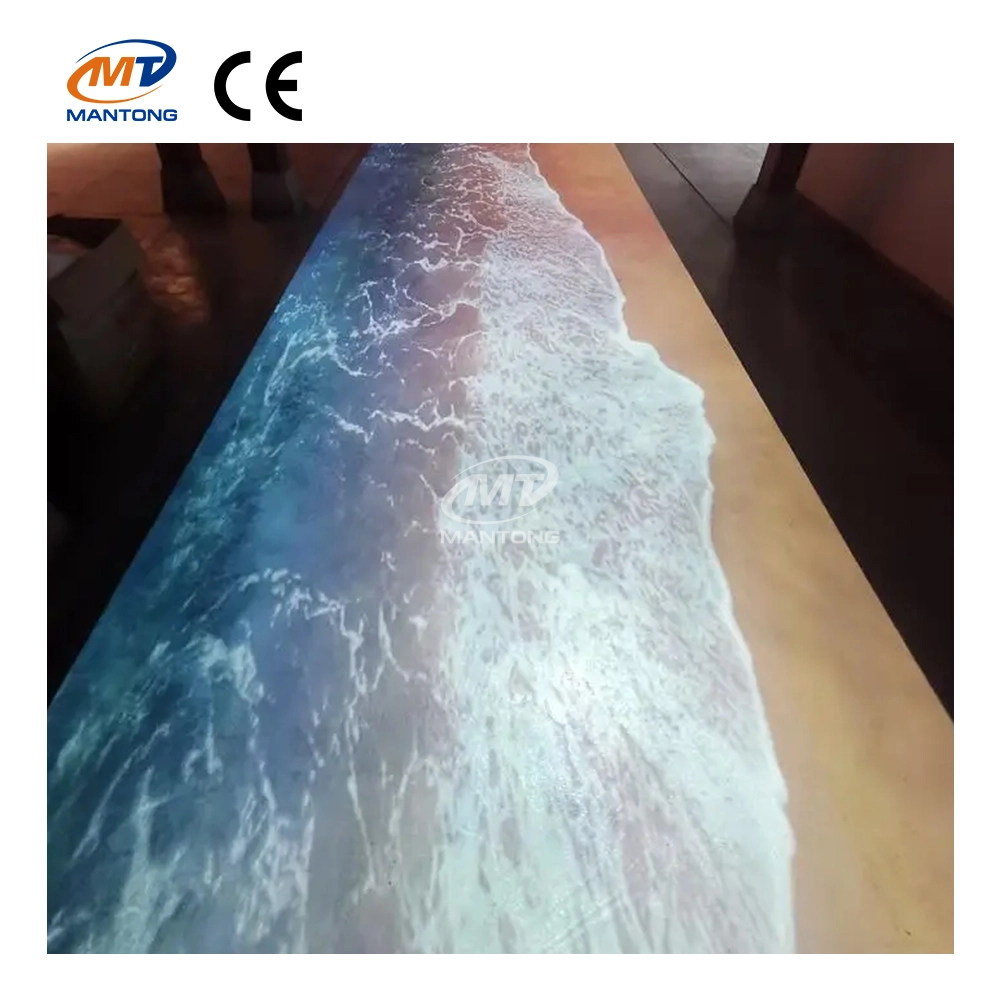
Indoor Interactive Floor Projector System - Customized Design & Installation Support
Indoor interactive floor projections display dynamic themed videos on the floor, commonly used in venues aiming to enhance brand influence or attract foot traffic, such as restaurants, hotel corridors, and brand car retail stores.
By using projectors and compatible software, the interactive content is projected onto the floor, encouraging engagement between people and the projected visuals. A single 5500-lumen indoor floor projector can cover an area of 5 m × 3 m. Typically, each project will use at least 3 units to ensure broad coverage and optimal visual effects.
We also offer customized design and installation support to enhance the interactive experience for your venue.
Amusement Rapidly Rotating Bouncing Sphere Interactive Wall Floor Projection Sports Games
Rapidly Rotating Bouncing Sphere is an interactive space where participants jump on rotating spheres. As they step on it, the spheres surface will show special interactivity
Jumping on spheres of the same color in succession causes them to pop, releasing light particles. The more consecutive jumps, the greater the reward—caterpillars appear, and eventually, all spheres of that color burst, filling the space with light and even more caterpillars.
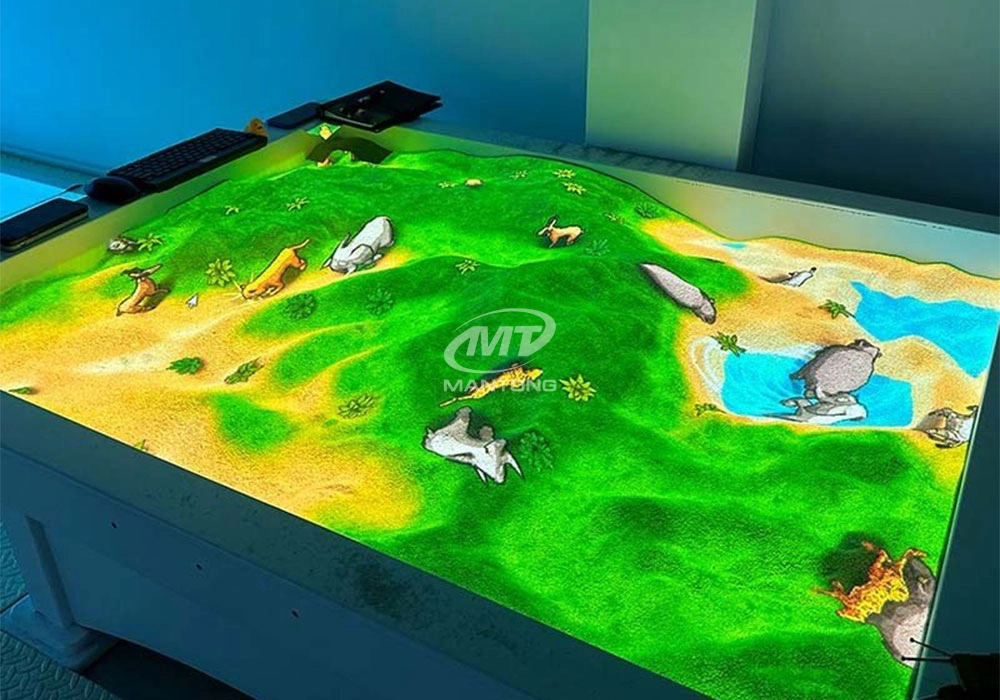
Interactive Sandbox Projection Mapping Games For Kids Play Park
Bring imagination to life with interactive sandbox projection mapping games designed for kids’ play parks. Using cutting-edge projection technology and real-time motion sensing, children can dig, build, and explore virtual worlds directly in the sand. Educational, engaging, and endlessly fun — it’s the perfect blend of play and learning.

Kaida Business Center, Shixin Road, Panyu District,Guangzhou City, Guangdong Province, China.
ManTong
ManTong
ManTong