
Interactive Projector Games for Healthcare: Therapy Uses
- Therapy goals and patient needs in modern care
- Clinical goals addressed by interactive projector games
- Patient populations and accessibility considerations
- Why projection vs. VR or tablet-based games?
- Evidence and clinical outcomes
- Research landscape and level of evidence
- Reported clinical benefits
- Evidence gaps and what to monitor
- Design, technology and deployment best practices
- Core technical components
- Game design principles for therapeutic effectiveness
- Safety, infection control and accessibility
- Implementation workflow, measurement and procurement
- Clinical workflow integration
- Outcome metrics and evaluation
- Procurement checklist and cost factors
- Mantong Digital: provider profile and partnership opportunities
- Mantong’s capabilities and competitive strengths
- Relevant Mantong products and application fit
- Why partner with Mantong?
- Practical case examples and quick-start activities
- Example: Balance training program (clinic pilot)
- Example: Pediatric sensory integration
- Scaling to remote and community settings
- Frequently Asked Questions (FAQ)
- 1. What conditions can interactive projector games help with?
- 2. Are interactive projector games evidence-based?
- 3. How do I measure clinical success?
- 4. What are typical costs and ROI considerations?
- 5. How do I choose a vendor?
- 6. Can projection systems be used safely with mobility aids?
- Conclusions and next steps
Summary for and users: Interactive projector games combine high-lumen projection, motion sensing, and gamified software to create accessible therapy environments for physical rehabilitation, cognitive stimulation, pediatric distraction, fall prevention and mental health interventions. With growing evidence from rehabilitation research and increasing adoption in clinics, hospitals and long-term care facilities, projector-based interactive systems offer low-barrier, hygienic, multisensory therapy that can be customized to patient needs and integrated into care pathways. This article explains therapy use-cases, clinical goals, design and safety considerations, implementation best practices, outcome measurement, procurement advice and real-world evidence to help healthcare leaders evaluate and deploy interactive projection solutions.
Therapy goals and patient needs in modern care
Clinical goals addressed by interactive projector games
Interactive projector games are used to meet several overlapping clinical objectives: motor recovery (gait, balance, upper-limb function), cognitive rehabilitation (attention, memory, executive function), pain and anxiety management (distraction, immersive engagement), pediatric therapy (sensory stimulation and engagement), and fall-prevention training. Each goal maps to specific game mechanics—for example, stepping targets and obstacle avoidance for gait training, or timed pattern-matching for attention training.
Patient populations and accessibility considerations
Suitable populations include stroke and traumatic brain injury survivors, older adults with balance impairment, children with developmental disorders, patients with chronic pain, and those undergoing post-operative mobility training. Key accessibility requirements are adjustable difficulty, large high-contrast visuals for low-vision users, non-contact input (to maintain infection control), and culturally and linguistically appropriate content. Interactive projector games are often preferred in mixed-ability settings because they allow multiple simultaneous users and minimize hardware handling compared to handheld controllers.
Why projection vs. VR or tablet-based games?
Projection-based systems keep users in the real-world environment, eliminating simulator sickness and reducing the supervision burden compared with head-mounted virtual reality. Compared with tablets, floor and wall projection enable whole-body movement and social interaction. For institutions concerned about hygiene, projection requires less direct contact with shared devices. For an overview of projection and mapping technologies, see Projection mapping (Wikipedia).
Evidence and clinical outcomes
Research landscape and level of evidence
The literature on immersive and gamified rehabilitation increasingly supports the efficacy of interactive, sensor-driven interventions for improving motivation and adherence. Systematic reviews on virtual reality and serious games in rehabilitation indicate moderate evidence for gains in motor function and balance when these technologies supplement conventional therapy. For a primer on serious games and their therapeutic rationale, see Serious game (Wikipedia). The World Health Organization highlights the global need to expand rehabilitation services, which can be supported by scalable digital tools: WHO Rehabilitation fact sheet.
Reported clinical benefits
Commonly reported benefits include increased patient engagement, improved session duration and intensity, measurable improvements in balance and gait metrics (step length, speed, symmetry), enhanced fine motor control for upper-limb exercises, and reduced anxiety in pediatric procedures through distraction and play. Many programs report better adherence—an important predictor of outcome—because games add variety and immediate feedback.
Evidence gaps and what to monitor
High-quality randomized controlled trials specifically isolating projector-based interventions remain limited relative to broader VR literature. Outcome measures should therefore include validated clinical scales (e.g., Berg Balance Scale, Timed Up and Go, Fugl-Meyer Assessment) and objective sensor-derived metrics from the projection system (reaction time, accuracy, completed repetitions). Track adverse events (falls, overuse), user satisfaction, and long-term follow-up where possible.
Design, technology and deployment best practices
Core technical components
An interactive projector game system typically includes: a high-brightness short-throw or ultra-short-throw projector, depth/motion sensors or camera arrays for tracking (e.g., structured light, time-of-flight), a processing unit with game engine and clinical software, and optional audio/speakers. Systems must allow calibration to room geometry and support sanitizable installations. For manufacturers and integrators, standardization around open APIs and clinical data export (CSV/HL7/FHIR-compatible output) is a best practice.
Game design principles for therapeutic effectiveness
Design should follow rehabilitation and behavioral science principles: graded difficulty, clear goals and feedback, repetition with variability, errorless learning where appropriate, and meaningful reward systems. For pediatric users, include multimodal stimuli (sound, light, touch) and narrative elements. Ensure clinician control panels allow rapid customization of parameters (duration, target size, speed, sensitivity) so therapy can be tailored in-session.
Safety, infection control and accessibility
Key safety measures include non-slip flooring, unobstructed movement zones, clear boundaries projected on the floor or wall, and software limits to avoid excessive repetitive strain. Choose projection hardware that keeps heat vents away from patient contact areas and use motion sensors that work reliably with assistive devices (canes, walkers). For infection control, maintain minimal shared touch surfaces and use UV-safe cleaning protocols for projector enclosures and sensors.
Implementation workflow, measurement and procurement
Clinical workflow integration
Start with a needs assessment (patient demographics, therapy goals, available space). Pilot in a single clinic room with a small caseload for 4–8 weeks to refine protocols. Train therapists on system calibration, safety checks, and data export. Embed game sessions into care plans as adjuncts (e.g., 15–30 minute daily progressive sessions) and document outcomes in the patient record. Where possible, engage multidisciplinary teams (OT, PT, SLP, psychology) to expand scenario libraries for cognitive and emotional therapy targets.
Outcome metrics and evaluation
Combine standardized clinical scales with device-derived metrics to evaluate effectiveness. Suggested evaluation matrix:
| Dimension | Clinical Measure | Device/Gameplay Metric | Frequency |
|---|---|---|---|
| Balance/Gait | Berg Balance Scale, Timed Up and Go | Mean step length, step time variability, number of successful target steps | Baseline, 4 weeks, 12 weeks |
| Upper-limb motor | Fugl-Meyer, Box and Block Test | Reach accuracy, movement smoothness, repetitions completed | Baseline, 6 weeks |
| Cognitive | MoCA, Trail Making Test | Reaction time, error rates, sustained attention duration | Baseline, 8 weeks |
Collect patient-reported outcomes (PROMs) such as engagement, perceived exertion and pain scores to contextualize quantitative data.
Procurement checklist and cost factors
When evaluating vendors, assess these attributes: turnkey vs. modular systems, clinical customization capabilities, data export and security compliance (HIPAA/GDPR as applicable), warranty and service level agreements, ease of use, and total cost of ownership (hardware, software licenses, installation, training). Table below compares typical choices at a glance.
| Feature | Entry-level systems | Clinical-grade systems |
|---|---|---|
| Hardware | Consumer projector + open-source tracking | Medical-grade projector, certified sensors, integrated enclosure |
| Software | Basic games, limited customization | Clinician dashboard, data export, customizable protocol builder |
| Support | Community/limited vendor support | On-site installation, training, remote monitoring, SLA |
| Typical cost (USD) | USD 2k–8k | USD 15k–60k+ |
Mantong Digital: provider profile and partnership opportunities
Mantong’s capabilities and competitive strengths
Mantong Digital is a one-stop interactive projection solution provider and direct manufacturer based in Guangzhou, China, with over 10 years of industry experience. Mantong designs and manufactures both hardware and software, offering tailored solutions for healthcare scenarios as well as entertainment, education and public spaces. Mantong’s strengths include vertical integration (manufacturing control over projector modules and sensors), customizable content creation, and turnkey deployment services that reduce procurement complexity for hospitals and clinics.
Relevant Mantong products and application fit
Mantong’s product portfolio includes immersive projection systems, interactive floor projection, interactive wall projection, immersive rooms, 3D projection, interactive projection games, projection shows and interactive projection mapping. For healthcare, Mantong can deliver compact short-throw systems for small therapy rooms, modular floor projection kits for group therapy, and immersive room installations for multisensory environments. Mantong emphasizes cost-effective customization—key for clinics balancing budget and clinical efficacy.
Why partner with Mantong?
Mantong’s direct manufacturing reduces unit costs and shortens lead times compared with multi-tiered distributors. The company provides software-hardware integration, post-sale training and global deployment support. Mantong is actively seeking worldwide business partnerships and aims to become the world's leading interactive projection manufacturer. For details and inquiries, visit Mantong Digital.
Practical case examples and quick-start activities
Example: Balance training program (clinic pilot)
Protocol: 20-minute sessions, 3x/week for 6 weeks. Exercises: projected stepping targets of graded size and timing, obstacle avoidance with audio cues, and dual-task trials pairing cognitive challenges with stepping. Outcomes: objective step metrics captured automatically; Berg Balance Scale pre/post; patient engagement surveys after each session.
Example: Pediatric sensory integration
Protocol: 15–25 minute playful sessions using colorful floor games that respond to touch and movement. Goals: increase spontaneous crawling/walking in children with motor delay, reduce anxiety during procedures through distraction. Design notes: high-contrast visuals, appealing sounds, parent/clinician controls for intensity.
Scaling to remote and community settings
Projection units can be deployed in community centers or day programs where space is available; portable short-throw units enable pop-up therapy in multipurpose rooms. For remote monitoring, systems should support secure data sync so clinicians can review session logs and adjust protocols between in-person visits.
Frequently Asked Questions (FAQ)
1. What conditions can interactive projector games help with?
They are useful for balance and gait disorders (e.g., post-stroke, Parkinson’s), upper-limb rehabilitation, pediatric motor delays, cognitive stimulation after brain injury, chronic pain distraction, and anxiety reduction during procedures. The exact benefit depends on program design and integration with conventional therapy.
2. Are interactive projector games evidence-based?
There is growing clinical evidence supporting gamified and virtual interventions for rehabilitation. While projector-specific randomized trials are fewer, systematic reviews of serious games and VR show benefits for motor recovery and engagement. Combine projector therapy with validated outcome measures to build local evidence.
3. How do I measure clinical success?
Use validated clinical scales (e.g., Berg Balance Scale, Timed Up and Go, Fugl-Meyer) alongside device-derived metrics (reaction time, accuracy, repetitions) and patient-reported outcomes. Regular assessment intervals and pre/post comparisons are recommended.
4. What are typical costs and ROI considerations?
Costs range from a few thousand dollars for basic setups to tens of thousands for clinical-grade turnkey systems. Consider ROI in terms of increased therapy throughput, improved adherence and outcomes, reduced need for one-to-one supervision in some activities, and potential marketing value for specialized services.
5. How do I choose a vendor?
Prioritize vendors that offer clinical customization, data export and security compliance, robust support and training, and proven installations in healthcare settings. Request pilot deployments, references, and the ability to adapt content to your patient population.
6. Can projection systems be used safely with mobility aids?
Yes, but ensure sensors are configured to recognize assistive devices and that projected content does not encourage risky movements. Site risk assessment and therapist supervision are essential during initial sessions.
Conclusions and next steps
Interactive projector games are a practical, low-barrier technology for augmenting therapeutic programs across multiple clinical populations. They combine engaging gameplay with measurable therapy dosing and provide a hygienic, social-friendly alternative to wearable VR. Successful deployments rely on clinical customization, robust outcome measurement and vendor support. If your facility is evaluating projection-based therapy, consider running a structured pilot with clear success metrics.
For turnkey interactive projection solutions, customization and global partnership inquiries, contact Mantong Digital — a Guangzhou-based manufacturer with over 10 years’ experience in immersive projection, interactive floor projection, interactive wall projection, immersive rooms, 3D projection, interactive projection games and projection shows. Visit https://www.mtprojection.com/ to learn more or request a consultation.
Future Trends in Floor Projection Game Technology
Maintenance Checklist for Interactive Floor Projections
Top 10 interactive game projector Manufacturers and Supplier Brands
Remote Management and Updates for Interactive Floor Systems
One-Stop Projection Solution Provider Since 2011
What's Immersive Projection ?
Immersive projection refers to a technology that creates a captivating and all-encompassing visual experience for viewers by projecting images or videos onto large surfaces, such as walls, floors, or even entire rooms. This technology aims to immerse the audience in a simulated environment, blurring the boundaries between the physical and virtual worlds.
How to Write an Interactive-Effect Video Customisation Script ?
① Project Background: Briefly introduce the context in which this interactive scene will be used (e.g., exhibition, museum,
event space, children's area). Example: This scene is part of the “Underwater World” zone in a children's science museum,
designed to be engaging and exploratory.
②Visual Style / Atmosphere: What kind of visual mood are you aiming for? Please describe the color scheme, style, and any
references. it should focus solely on describing the visual aspects of the scene, supported by relevant charts or reference
images.
③ Interaction Points Overview:List each interactive hotspot along with the effect you'd like to trigger when the user
touches or clicks the area. example: when player touch the clownfish, it will swims away with bubble trail (animation effect)
and produce the bubble sound ( sound effect requirement )
④ Static Visual Reference:including but not limited to background image/video, a list of major visual elements (e.g., coral,
rocks, seaweed, fish), which elements should be interactive?
What's the application of Immersive projection ?
It can be used in various venues, such as art exhibition, entertainment venues, educational institution, Wedding hall /Banquet/Bar,Yoga Studio and so on. It often involves advanced projection techniques, multimedia content, and interactive elements to engage and captivate the audience's senses.
What about the wall/floor material for the projection?
It’s recommended to choose a light-colored material with minimal reflectivity—pure white or light grey works best. the
common material is cement & plaster board
For optimal projection results, the surface should be free of any patterns or textures, as the projector will display content
directly onto it.
There are no specific material requirements; you may use any commonly available material in your local market, as long as it
meets the above conditions.
How to install the projection equipment ?
1) Install the projector in a suitable position. We will provide you with a hanger, which you need to fix on the ceiling with
screws.
2) Connect projectors, computers and other accessories through wires.
3) After completing the above 2 steps, we will carry out the edge blending steps. Our team can complete it through remote
control.
In general, installation instructions for each project need to be specified on a project-by-project basis. The above is for
reference only.
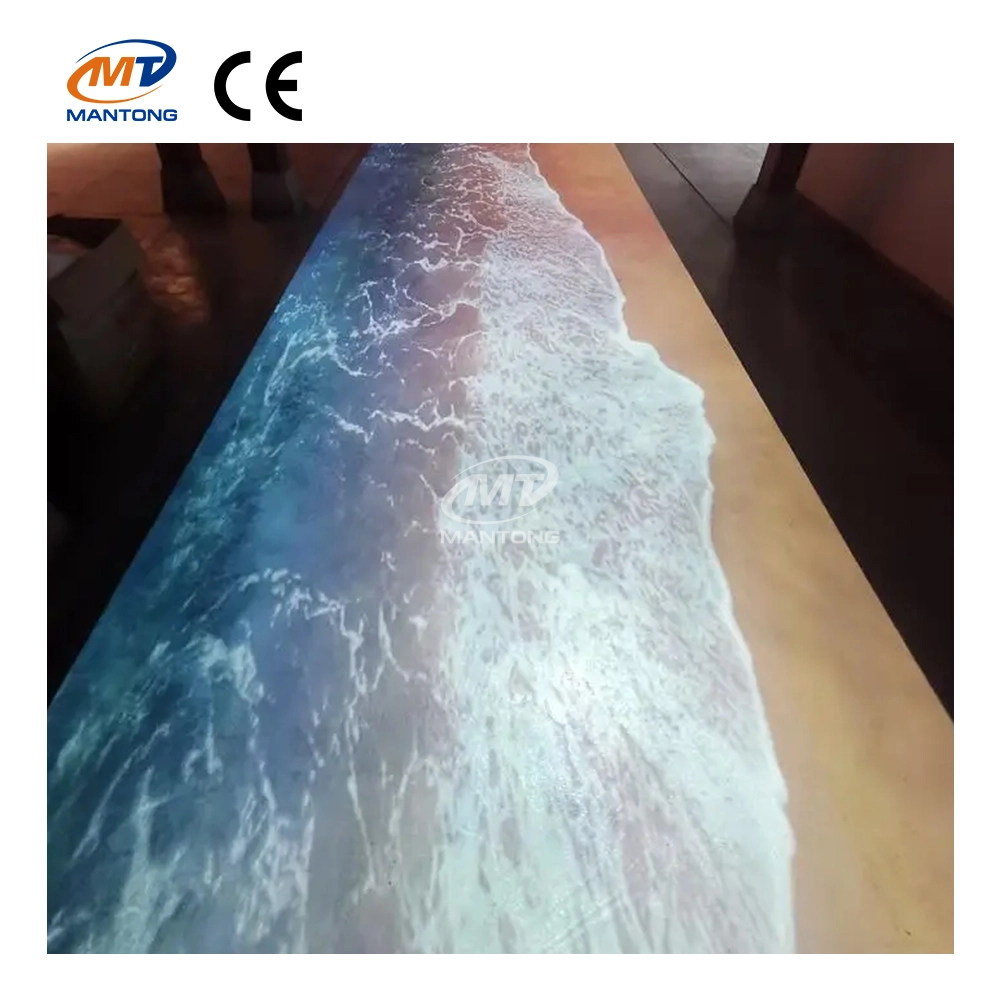
Indoor Interactive Floor Projector System - Customized Design & Installation Support
Indoor interactive floor projections display dynamic themed videos on the floor, commonly used in venues aiming to enhance brand influence or attract foot traffic, such as restaurants, hotel corridors, and brand car retail stores.
By using projectors and compatible software, the interactive content is projected onto the floor, encouraging engagement between people and the projected visuals. A single 5500-lumen indoor floor projector can cover an area of 5 m × 3 m. Typically, each project will use at least 3 units to ensure broad coverage and optimal visual effects.
We also offer customized design and installation support to enhance the interactive experience for your venue.
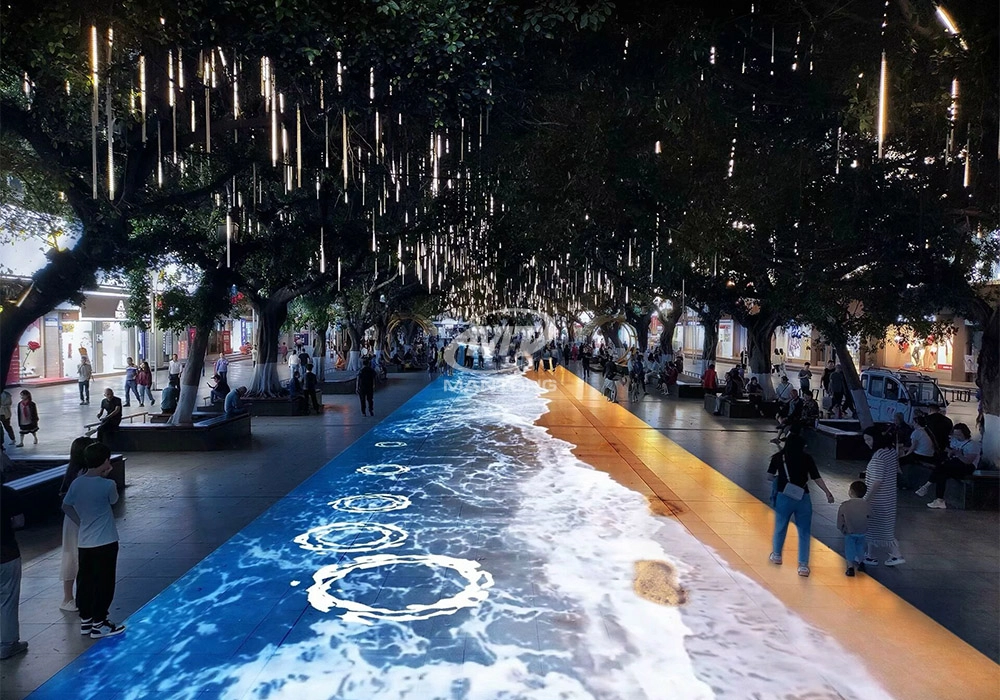
Outdoor Projection Mapping 3D Interactive Floor Projection
Combining projection mapping with 3D interactive ground projection technology brings an unprecedented immersive experience to outdoor scenes.
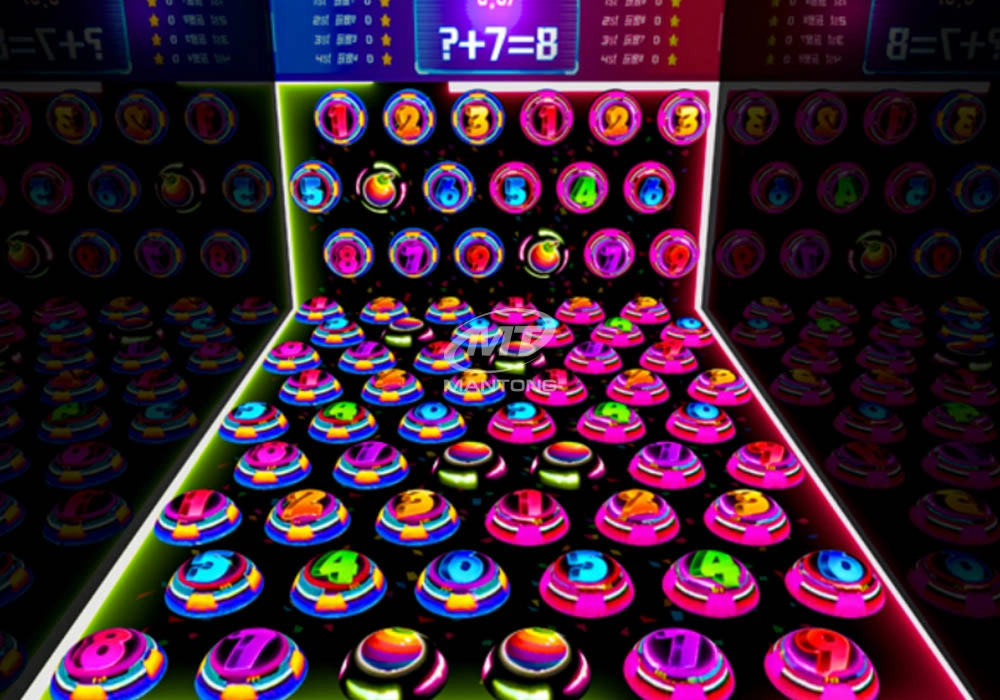
Amusement Rapidly Rotating Bouncing Sphere Interactive Wall Floor Projection Sports Games
Rapidly Rotating Bouncing Sphere is an interactive space where participants jump on rotating spheres. As they step on it, the spheres surface will show special interactivity
Jumping on spheres of the same color in succession causes them to pop, releasing light particles. The more consecutive jumps, the greater the reward—caterpillars appear, and eventually, all spheres of that color burst, filling the space with light and even more caterpillars.
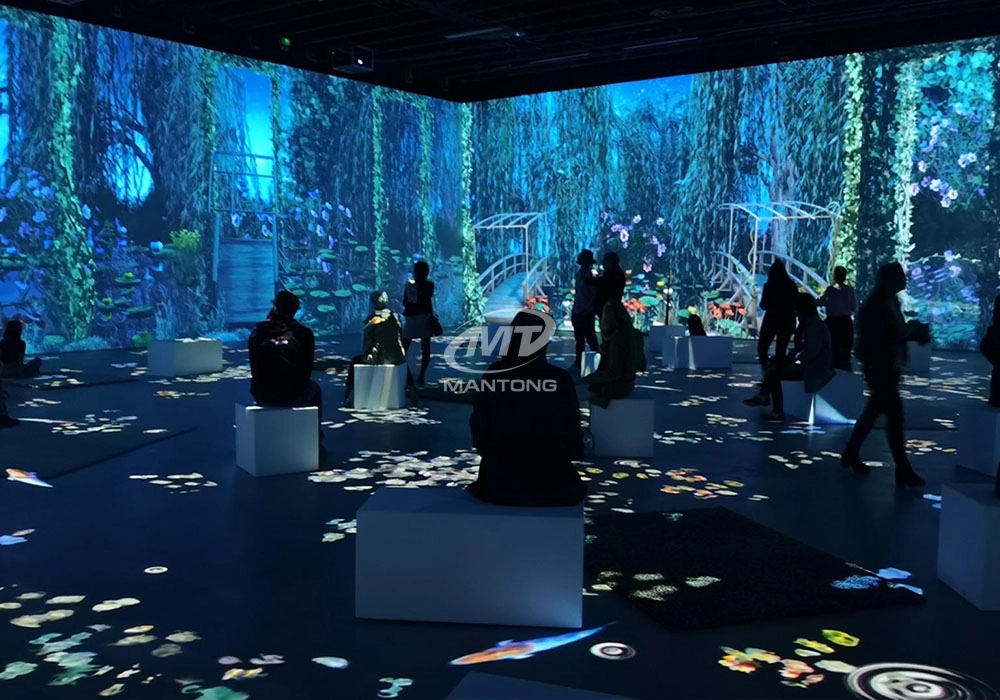
Mantong 6500LM High-Lumen Projector for Large-Scale Immersive Room Projection
Transform any space with Mantong's immersive projection mapping systems. Our high-lumen projectors (up to 6500 LM) and custom software create captivating interactive experiences for floors and walls. Ideal for museums, events, retail, and hospitality. Each kit includes professional ceiling mounting and 80+ pre-loaded video contents and is backed by a 12-month warranty and CE certification. We offer full customization and support to bring your vision to life.

Kaida Business Center, Shixin Road, Panyu District,Guangzhou City, Guangdong Province, China.
ManTong
ManTong
ManTong