
Interactive Projection Wall Use Cases in Museums and Exhibitions
- Transforming Visitor Engagement with Projection Technology
- What is an interactive projector wall and why museums choose it
- interactive projector wall: core components and interaction modes
- interactive projector wall Benefits for Museums and Exhibitions
- interactive projector wall: practical use cases by gallery type
- interactive projector wall for permanent galleries: contextual layers and storytelling
- interactive projector wall in temporary exhibitions and traveling shows
- interactive projector wall for educational zones and interactive learning
- interactive projector wall for immersive rooms and projection mapping
- interactive projector wall vs LED screens — cost, flexibility, and maintenance
- interactive projector wall for accessibility, wayfinding, and universal design
- interactive projector wall technical considerations and ROI
- interactive projector wall project timeline (typical)
- interactive projector wall: Mantong Digital — turnkey solutions and manufacturing strengths
- interactive projector wall security, safety and conservation considerations
- interactive projector wall deployment checklist
- interactive projector wall FAQ
- 1. What are the typical costs for installing an interactive projector wall in a museum?
- 2. How durable are projection installations for high-traffic museum spaces?
- 3. Can interactive projector walls work in bright galleries?
- 4. How do we measure whether an interactive projector wall increased visitor engagement?
- 5. Is projection mapping safe for conserved artifacts?
- 6. How scalable are interactive projector walls for traveling exhibitions?
- Contact and next steps — request a consultation or product demo
- References and further reading
Transforming Visitor Engagement with Projection Technology
What is an interactive projector wall and why museums choose it
An interactive projector wall is a large-scale surface—often a museum wall, partition, or freestanding panel—augmented by projection and interactive systems (infrared sensors, cameras, depth sensors, or touch overlays) to respond to visitor motion, touch, or device input. Museums and exhibitions select interactive projector walls because they combine high visual impact, flexible content updates, spatial immersion, and relatively low hardware footprint compared with LED arrays or leaded glass installations. The technology supports storytelling at scale: overlay historical imagery, augment real objects with contextual layers, or let visitors manipulate virtual artifacts using gestures.
interactive projector wall: core components and interaction modes
Typical systems include a high-lumen projector (short-throw or ultra-short-throw to minimize shadows and hot-spotting), a media server or dedicated mini-PC, interactive middleware (tracking and content engine), and a sensing layer (camera, depth sensor, LIDAR, or infrared). Interaction modes commonly used in museums:
- Gesture-based interaction (visitor moves hands or body)
- Floor-anchored projection with proximity/pressure sensors
- Touch-enabled painted or glass surfaces with touch overlay
- Mobile-device pairing via QR codes or web apps
- Multi-user games and collaborative tasks
interactive projector wall Benefits for Museums and Exhibitions
Interactive projector walls deliver measurable benefits across visitor experience, accessibility, operations, and marketing.
- Engagement: Studies in museum learning (constructivist frameworks) show active learning increases retention and visitor satisfaction compared with passive displays.1
- Flexibility: Content can be changed quickly for rotating exhibitions or seasonal events, reducing the need for expensive physical fabrication.
- Accessibility: Projection can enlarge captions, provide audio-visual alternatives, and adapt interfaces for visitors with mobility or visual impairments.
- Cost-efficiency: For large-format, content-driven installations an interactive projector wall can be less expensive than custom LED walls or glass-integrated touch surfaces.
interactive projector wall: practical use cases by gallery type
Below are high-value use cases where interactive projector walls are already proving effective in museums and exhibitions.
interactive projector wall for permanent galleries: contextual layers and storytelling
Permanent galleries benefit from projection walls that overlay contextual information directly onto exhibited artifacts or architectural surfaces. Examples include:
- Historical context overlays: When positioned adjacent to original artifacts, the wall can show the artifact in-situ (e.g., reconstructed room scenes) or display conservation timelines.
- Layered narratives: Allow visitors to toggle between different historical perspectives (social, economic, artistic) with simple gestures.
- Multi-language localization: Instantly switch caption and narration languages depending on visitor selection.
Operational advice: Use calibrated short-throw projectors and carefully controlled ambient lighting. Schedule content changes through a content management system (CMS) so curators can update narratives without vendor intervention.
interactive projector wall in temporary exhibitions and traveling shows
Temporary exhibitions often face time and budget constraints. Interactive projector walls provide rapid, non-invasive installations that can be packed or re-mounted in different venues. Benefits include:
- Speed of deployment: Projector mounts and sensor rigs can be standardized into road cases for touring.
- Modularity: Content packages can be swapped to reflect different local partner needs.
- Reduced freight weight: Compared to LED walls, projection setups are lighter when using compact projectors and rollable screen surfaces.
interactive projector wall for educational zones and interactive learning
Education-focused zones in museums leverage interactive projector walls for guided learning modules, quizzes, and discovery games. Typical formats:
- Guided discovery paths where projection responds as a group moves from panel to panel.
- Interactive timelines where students drag or gesture to reveal cause-and-effect relationships.
- Collaborative challenges where groups solve puzzles projected across a multi-panel wall.
Design tip: Pair projected interaction with low-stakes game mechanics—timed challenges, badges, or digital postcards—to increase repeat engagement among school groups.
interactive projector wall for immersive rooms and projection mapping
Projection mapping can transform full rooms into immersive environments. When the walls themselves are interactive projector walls, museums enable both immersion and agency for visitors. Use cases:
- Environmental reconstructions (e.g., ancient marketplaces, natural habitats) where visitors can affect elements by movement.
- 360° storytelling that changes perspective as visitors navigate the room.
- Mixed-media shows combining lighting, projection, and physical set pieces for evening events or special programs.
interactive projector wall vs LED screens — cost, flexibility, and maintenance
Choosing between projection and LED requires evaluation of cost, ambient light conditions, maintenance, and content strategy. The following table summarizes typical considerations.
| Factor | Interactive Projector Wall | LED Wall |
|---|---|---|
| Initial hardware cost (large area) | Lower to moderate | High |
| Installation complexity | Medium (mounts, calibration) | High (rigging, power, pixel mapping) |
| Ambient light sensitivity | Requires controlled lighting for best contrast | Performs well in bright environments |
| Surface versatility | Can use curved, textured, or architectural surfaces | Usually flat panels; custom shapes cost more |
| Maintenance | Projector lamp/laser module and optical alignment | Module replacement; longer lifetime but higher repair cost |
| Content flexibility | Very high (mapping to any surface) | High (fixed pixel grid) |
interactive projector wall for accessibility, wayfinding, and universal design
Interactive projector walls help museums meet accessibility goals by providing multimodal information. Examples:
- High-contrast projected text and large-font options for low-vision visitors.
- Audio descriptions triggered by proximity or a personal device pairing.
- Interactive wayfinding that projects step-by-step floor paths and dwell-time estimates for visitors with mobility needs.
Best practice: Include non-visual interactions (audio, haptic feedback via paired devices) and ensure projected content does not rely solely on color.
interactive projector wall technical considerations and ROI
Implementing interactive projector walls requires planning across technology, content, safety, and evaluation metrics. Key steps to ensure return on investment (ROI):
- Define success metrics: dwell time, repeat visits, membership conversion, education program sign-ups.
- Choose the right projector class: laser light sources for long life and stable brightness; consider 4K mapping for fine detail.
- Design for maintainability: easy access mounts, redundant media players, and remote monitoring of projector health.
- Measure impact: use anonymized sensors to capture dwell time and heatmaps and compare with pre-install baselines.
interactive projector wall project timeline (typical)
A typical mid-size gallery install timeline:
- Weeks 0–4: Concept, stakeholder workshops, content storyboard.
- Weeks 4–8: Technical design and prototyping (small mock-up).
- Weeks 8–12: Content production and integration testing.
- Weeks 12–16: On-site installation, calibration, user testing.
- Week 16+: Launch and iterative tuning.
interactive projector wall: Mantong Digital — turnkey solutions and manufacturing strengths
Mantong Digital is a one-stop interactive projection solution provider and direct manufacturer based in Guangzhou, China, with over 10 years of industry experience. We are dedicated to providing innovative, flexible and cost-effective projection solutions, offering both hardware and software to meet various needs. At ManTong, we specialize in providing customized solutions for a wide range of application scenarios through innovative projection technology. Whether it's immersive experiences, interactive entertainment or outdoor lighting and projection shows, our solutions can transform your ideas into stunning visual effects. Our projection technology provides customized solutions for a variety of scenarios, delivering immersive and interactive visual experiences.
We are now looking for business partnerships worldwide. Our vision is to become the world's leading interactive projection manufacturer. Our website is https://www.mtprojection.com/.
Mantong advantages and product highlights (summary):
- Direct manufacturing: full control of hardware quality and lead times.
- End-to-end service: hardware, bespoke software, content tools, and installation support.
- Proven product range: immersive projection, interactive floor projection, interactive projection, interactive wall projection, immersive room, 3D projection, interactive projection games, projection shows, and interactive projection mapping.
- Customization capability: tailored optics, sensor integration, and CMS workflows for museum requirements.
- Cost competitiveness: volume manufacturing and modular designs reduce total project cost.
Why partner with a specialist vendor like Mantong? Choosing a vendor with deep vertical experience shortens procurement cycles, reduces risk in touring scenarios, and provides robust post-installation support — factors that directly affect a museum’s ability to deliver reliable public programming and measurable audience impact.
interactive projector wall security, safety and conservation considerations
Museum projects must balance interactivity with artifact preservation. Key considerations:
- Light exposure: Use projector brightness and spectrum control to limit UV/IR exposure to sensitive materials. Laser projectors with appropriate filters can reduce harmful output compared with legacy lamps.
- Visitor flow: Design interactive zones to avoid crowding near fragile exhibits.
- Physical barriers and non-contact interactions: Prefer gesture and depth sensing to direct contact on or near artifacts.
interactive projector wall deployment checklist
Quick checklist for museums planning an interactive projector wall:
- Define audience needs and learning objectives
- Set measurable KPIs (dwell time, conversions)
- Pick hardware class (laser projector, short-throw optics)
- Design for accessibility and ADA compliance
- Plan for content lifecycle and CMS workflows
- Include maintenance, spare parts, and remote monitoring
interactive projector wall FAQ
Below are frequently asked questions museum professionals search for when evaluating interactive projector walls.
1. What are the typical costs for installing an interactive projector wall in a museum?
Costs vary by size, resolution, and interactivity level. For a medium gallery (6–10 m wall) expect hardware, sensors, and installation to range from roughly $15,000 to $75,000 USD depending on projector class and control systems. Custom content production and CMS integration are additional. Mantong Digital offers tailored quotes and scalable packages to fit budgets and touring needs.
2. How durable are projection installations for high-traffic museum spaces?
When specified with rugged mounts, laser light sources (longer lifespan), and remote monitoring, projector installations can achieve dependable uptime. Expect lower day-to-day wear than touch screens because many projection interactions are contactless. Regular preventative maintenance (cleaning optics, firmware updates) is recommended.
3. Can interactive projector walls work in bright galleries?
Projection performs best in controlled lighting. For bright environments, options include: increasing projector lumen output, using high-gain screen materials, or combining projection with LED accents. In some cases, hybrid solutions (LED for bright zones and projection for textured surfaces) provide the best outcome.
4. How do we measure whether an interactive projector wall increased visitor engagement?
Use a combination of automated metrics (dwell time from anonymous sensors, interaction counts) and qualitative data (visitor surveys, educator feedback). Compare baseline data before installation to post-install metrics. KPIs like increased average dwell time, program sign-ups, or membership conversions are common success indicators.
5. Is projection mapping safe for conserved artifacts?
Yes—if designed with conservation in mind. Limit overall light exposure (lux hours), avoid direct projection onto highly light-sensitive materials, and consult conservation staff. Many projection projects use indirect projection or adjacent projected interpretation to keep artifacts safe.
6. How scalable are interactive projector walls for traveling exhibitions?
Highly scalable if systems are designed modularly with road cases, standardized mounts, and pre-configured content packages. Mantong Digital has experience delivering touring-ready kits that reduce re-installation time and ensure consistent visual quality across venues.
Contact and next steps — request a consultation or product demo
If you are planning a new exhibit or retrofitting a gallery, contact Mantong Digital for a consultation, live demo, or project quote. Visit https://www.mtprojection.com/ to view product lines and request custom proposals. Our team can provide site surveys, proof-of-concept builds, and partnership options for museums worldwide.
References and further reading
- International Council of Museums (ICOM) — https://icom.museum/ (accessed 2025-12-20)
- American Alliance of Museums (AAM) — https://www.aam-us.org/ (accessed 2025-12-20)
- Projection mapping — Wikipedia — https://en.wikipedia.org/wiki/Projection_mapping (accessed 2025-12-18)
- Statista — Museums topic overview — https://www.statista.com/topics/1116/museums/ (accessed 2025-12-19)
- Falk, J.H. & Dierking, L.D., Learning from Museums: Visitor Experiences and the Making of Meaning — (research on museum learning frameworks) — summary: https://en.wikipedia.org/wiki/John_H._Falk (accessed 2025-12-18)
- Mantong Digital official site — https://www.mtprojection.com/ (accessed 2025-12-20)
The latest trends for interactive projection wall games
Best Top Benefits of Implementing an Immersive Meeting Room in Your Office manufacturers and supplier brands
Where to Buy immersive projection system
How to Choose the immersive conference room manufacturer and supplier in China?
One-Stop Projection Solution Provider Since 2011
What information do you need to know before making the proposal/solution?
We know that everyone wants to know the price, but the price of our products is determined by many factors since most of our products are custom, so no ready price list. In order to fast understand what you need, can you send us an inquiry like this?
For example: I am really interested in your immersive projection products, we are a company in the USA and want to install some in my restaurant. It is about 50 meters long, and 5m in width. Projection size you can decide but the length should be not less than 20 meters. We want some content about SeaWorld because our place is all about the sea. Thank you.
Are you trader or manufacturer ?
We are direct manufacturer who specialize in providing one-stop solution for different outdoor & indoor projection project with our stable software and qualified projectors
How to Write an Interactive-Effect Video Customisation Script ?
① Project Background: Briefly introduce the context in which this interactive scene will be used (e.g., exhibition, museum,
event space, children's area). Example: This scene is part of the “Underwater World” zone in a children's science museum,
designed to be engaging and exploratory.
②Visual Style / Atmosphere: What kind of visual mood are you aiming for? Please describe the color scheme, style, and any
references. it should focus solely on describing the visual aspects of the scene, supported by relevant charts or reference
images.
③ Interaction Points Overview:List each interactive hotspot along with the effect you'd like to trigger when the user
touches or clicks the area. example: when player touch the clownfish, it will swims away with bubble trail (animation effect)
and produce the bubble sound ( sound effect requirement )
④ Static Visual Reference:including but not limited to background image/video, a list of major visual elements (e.g., coral,
rocks, seaweed, fish), which elements should be interactive?
What's the application of Immersive projection ?
It can be used in various venues, such as art exhibition, entertainment venues, educational institution, Wedding hall /Banquet/Bar,Yoga Studio and so on. It often involves advanced projection techniques, multimedia content, and interactive elements to engage and captivate the audience's senses.
What about the wall/floor material for the projection?
It’s recommended to choose a light-colored material with minimal reflectivity—pure white or light grey works best. the
common material is cement & plaster board
For optimal projection results, the surface should be free of any patterns or textures, as the projector will display content
directly onto it.
There are no specific material requirements; you may use any commonly available material in your local market, as long as it
meets the above conditions.
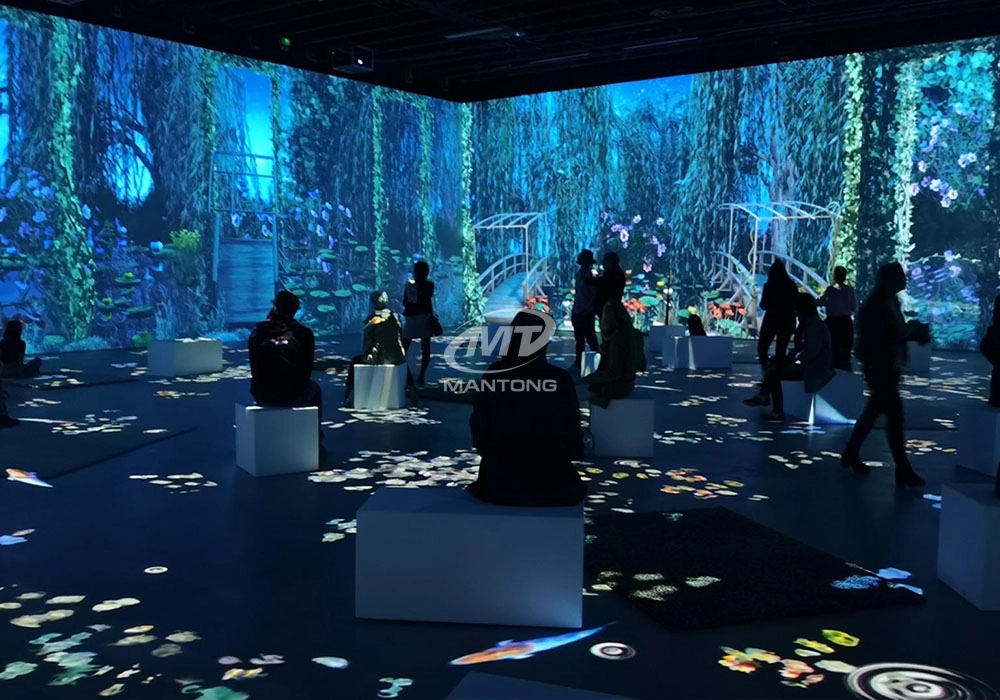
Mantong 6500LM High-Lumen Projector for Large-Scale Immersive Room Projection
Transform any space with Mantong's immersive projection mapping systems. Our high-lumen projectors (up to 6500 LM) and custom software create captivating interactive experiences for floors and walls. Ideal for museums, events, retail, and hospitality. Each kit includes professional ceiling mounting and 80+ pre-loaded video contents and is backed by a 12-month warranty and CE certification. We offer full customization and support to bring your vision to life.
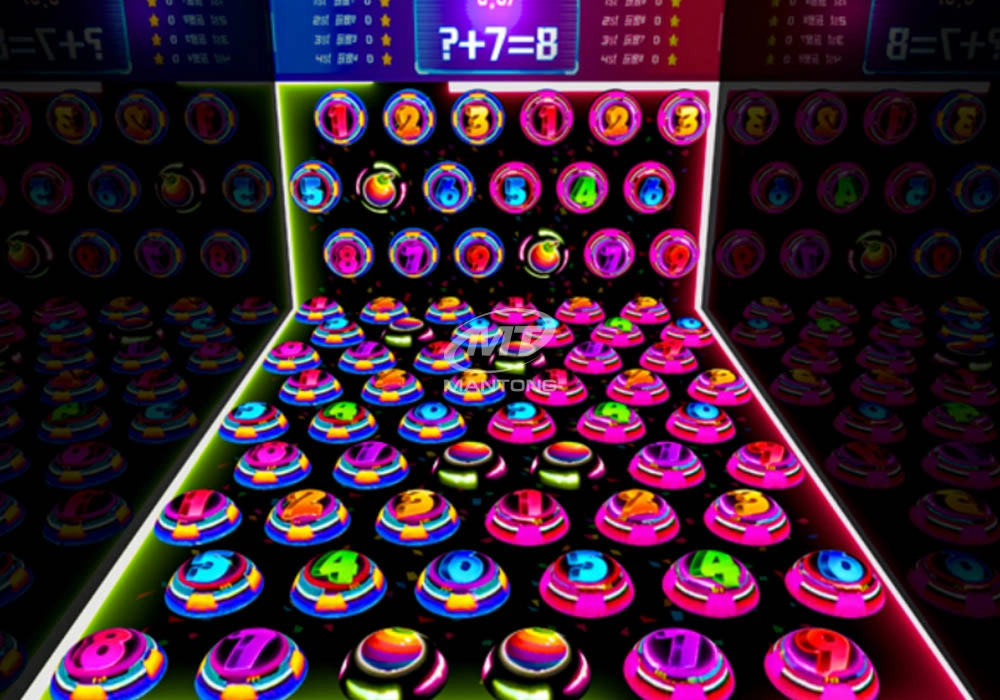
Amusement Rapidly Rotating Bouncing Sphere Interactive Wall Floor Projection Sports Games
Rapidly Rotating Bouncing Sphere is an interactive space where participants jump on rotating spheres. As they step on it, the spheres surface will show special interactivity
Jumping on spheres of the same color in succession causes them to pop, releasing light particles. The more consecutive jumps, the greater the reward—caterpillars appear, and eventually, all spheres of that color burst, filling the space with light and even more caterpillars.
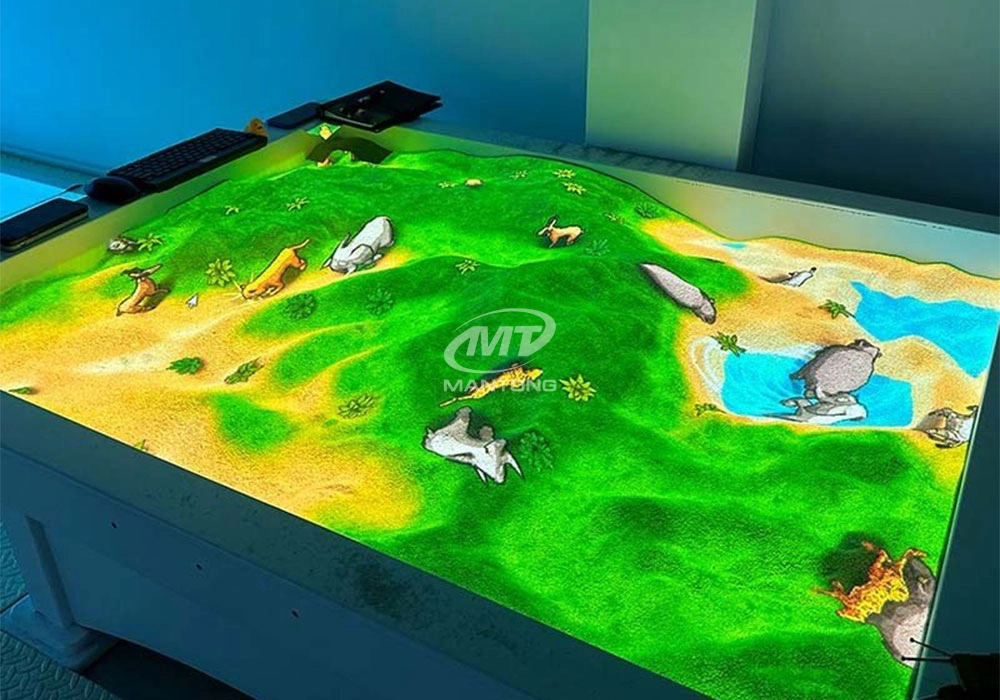
Interactive Sandbox Projection Mapping Games For Kids Play Park
Bring imagination to life with interactive sandbox projection mapping games designed for kids’ play parks. Using cutting-edge projection technology and real-time motion sensing, children can dig, build, and explore virtual worlds directly in the sand. Educational, engaging, and endlessly fun — it’s the perfect blend of play and learning.
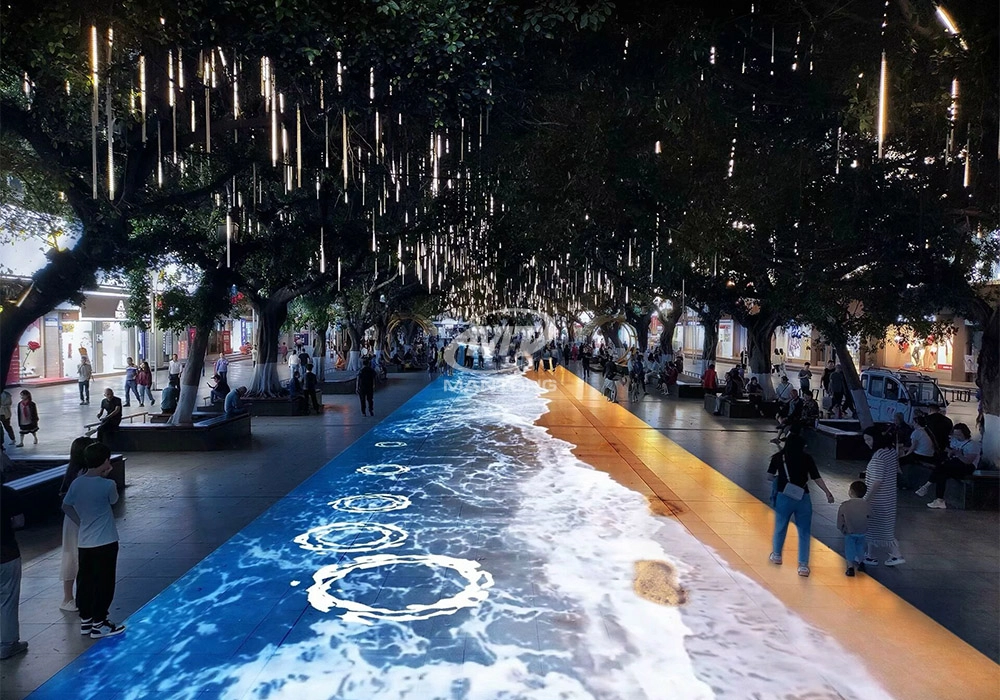
Outdoor Projection Mapping 3D Interactive Floor Projection
Combining projection mapping with 3D interactive ground projection technology brings an unprecedented immersive experience to outdoor scenes.

Kaida Business Center, Shixin Road, Panyu District,Guangzhou City, Guangdong Province, China.
ManTong
ManTong
ManTong