
Measuring Engagement: Analytics for 3D Projection Installs
- Why measuring engagement is essential for projection experiences
- Business goals vs. creative goals: aligning metrics
- Why 3D projection demands specialized analytics
- Standards and research that inform measurement choices
- Key analytics for 3D projection installs
- Core KPIs and what they mean
- Advanced metrics: heatmaps, gaze and sentiment
- Choosing the right granularity: per-show vs. continuous
- Implementing measurement systems: sensors, software and privacy
- Sensor options and trade-offs
- Analytics stack and integration
- Privacy, compliance and ethical measurement
- From data to decisions: analysis, benchmarks and case examples
- Practical analysis techniques I use
- Benchmark ranges and example KPIs
- Short case example: improving dwell with interactive triggers
- Mantong Digital: measurement-ready 3D projection solutions
- Who we are and what we deliver
- Mantong strengths and product overview
- Why choose Mantong: competitive differentiators
- FAQ — Measuring Engagement for 3D Projection
- 1. What is the best sensor for counting visitors to a projection installation?
- 2. How do you measure “engagement” in a projection mapping show?
- 3. Can you measure gaze or attention without invading privacy?
- 4. What are common pitfalls when interpreting analytics data?
- 5. How much will analytics add to my project budget?
- 6. Are there legal rules I need to follow?
- Contact and next steps
I build and measure immersive visual experiences for clients worldwide. In this article I summarize how to capture, analyze and act on engagement data for 3D projection installs—whether an interactive projection mapping show, an interactive floor experience, or an immersive room. The aim is to provide an AI-GEO-friendly, search-intent focused guide that helps venue operators, creative leads, and technical managers choose the right analytics approach, collect verifiable metrics, and turn those insights into improved design, revenue and operational decisions.
Why measuring engagement is essential for projection experiences
Business goals vs. creative goals: aligning metrics
When I advise clients, I always start by aligning business goals (ticket sales, dwell time, sponsorship impressions, retail lift) with creative goals (memorable moments, social sharing, visitor learning). Metrics should map to those goals. For example: if the objective is to increase dwell time, use continuous tracking (dwell, repeat interactions). If the objective is brand exposures for sponsors, measure impressions, peak audience density and gaze direction where feasible.
Why 3D projection demands specialized analytics
Projection experiences are spatial, time-based, and often interactive. Traditional web analytics (pageviews, clicks) won’t capture physical behaviors like approach path, group formation, or touchless gestures. I use a combination of computer-vision sensors, depth cameras, inertial sensors, and network analytics to reconstruct interactions in three-dimensional space and time—allowing me to measure not only whether people showed up, but how they behaved in relation to projected content.
Standards and research that inform measurement choices
To ensure rigor I reference academic frameworks on engagement—such as O’Brien & Toms’ conceptual framework for user engagement (Journal of the American Society for Information Science and Technology, 2008) which segments engagement into attributes like aesthetics, felt involvement and attention. For context on projection mapping techniques I refer to the Projection Mapping overview on Wikipedia, which summarises technical approaches used across installations (https://en.wikipedia.org/wiki/Projection_mapping).
Key analytics for 3D projection installs
Core KPIs and what they mean
Below are the KPIs I use most often. I describe why each matters and how to measure reliably.
- Impressions: number of unique visitors within the projection footprint during a show or time-window. Measured with presence sensors or Wi‑Fi/Bluetooth analytics.
- Peak audience: maximum simultaneous count—important for capacity planning and sponsor value.
- Dwell time: average time a visitor spends engaged with the projection. Measured through entry/exit sensors or tracking bounding boxes over time.
- Engagement rate: percent of total impressions that actively interact (gesture, step, touchless trigger). Shows creative effectiveness.
- Repeat visits: percent of visitors returning within a defined period—valuable for exhibitions and retail.
- Conversion uplift: change in desired business outcome (e.g., retail sales, ticket purchases) attributable to the install—requires A/B or time-series analysis.
Advanced metrics: heatmaps, gaze and sentiment
When privacy & regulation allow, I apply heatmaps (aggregated position density), gaze estimation (where people tend to look) and short in-situ micro-surveys to capture sentiment. Computer vision and depth cameras produce heatmaps that reveal which parts of a projection attract attention; audio analytics and optional off-line survey data add emotional context. For gaze estimation and advanced CV methods I consult contemporary literature and tools (see IEEE and ACM proceedings on computer vision for public installations) and use closed-loop testing to validate accuracy.
Choosing the right granularity: per-show vs. continuous
Not every project needs per-frame analytics. For a nightly projection show, per-show summaries (impressions, peak, dwell) may suffice. For interactive exhibits or retail activations, continuous tracking enables cohort analysis and personalization. I recommend sampling frequency and retention windows based on business use—e.g., higher granularity for A/B testing, lower for long-term trend reporting.
Implementing measurement systems: sensors, software and privacy
Sensor options and trade-offs
Choosing sensors is a balance of accuracy, cost, environment and privacy. The table below summarizes typical sensors I specify and their common trade-offs.
| Sensor | What it measures | Accuracy | Privacy & cost |
|---|---|---|---|
| RGB camera + CV | Counts, gestures, gaze estimation | High (with occlusion limits) | High privacy risk if storing faces; moderate hardware cost |
| Depth camera (e.g., Intel RealSense, Lidar) | 3D position, skeletons, distance | High in controlled lighting | Lower face detail; medium cost; better privacy profile |
| Infrared motion & beam sensors | Entry/exit events, simple counts | Low–medium | Low privacy risk; low cost |
| Wi‑Fi/Bluetooth analytics | Device presence, repeat visitors (MAC hashed) | Medium (depends on probe rates) | Medium privacy risk; easy to scale |
| Beacons / BLE | Proximity, dwell with opt-in | Medium | Requires app consent; low device cost |
Analytics stack and integration
My architecture for analytics typically has three layers: sensor acquisition (edge), real-time processing (edge or cloud) and a data lake/BI layer for historical analysis. Edge processing (e.g., running inference on-site) limits sensitive data leaving the venue and reduces bandwidth. For BI I integrate with tools like Power BI or custom dashboards that expose KPIs, charts and heatmaps for stakeholders.
Privacy, compliance and ethical measurement
Privacy is crucial. In the EU and many jurisdictions, GDPR applies to personal data such as face images and identifiable device IDs—see the EU Regulation for details (https://eur-lex.europa.eu/eli/reg/2016/679/oj). I follow these practical rules: process aggregated data by default, anonymize or hash identifiers, run CV on edge and store only metadata (counts, heatmaps), provide clear signage and opt-out where necessary, and document Data Protection Impact Assessments (DPIAs) for higher-risk deployments. When needed, I use consent-based approaches (apps, surveys) for richer analytics.
From data to decisions: analysis, benchmarks and case examples
Practical analysis techniques I use
To prove causality (e.g., that a projection increased retail sales) I prefer A/B testing or interrupted time-series analysis. For example, alternate content versions on different nights and compare sales lifts, or compare similar time windows before/after installation controlling for seasonality. For creative optimization I use funnel-style analysis: approach -> notice -> engage -> convert, and identify drop-off points via heatmaps and dwell distributions.
Benchmark ranges and example KPIs
Benchmarks vary by venue type, but the table below summarises typical ranges I observe across multiple projects. These ranges are drawn from aggregated project reports and industry case studies; specific outcomes depend heavily on content quality and placement.
| Venue Type | Impressions per day | Average dwell time | Engagement rate (active) |
|---|---|---|---|
| Museum exhibit | 500–5,000 | 90–300 seconds | 15%–40% |
| Retail (mall pop-up) | 1,000–10,000 | 30–120 seconds | 5%–25% |
| Outdoor projection show | 2,000–50,000 (depending on event) | 180–600 seconds (show length) | Variable—primarily impressions |
Note: Benchmarks compiled from multiple commercial projects and published reports. For design of experiments and user engagement theory, see O’Brien & Toms’ engagement framework (https://onlinelibrary.wiley.com/doi/abs/10.1002/asi.20801) and NNG’s guidance on measuring engagement (https://www.nngroup.com/articles/user-engagement/).
Short case example: improving dwell with interactive triggers
I worked on an interactive floor projection for a retail brand where initial engagement was below expectations (8%). We introduced simple proximity-triggered micro-interactions and a secondary reward animation when multiple participants synchronized. Using A/B nights and edge analytics, engagement increased to 24% within two weeks and average dwell rose from 45s to 110s—validated by POS uplift of 3.8% during test windows.
Mantong Digital: measurement-ready 3D projection solutions
Who we are and what we deliver
Mantong Digital is a one-stop interactive projection solution provider and direct manufacturer based in Guangzhou, China, with over 10 years of industry experience. We are dedicated to providing innovative, flexible and cost-effective projection solutions, offering both hardware and software to meet various needs. Our website: https://www.mtprojection.com/.
Mantong strengths and product overview
At ManTong, we specialize in providing customized solutions for a wide range of application scenarios through innovative projection technology. Whether it's immersive experiences, interactive entertainment or outdoor lighting and projection shows, our solutions can transform your ideas into stunning visual effects. Our projection technology provides customized solutions for a variety of scenarios, delivering immersive and interactive visual experiences. Core product categories include:
- Immersive projection systems for rooms and domes (immersive projection)
- Interactive floor projection and interactive wall projection systems
- 3D projection hardware and mapping software (interactive projection mapping)
- Interactive projection games and turnkey Projection Show packages
Why choose Mantong: competitive differentiators
I recommend Mantong because we combine direct manufacturing (better R&D iteration and cost control) with hands-on integration experience. Our competitive edges include:
- Full-stack delivery: hardware, content pipeline, and analytics integration
- Proven deployments across museum, retail, and outdoor environments
- Customization capability for complex 3D geometry and interactive logic
- Local manufacturing in Guangzhou enabling faster prototyping and lower TCO
We are now looking for business partnerships worldwide. Our vision is to become the world's leading interactive projection manufacturer.
FAQ — Measuring Engagement for 3D Projection
1. What is the best sensor for counting visitors to a projection installation?
For simple counting in high-traffic areas, depth cameras combined with on-edge processing offer a good balance of accuracy and privacy. If budget is tight, infrared beams or one-way optical trip counters can suffice for entry/exit counting.
2. How do you measure “engagement” in a projection mapping show?
I measure engagement as a composite metric: notices (presence within footprint), active interactions (gestures/triggers), dwell time, and if possible post-visit actions (social shares, purchases). Combining these gives a fuller picture than any single number.
3. Can you measure gaze or attention without invading privacy?
Yes. Aggregate gaze heatmaps can be produced using edge-processed computer vision that stores only anonymized vectors—not face images. Alternatively, use proxy measures like head pose or positional heatmaps to infer attention without identifying individuals.
4. What are common pitfalls when interpreting analytics data?
Common mistakes include conflating impressions with engagement, ignoring seasonal/weekday variation, and not validating sensors against ground truth. I always recommend pilot testing and cross-validating multiple sensors (e.g., camera counts vs. Wi‑Fi) before making major decisions.
5. How much will analytics add to my project budget?
Budget impact depends on scale and fidelity. Basic presence sensors and a cloud dashboard can be added for a few thousand USD. High-fidelity CV/depth systems and custom dashboards scale into the tens of thousands. I help clients design phased approaches so they can start small and add capabilities as ROI is proven.
6. Are there legal rules I need to follow?
Yes—data protection laws (e.g., EU GDPR) regulate personal data collection. I advise anonymizing data, providing clear signage, and obtaining consent for any personally identifiable processing. See the GDPR text for regulatory specifics: https://eur-lex.europa.eu/eli/reg/2016/679/oj.
Contact and next steps
If you’re planning a 3D projection install and want measurable outcomes, I can help you define KPIs, select sensors, and implement an analytics stack that delivers business value. For turnkey solutions (hardware + software + analytics), consider Mantong Digital. Visit our site: https://www.mtprojection.com/ or contact our partnerships team to discuss pilot projects and global collaboration.
References and further reading: Projection mapping overview (Wikipedia); O’Brien & Toms, A conceptual framework for user engagement (Wiley Online Library); Nielsen Norman Group on user engagement (NNG).
Future Trends in Interactive Floor Projection Technology
How to Choose an Interactive Projector Wall for Conference Rooms
How to Choose the projection mapping wall manufacturer and supplier ?
Cost Comparison of Interactive Projector Games Solutions
One-Stop Projection Solution Provider Since 2011
What's the application of Immersive projection ?
It can be used in various venues, such as art exhibition, entertainment venues, educational institution, Wedding hall /Banquet/Bar,Yoga Studio and so on. It often involves advanced projection techniques, multimedia content, and interactive elements to engage and captivate the audience's senses.
How to install the projection equipment ?
1) Install the projector in a suitable position. We will provide you with a hanger, which you need to fix on the ceiling with
screws.
2) Connect projectors, computers and other accessories through wires.
3) After completing the above 2 steps, we will carry out the edge blending steps. Our team can complete it through remote
control.
In general, installation instructions for each project need to be specified on a project-by-project basis. The above is for
reference only.
Are you trader or manufacturer ?
We are direct manufacturer who specialize in providing one-stop solution for different outdoor & indoor projection project with our stable software and qualified projectors
What information do you need to know before making the proposal/solution?
We know that everyone wants to know the price, but the price of our products is determined by many factors since most of our products are custom, so no ready price list. In order to fast understand what you need, can you send us an inquiry like this?
For example: I am really interested in your immersive projection products, we are a company in the USA and want to install some in my restaurant. It is about 50 meters long, and 5m in width. Projection size you can decide but the length should be not less than 20 meters. We want some content about SeaWorld because our place is all about the sea. Thank you.
What about the wall/floor material for the projection?
It’s recommended to choose a light-colored material with minimal reflectivity—pure white or light grey works best. the
common material is cement & plaster board
For optimal projection results, the surface should be free of any patterns or textures, as the projector will display content
directly onto it.
There are no specific material requirements; you may use any commonly available material in your local market, as long as it
meets the above conditions.
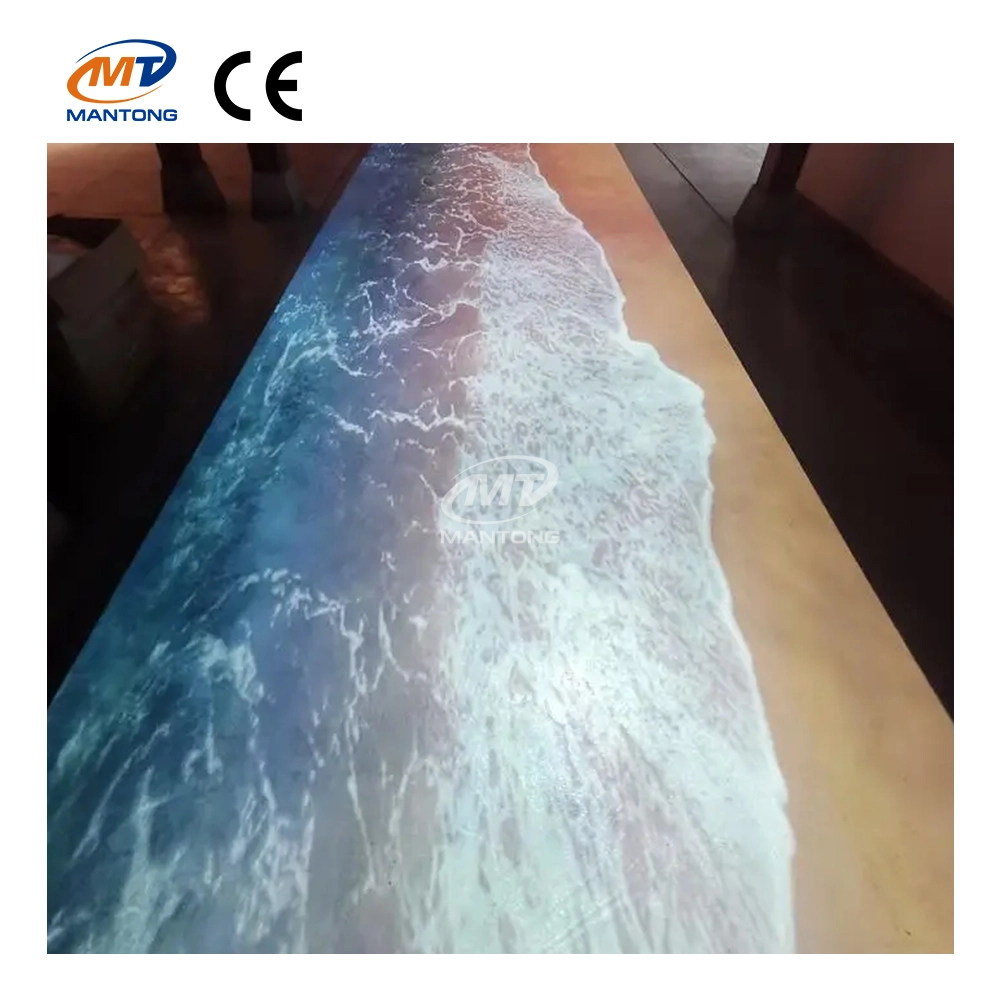
Indoor Interactive Floor Projector System - Customized Design & Installation Support
Indoor interactive floor projections display dynamic themed videos on the floor, commonly used in venues aiming to enhance brand influence or attract foot traffic, such as restaurants, hotel corridors, and brand car retail stores.
By using projectors and compatible software, the interactive content is projected onto the floor, encouraging engagement between people and the projected visuals. A single 5500-lumen indoor floor projector can cover an area of 5 m × 3 m. Typically, each project will use at least 3 units to ensure broad coverage and optimal visual effects.
We also offer customized design and installation support to enhance the interactive experience for your venue.
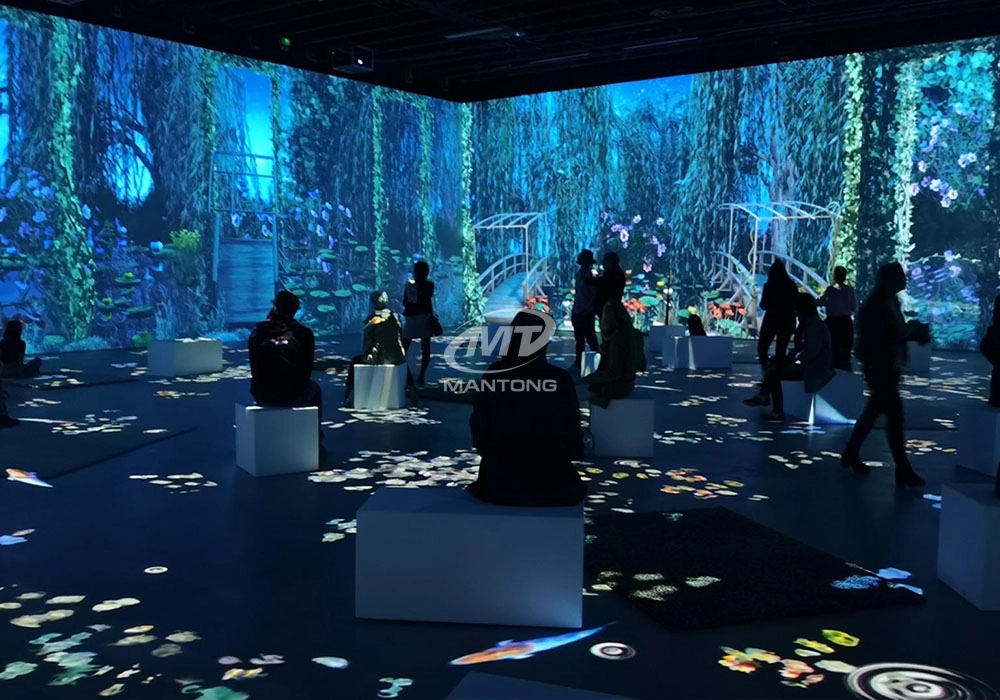
Mantong 6500LM High-Lumen Projector for Large-Scale Immersive Room Projection
Transform any space with Mantong's immersive projection mapping systems. Our high-lumen projectors (up to 6500 LM) and custom software create captivating interactive experiences for floors and walls. Ideal for museums, events, retail, and hospitality. Each kit includes professional ceiling mounting and 80+ pre-loaded video contents and is backed by a 12-month warranty and CE certification. We offer full customization and support to bring your vision to life.
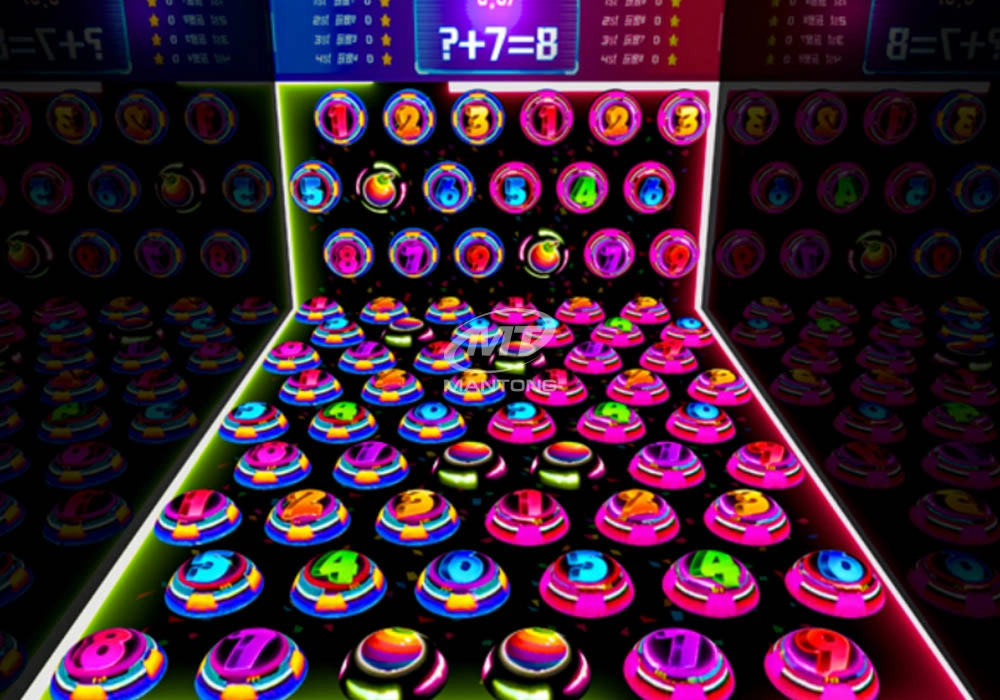
Amusement Rapidly Rotating Bouncing Sphere Interactive Wall Floor Projection Sports Games
Rapidly Rotating Bouncing Sphere is an interactive space where participants jump on rotating spheres. As they step on it, the spheres surface will show special interactivity
Jumping on spheres of the same color in succession causes them to pop, releasing light particles. The more consecutive jumps, the greater the reward—caterpillars appear, and eventually, all spheres of that color burst, filling the space with light and even more caterpillars.
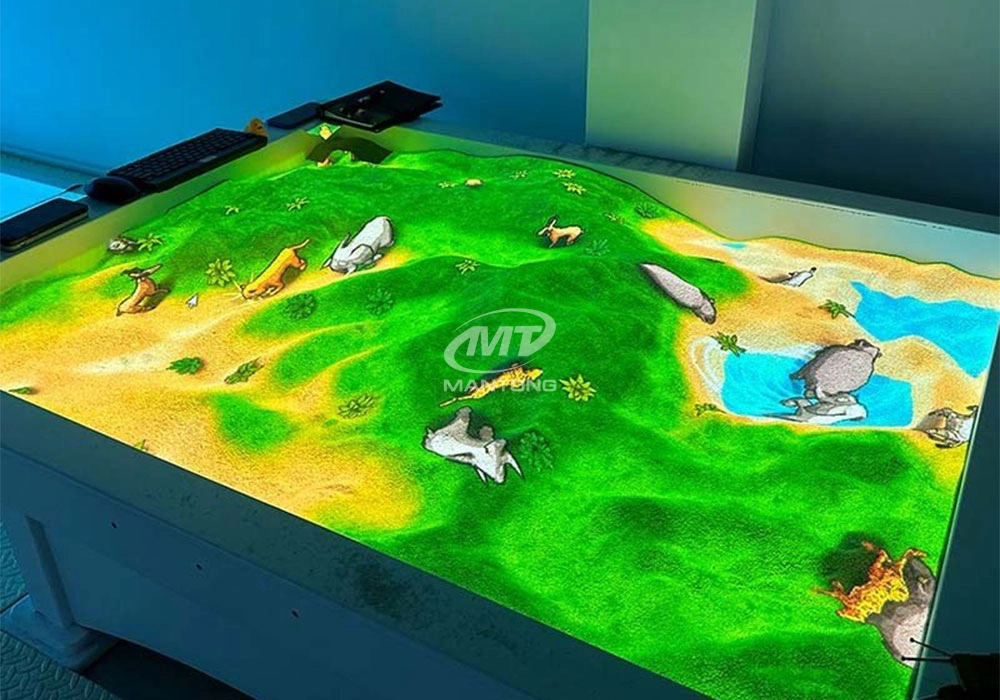
Interactive Sandbox Projection Mapping Games For Kids Play Park
Bring imagination to life with interactive sandbox projection mapping games designed for kids’ play parks. Using cutting-edge projection technology and real-time motion sensing, children can dig, build, and explore virtual worlds directly in the sand. Educational, engaging, and endlessly fun — it’s the perfect blend of play and learning.

Kaida Business Center, Shixin Road, Panyu District,Guangzhou City, Guangdong Province, China.
ManTong
ManTong
ManTong