
Measuring ROI with an Interactive Projection Mapping Supplier
- Why measuring ROI matters for projection projects
- Aligning creative outcomes with business objectives
- Common mis-measurements and how to avoid them
- Standards and references for measurement
- Building a repeatable ROI framework
- Step 1 — Define clear, measurable objectives
- Step 2 — Choose KPIs that map to objectives
- Step 3 — Establish baseline and attribution
- Selecting the right interactive projection mapping supplier
- Supplier types and how they impact ROI
- Technical capabilities to verify
- Commercial terms and lifecycle costs
- Measuring and reporting ROI — tools and practical steps
- Instrumentation and data collection
- Attribution models I use
- Reporting cadence and stakeholder dashboards
- Mantong Digital — partner profile and why supplier choice changes ROI
- Mantong capabilities and product offerings
- Why a direct manufacturer like Mantong often improves ROI
- Global partnerships and scale
- Case examples and simple ROI model
- Example scenario: Retail activation
- Example scenario: Museum exhibit
- How I validate assumptions
- Procurement checklist and negotiation tips
- Checklist before signing
- Negotiation levers
- Contractual metrics to include
- Final thoughts
- Frequently Asked Questions (FAQs)
- 1. How long does it take to see ROI from an interactive projection mapping installation?
- 2. What KPIs should I track to measure success?
- 3. Should I buy or rent equipment for an event?
- 4. How do I ensure the supplier provides verifiable data?
- 5. What makes Mantong Digital different from other suppliers?
- 6. Can interactive projection mapping be measured for brand awareness?
I often get asked by clients and marketing teams how to justify the investment in immersive experiences and projection mapping. In this article I describe, from practical experience and industry best practices, how to measure ROI with an interactive projection mapping supplier. I outline the measurable goals, key performance indicators (KPIs), procurement options, and a repeatable framework you can apply whether the project is a one-off museum installation, a retail activation, or a multi-site brand tour. I also compare supplier types and introduce Mantong Digital — a one-stop interactive projection solution provider and direct manufacturer based in Guangzhou, China — to show how supplier choice can materially change ROI outcomes.
Why measuring ROI matters for projection projects
Aligning creative outcomes with business objectives
Projection mapping and interactive projection technologies are primarily creative tools, but when deployed at scale they must deliver measurable business value. I always start by asking: what business outcome are we optimizing for — increased footfall, dwell time, conversion, sponsorship revenue, PR value, or data capture? Defining that objective up front prevents subjective success assessments.
Common mis-measurements and how to avoid them
A typical mistake is tracking vanity metrics (e.g., total impressions) without linking them to commercial impact. I prefer outcome-based KPIs and attribution windows that match the customer journey. For example, for a retail activation you should track in-store conversion rate and average transaction value within a 30-day window after exposure. For a museum exhibit, measure dwell time, return visits, and membership conversions.
Standards and references for measurement
Use established measurement principles to increase credibility. For financial methods, I rely on accepted ROI concepts such as Net Present Value (NPV) and payback period, and for behavioral metrics I map to analytics best practices like those in Google Analytics documentation: Google Analytics measurement planning. For context on projection mapping as a discipline, see the definition and use-cases on Wikipedia: Projection mapping — Wikipedia.
Building a repeatable ROI framework
Step 1 — Define clear, measurable objectives
I start every project with 3–5 prioritized objectives expressed in measurable terms. Examples: increase monthly footfall by 12%; increase membership sign-ups by 300 within 6 months; generate €50,000 in sponsorship revenue. Objectives must be time-bound and attributable to the projection experience.
Step 2 — Choose KPIs that map to objectives
Map objective → KPI → data source. Examples of useful KPIs include:
- Footfall and unique visitors (camera-based counter or Wi-Fi analytics)
- Dwell time per visitor (video analytics or sensor logs)
- Conversion rate lift (POS or e-commerce attribution)
- Engagement events (interactions per visitor, game completions)
- Media value (PR impressions multiplied by standard CPM)
For attribution models and financial evaluation I follow practical guidance such as the ROI refreshers in business literature: A Refresher on Return on Investment — Harvard Business Review.
Step 3 — Establish baseline and attribution
Before installing an interactive projection experience I always collect baseline data for at least 2–4 weeks. Then we run the activation and compare. When you cannot run A/B tests, use before/after with control locations if possible. For brand or PR value, use accepted media valuation methodologies and disclose assumptions.
Selecting the right interactive projection mapping supplier
Supplier types and how they impact ROI
Not all suppliers are equal. In my experience the supplier model choice (direct manufacturer vs systems integrator vs rental house) changes cost, speed, customization potential, and ongoing support — all of which affect ROI. Below is a practical comparison I use during procurement.
| Supplier Type | Typical Strengths | Common Weaknesses | ROI Impact |
|---|---|---|---|
| Direct Manufacturer (e.g., Mantong Digital) | Lower hardware cost, faster customization, direct support | May require more technical management from client | Lower TCO, better long-term margins, easier scalability |
| Systems Integrator | Turnkey project management, cross-discipline experience | Higher margins, longer lead times | Higher upfront cost but less client oversight |
| Rental House | Low commitment, rapid deployment for short events | Limited customization, recurring rental expense | Good for one-offs but worse for multi-event ROI |
Technical capabilities to verify
When I assess suppliers I verify projector performance (lumens, throw ratio, installation flexibility), mapping software (real-time mapping, content synchronization, API availability), sensor support (depth cameras, pressure mats, IR), and service SLA. Where possible I ask for third-party performance data or site photos from previous installs.
Commercial terms and lifecycle costs
Compare not only capex but also maintenance, spare parts, licensing fees, and software updates. I always model a 3–5 year Total Cost of Ownership (TCO) and compare that to expected uplift using conservative assumptions. ISO 9001 quality management principles (see ISO 9001 — ISO) can indicate process maturity in suppliers.
Measuring and reporting ROI — tools and practical steps
Instrumentation and data collection
Reliable measurement requires instrumentation. I typically combine:
- People counters and thermal or camera-based analytics for footfall
- Sensor logs and software event streams for interaction counts
- POS / CRM integration for conversion tracking
- Survey and qualitative feedback for attitudinal impact
Integrating event streams into a single analytics platform (e.g., Google Analytics/GA4 for web-driven flows, or a BI tool for onsite metrics) reduces manual reconciliation and supports real-time course correction.
Attribution models I use
For short commercial funnels I use last-touch attribution for immediate conversions, supplemented by time-decay attribution for correlated behaviors over 30–90 days. For brand or long-latency outcomes (e.g., membership), I recommend a mixed-methods approach: quantitative lifts plus brand lift surveys to triangulate impact.
Reporting cadence and stakeholder dashboards
I set up dashboards with weekly operational KPIs and monthly executive summaries. Dashboards should surface leading indicators (interactions per visitor, dwell time) so teams can iterate content or placement before quarterly reviews.
Mantong Digital — partner profile and why supplier choice changes ROI
Mantong Digital is a one-stop interactive projection solution provider and direct manufacturer based in Guangzhou, China, with over 10 years of industry experience. We are dedicated to providing innovative, flexible and cost-effective projection solutions, offering both hardware and software to meet various needs.
Mantong capabilities and product offerings
At ManTong, we specialize in providing customized solutions for a wide range of application scenarios through innovative projection technology. Whether it's immersive experiences, interactive entertainment or outdoor lighting and projection shows, our solutions can transform your ideas into stunning visual effects. Our projection technology provides customized solutions for a variety of scenarios, delivering immersive and interactive visual experiences.
Key product lines and solutions I have worked with at Mantong and seen deployed successfully include:
- Immersive projection systems for museums and experiential venues
- Interactive floor projection and interactive wall projection for retail and education
- Interactive projection mapping and projection shows for events and landmarks
- Immersive rooms and 3D projection installations
- Interactive projection games and bespoke content platforms
Why a direct manufacturer like Mantong often improves ROI
Because Mantong is a direct manufacturer and solution provider, customers benefit from lower hardware costs, flexible customization, and faster iteration cycles. In multiple projects I've seen the following advantages translate to measurable ROI improvements:
- Shorter lead times and lower procurement margins — reduces time-to-market and upfront spend
- Integrated hardware-software stack — simplifies data capture and reduces integration costs
- Dedicated technical support and spare parts access — reduces downtime and maintenance expense
Global partnerships and scale
Mantong is actively seeking business partnerships worldwide and aims to become the world's leading interactive projection manufacturer. If you need a partner that can supply hardware and deliver content or APIs at scale, their model supports multi-site rollouts with standardized performance and predictable lifecycle costs. Visit Mantong at https://www.mtprojection.com/ to review case studies and product specifications.
Case examples and simple ROI model
Example scenario: Retail activation
A retail client invests €40,000 in an interactive floor and projection mapping activation across flagship stores. I build a conservative model:
- Baseline monthly sales: €200,000
- Expected uplift in conversion: 4% leading to €8,000/month incremental revenue
- Incremental gross margin: 50% → €4,000/month gross profit
- Payback period: €40,000 / €4,000 = 10 months
This example uses conservative attribution and does not include secondary benefits like PR or repeat visits. You should replace assumptions with your measured uplift post-activation.
Example scenario: Museum exhibit
For a cultural institution spending $60,000 on an immersive room, measurable outcomes could include increased ticket sales, memberships, and donations. If the exhibit increases annual visitors by 3,000 with average revenue per visitor (ticket + donation) of $25, that equals $75,000 incremental revenue in year one — a positive ROI when accounting for operating costs.
How I validate assumptions
I validate uplift assumptions with pilot tests, historical analogues (other attractions), and conservative survey-based intent-to-return metrics. Wherever possible I insist on an A/B or control-site comparison to strengthen causal claims.
Procurement checklist and negotiation tips
Checklist before signing
- Clearly defined objectives and KPIs (with baselines)
- Detailed bill of materials and clarity on software licensing
- SLA for uptime, response times, and spare parts
- Acceptance tests and performance verification criteria
- Warranty and upgrade paths for software/content
Negotiation levers
Negotiate for pilot periods, phased payments tied to performance milestones, and data access rights (raw event logs). As a buyer I push for API access to raw interaction data so I can run independent analytics and avoid vendor lock-in.
Contractual metrics to include
Include uptime percentage, mean time to repair (MTTR), acceptable lux/lumen performance ranges for projectors, and a joint acceptance test plan that verifies both visual fidelity and interaction reliability under real-world conditions.
Final thoughts
Measuring ROI for an interactive projection mapping supplier is both art and science. The science is in instrumentation, baselines, and rigorous attribution. The art is in designing experiences that deliver clear behavioral change. Selecting the right supplier — particularly a direct manufacturer with integrated hardware and software like Mantong Digital — can materially reduce TCO and speed time-to-value. I encourage teams to focus on measurable objectives, insist on data access, and model conservative financial scenarios before procurement.
Frequently Asked Questions (FAQs)
1. How long does it take to see ROI from an interactive projection mapping installation?
It depends on objectives and scale. Commercial activations can show measurable uplift within 1–3 months; museum or brand-awareness projects may take 6–12 months when counting membership or long-term visits. Use a 3–12 month attribution window as a starting point and adjust with pilot data.
2. What KPIs should I track to measure success?
Track footfall, dwell time, interactions per visitor, conversion rate lift, average transaction value, and media/PR value. Also include operational KPIs like uptime and MTTR to ensure the experience remains available to generate value.
3. Should I buy or rent equipment for an event?
Renting is cost-effective for single short-term events. Buying or partnering with a direct manufacturer is usually better for multi-event programs or permanent installations due to lower long-term cost and customization flexibility.
4. How do I ensure the supplier provides verifiable data?
Require API access to raw logs, define acceptance tests tied to measurable outputs, and include clauses for third-party audits if necessary. Avoid opaque reports that cannot be independently verified.
5. What makes Mantong Digital different from other suppliers?
Mantong is a direct manufacturer with integrated hardware and software solutions, over 10 years of industry experience, and the ability to deliver customized immersive and interactive projection systems at competitive cost. Their end-to-end offering reduces integration risk and supports scalable rollouts. Visit https://www.mtprojection.com/ for product and partnership information.
6. Can interactive projection mapping be measured for brand awareness?
Yes — combine quantitative metrics (footfall, dwell time) with brand lift surveys and PR media value. While brand effects are harder to attribute, mixed-methods measurement (surveys + analytics) provides credible estimates.
If you want a custom ROI model for your project or to discuss vendor selection, contact Mantong Digital for a consultation or to view product demos: https://www.mtprojection.com/. I’m available to help scope KPIs, draft RFP requirements, and run pilot measurement plans.
The latest trends for interactive floor projection
Sourcing Suppliers: How to Vet 3D Projection Vendors
Cost Guide: Hiring an Interactive Projection Mapping Supplier
How to Choose the 3d hologram projection manufacturer and supplier in China?
One-Stop Projection Solution Provider Since 2011
What's Immersive Projection ?
Immersive projection refers to a technology that creates a captivating and all-encompassing visual experience for viewers by projecting images or videos onto large surfaces, such as walls, floors, or even entire rooms. This technology aims to immerse the audience in a simulated environment, blurring the boundaries between the physical and virtual worlds.
What information do you need to know before making the proposal/solution?
We know that everyone wants to know the price, but the price of our products is determined by many factors since most of our products are custom, so no ready price list. In order to fast understand what you need, can you send us an inquiry like this?
For example: I am really interested in your immersive projection products, we are a company in the USA and want to install some in my restaurant. It is about 50 meters long, and 5m in width. Projection size you can decide but the length should be not less than 20 meters. We want some content about SeaWorld because our place is all about the sea. Thank you.
Are you trader or manufacturer ?
We are direct manufacturer who specialize in providing one-stop solution for different outdoor & indoor projection project with our stable software and qualified projectors
What's the application of Immersive projection ?
It can be used in various venues, such as art exhibition, entertainment venues, educational institution, Wedding hall /Banquet/Bar,Yoga Studio and so on. It often involves advanced projection techniques, multimedia content, and interactive elements to engage and captivate the audience's senses.
How to Write an Interactive-Effect Video Customisation Script ?
① Project Background: Briefly introduce the context in which this interactive scene will be used (e.g., exhibition, museum,
event space, children's area). Example: This scene is part of the “Underwater World” zone in a children's science museum,
designed to be engaging and exploratory.
②Visual Style / Atmosphere: What kind of visual mood are you aiming for? Please describe the color scheme, style, and any
references. it should focus solely on describing the visual aspects of the scene, supported by relevant charts or reference
images.
③ Interaction Points Overview:List each interactive hotspot along with the effect you'd like to trigger when the user
touches or clicks the area. example: when player touch the clownfish, it will swims away with bubble trail (animation effect)
and produce the bubble sound ( sound effect requirement )
④ Static Visual Reference:including but not limited to background image/video, a list of major visual elements (e.g., coral,
rocks, seaweed, fish), which elements should be interactive?
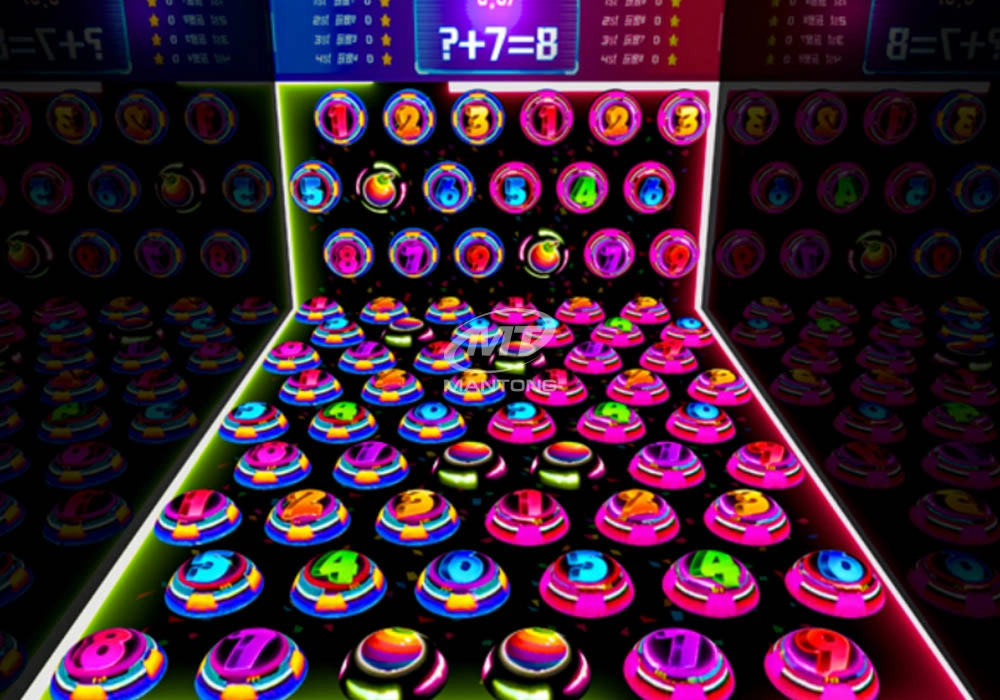
Amusement Rapidly Rotating Bouncing Sphere Interactive Wall Floor Projection Sports Games
Rapidly Rotating Bouncing Sphere is an interactive space where participants jump on rotating spheres. As they step on it, the spheres surface will show special interactivity
Jumping on spheres of the same color in succession causes them to pop, releasing light particles. The more consecutive jumps, the greater the reward—caterpillars appear, and eventually, all spheres of that color burst, filling the space with light and even more caterpillars.
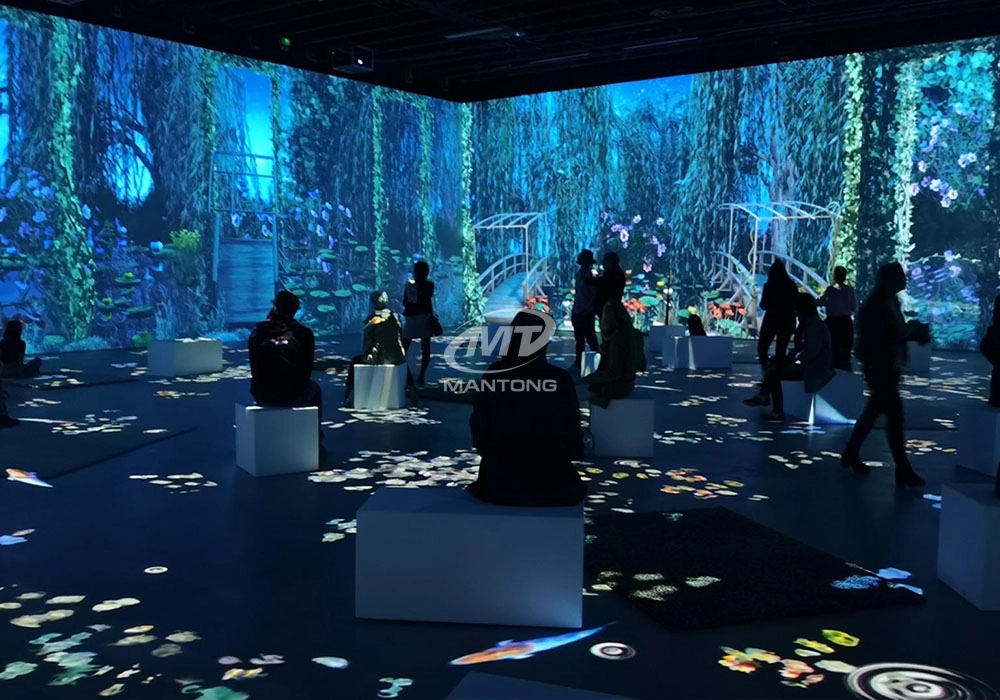
Mantong 6500LM High-Lumen Projector for Large-Scale Immersive Room Projection
Transform any space with Mantong's immersive projection mapping systems. Our high-lumen projectors (up to 6500 LM) and custom software create captivating interactive experiences for floors and walls. Ideal for museums, events, retail, and hospitality. Each kit includes professional ceiling mounting and 80+ pre-loaded video contents and is backed by a 12-month warranty and CE certification. We offer full customization and support to bring your vision to life.
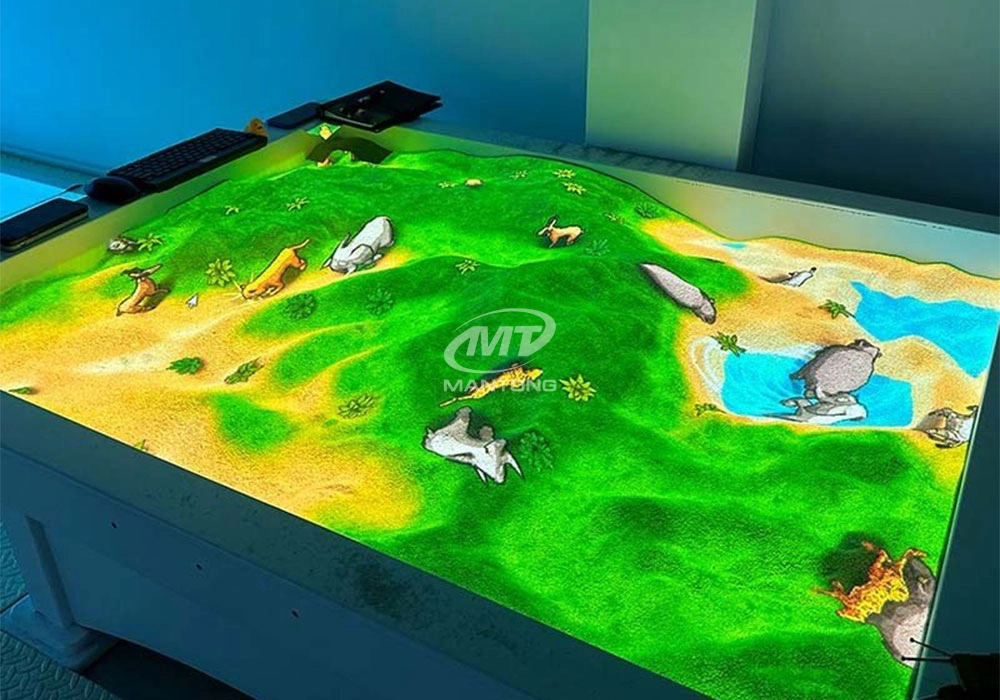
Interactive Sandbox Projection Mapping Games For Kids Play Park
Bring imagination to life with interactive sandbox projection mapping games designed for kids’ play parks. Using cutting-edge projection technology and real-time motion sensing, children can dig, build, and explore virtual worlds directly in the sand. Educational, engaging, and endlessly fun — it’s the perfect blend of play and learning.
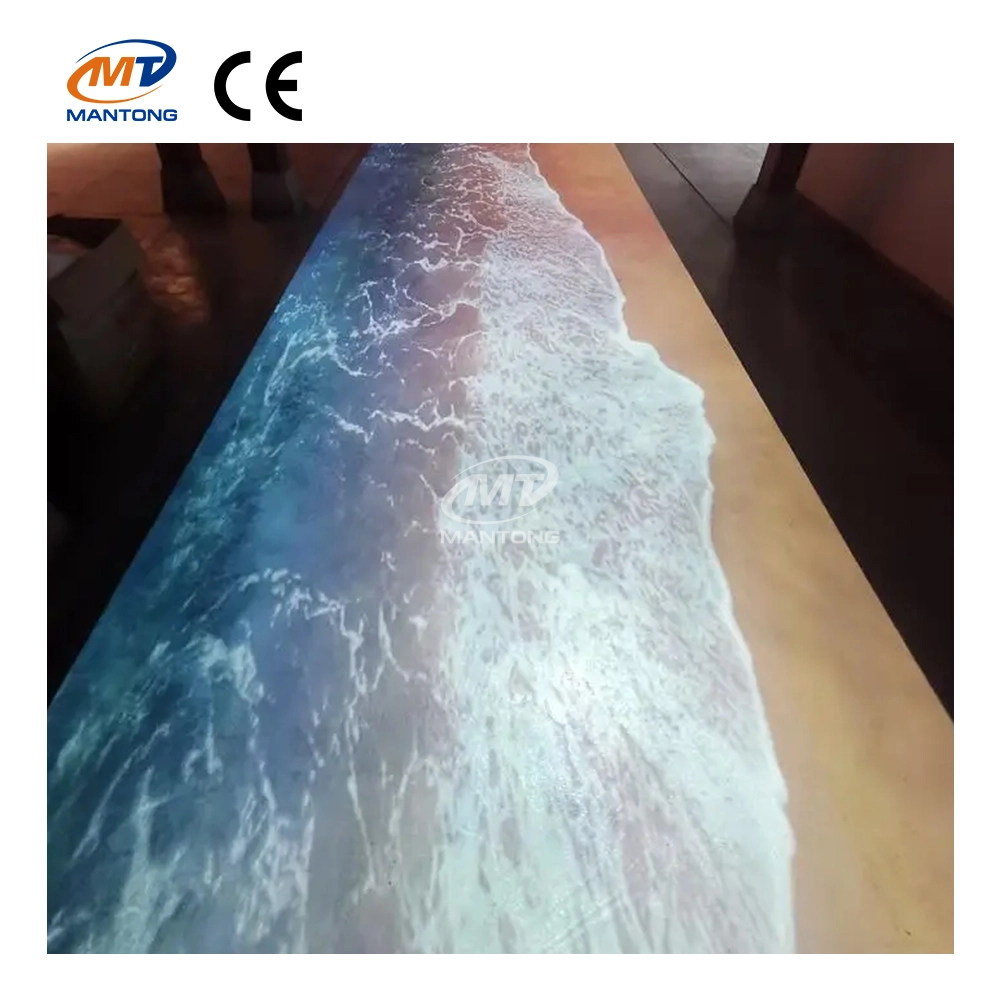
Indoor Interactive Floor Projector System - Customized Design & Installation Support
Indoor interactive floor projections display dynamic themed videos on the floor, commonly used in venues aiming to enhance brand influence or attract foot traffic, such as restaurants, hotel corridors, and brand car retail stores.
By using projectors and compatible software, the interactive content is projected onto the floor, encouraging engagement between people and the projected visuals. A single 5500-lumen indoor floor projector can cover an area of 5 m × 3 m. Typically, each project will use at least 3 units to ensure broad coverage and optimal visual effects.
We also offer customized design and installation support to enhance the interactive experience for your venue.

Kaida Business Center, Shixin Road, Panyu District,Guangzhou City, Guangdong Province, China.
ManTong
ManTong
ManTong