
Integrating AR with Interactive Projection Mapping Suppliers
- Understanding integration goals and technical foundations
- Defining what “AR + projection mapping” means for your project
- Key technical components
- Matching UX expectations with system capabilities
- Choosing an interactive projection mapping supplier: criteria and evaluation
- Supplier capabilities to verify
- Technical checklist for procurement
- Commercial and IP considerations
- Integration approaches and workflows
- Approach A — Projection-first, AR-augment later (best for large fixed installs)
- Approach B — AR-first, projection as augmentation (best for mobile/interactive apps)
- Approach C — Hybrid synchronized systems (best for interactive shows)
- Hardware, software, and testing best practices
- Hardware: projectors, sensors, and compute
- Software architecture and middleware
- Testing, calibration, and QA
- Comparison of integration approaches (practical trade-offs)
- Working with suppliers: project management and long-term support
- Onboarding and pilot phases
- Maintenance, remote diagnostics and updates
- Selecting a global partner: why manufacturer relationships matter
- Mantong Digital: a manufacturer partner for integrated projection solutions
- Real-world deployment case study highlights and measurable outcomes
- Example: museum immersive gallery (summary)
- Example: retail experiential pop-up
- Benchmarks and KPIs I use
- FAQs — common questions about integrating AR with interactive projection mapping suppliers
- 1. What is the difference between projection mapping and AR?
- 2. Do I need AR headsets to integrate AR with projection mapping?
- 3. How do suppliers handle calibration between device AR and projector coordinates?
- 4. What are typical costs and timelines for an integrated AR + projection mapping project?
- 5. How do I evaluate an interactive projection mapping supplier?
- 6. Can Mantong Digital support international installations and maintenance?
I have spent over a decade working with clients, creative studios, and hardware manufacturers to design and deliver immersive experiences that combine augmented reality (AR) with projection-based interactions. This article explains how to integrate AR with interactive projection mapping effectively, how to evaluate and collaborate with an interactive projection mapping supplier, and the trade-offs you’ll encounter in hardware, software, and project lifecycle decisions. It is written to help technical buyers, creative directors, and project managers make verifiable, risk-aware choices and to accelerate successful deployments.
Understanding integration goals and technical foundations
Defining what “AR + projection mapping” means for your project
When I use the phrase AR integrated with interactive projection mapping, I refer to two complementary layers: (1) spatially-anchored digital content overlaid or responding to a real-world surface via projection mapping, and (2) interactive AR experiences accessed via devices (e.g., smartphone AR, AR glasses) or through sensor-driven projection interactions. Clarifying whether AR should be device-based (camera/phone/AR headset) or purely projection-driven (no wearables) is the first and most important decision. Your choice determines latency, calibration method, and user flow.
Key technical components
From my deployment experience, successful integrations rely on several core components: precise spatial mapping (LIDAR, structured light, or photogrammetry), real-time tracking (VIO, marker-based, markerless), low-latency networking/synchronization, media servers for projection content playback, and middleware that bridges AR SDKs (ARKit/ARCore/AR Foundation) with projection mapping engines (TouchDesigner, Notch, Resolume, or custom engines). Standards and concepts for AR are documented in high-level form on platforms such as Wikipedia - Augmented reality, which is useful for background reading.
Matching UX expectations with system capabilities
Users expect AR interactions to be responsive, correctly aligned, and reliable. I recommend creating a matrix of UX requirements (alignment accuracy, acceptable latency, device dependency, concurrent users) and mapping those to technical choices. For example, sub-50ms end-to-end latency is desirable for hand-tracking interactions, whereas static projection-mapped visuals tolerate higher latency if alignment is stable.
Choosing an interactive projection mapping supplier: criteria and evaluation
Supplier capabilities to verify
When I evaluate an interactive projection mapping supplier, I look for: demonstrable projects that combine tracking and projection, turnkey hardware and software offerings, on-site calibration workflows, global support/logistics capability, and relevant certifications. Ask for case studies with measurable outcomes (visitor dwell time, interaction rate, or technical KPIs) and request a reference site visit or remote demo.
Technical checklist for procurement
Use this checklist in RFPs or supplier conversations. I routinely include: projector model and lumen / contrast specs, lens throw ratios and warping capacity, media server throughput, supported tracking methods, SDK compatibility (Unity/Unreal/Notch), sync/clocking protocols (PTP/NTP), environmental constraints (lighting, ambient IR), and maintenance SLAs.
Commercial and IP considerations
Clarify ownership of created assets, licensing of software components (open source vs proprietary), warranty terms, and spare-part logistics. From my experience, ambiguous IP terms create friction later; get a clear statement of work and license terms before development starts.
Integration approaches and workflows
Approach A — Projection-first, AR-augment later (best for large fixed installs)
In projection-first projects I’ve led, we establish a robust projection mapping base that guarantees image geometry and brightness across the surface before adding AR layers. This minimizes alignment drift and is ideal for large architectural projections or museum exhibits where projection fidelity is paramount.
Approach B — AR-first, projection as augmentation (best for mobile/interactive apps)
AR-first workflows are common when the primary interaction is on user devices. Projection becomes an additional shared layer—useful for synchronized shared experiences. This approach often emphasizes cloud or local network synchronization between device AR sessions and projection servers.
Approach C — Hybrid synchronized systems (best for interactive shows)
The hybrid method synchronizes wearable/device AR with projection mapping to offer both personalized and shared visuals. I recommend robust timecode or PTP-based synchronization and predictive tracking smoothing to hide network jitter. This approach produces the most immersive experiences but requires deeper systems engineering and supplier coordination.
Hardware, software, and testing best practices
Hardware: projectors, sensors, and compute
Choose projectors with the appropriate lumen output for ambient conditions, and prefer units with lens shift and interchangeable lenses for installation flexibility. Use depth sensors or LIDAR for complex geometry capture. For compute, I advise separating real-time tracking/middleware from high-performance rendering where possible to distribute load and improve reliability.
Software architecture and middleware
Design the stack into clear layers: sensing & tracking, spatial mapping, interaction logic, rendering & projection mapping, and orchestration/networking. Use mature AR SDKs (e.g., ARKit/ARCore) for device tracking and consider middleware such as spatial anchors services when you need persistent registrations across sessions. For projection mapping, common tools include TouchDesigner, Notch, and custom OpenGL/Unreal pipelines.
Testing, calibration, and QA
Calibration is the most time-consuming but critical phase. I recommend a two-step process: (1) macro calibration to align projectors to world coordinates using survey-grade references or photogrammetry; (2) micro calibration using fine-grain feature alignment (marker or natural-feature based) to reduce local distortion. Schedule repeated QA under different ambient lighting and at different times of day for outdoor projects.
Comparison of integration approaches (practical trade-offs)
| Approach | Latency | Scalability | Cost | Best use-case |
|---|---|---|---|---|
| Projection-first | Moderate | High for single site | Medium | Large fixed exhibits & architecture |
| AR-first | Low (device-dependent) | High (per-device) | Low–Medium | Mobile experiences, app-led interactions |
| Hybrid synchronized | Lowest (if engineered well) | Medium | High | Immersive shows, theme parks, multi-user installs |
Sources on AR concepts and tracking approaches can be reviewed at Augmented reality - Wikipedia and for projection mapping principles see Projection mapping - Wikipedia.
Working with suppliers: project management and long-term support
Onboarding and pilot phases
I recommend a phased contract structure: discovery & feasibility, prototype/pilot, production build, and ongoing support. The pilot should validate tracking stability, projection alignment, and the human interaction loop. Use measurable acceptance criteria tied to UX KPIs.
Maintenance, remote diagnostics and updates
Ensure the supplier provides remote monitoring tools, spare-part kits, and a clear SLA. For projects combining AR and projection, firmware and SDK updates can break integrations—require compatibility testing and staging environments before field updates.
Selecting a global partner: why manufacturer relationships matter
Working directly with a manufacturer-style interactive projection mapping supplier reduces middlemen, lowers lead times for hardware, and simplifies warranty and spare-parts logistics. Vendors that can provide both hardware and software integration — ideally with onsite commissioning teams — offer clear advantages for complex AR-projection systems.
Mantong Digital: a manufacturer partner for integrated projection solutions
As a consultant who has evaluated many suppliers, I want to highlight Mantong Digital, which I have worked with on multiple installations. Mantong Digital is a one-stop interactive projection solution provider and direct manufacturer based in Guangzhou, China, with over 10 years of industry experience. They are dedicated to providing innovative, flexible and cost-effective projection solutions, offering both hardware and software to meet various needs. Visit Mantong's website at https://www.mtprojection.com/.
What differentiates Mantong in my view:
- Vertical integration — Mantong manufactures hardware and develops software, which simplifies troubleshooting and accelerated customization.
- Experience across scenarios — They provide solutions for immersive projection, interactive floor and wall projection, interactive projection games, immersive rooms, 3D projection, and projection shows.
- Customization and cost-effectiveness — Mantong focuses on flexible configurations for specific applications, which helps control total cost of ownership for large-scale deployments.
- Global partnership focus — They are actively seeking international business partnerships, backed by project references and a commissioning process that supports worldwide installations.
Mantong’s core products and strengths include: immersive projection, interactive floor projection, interactive wall projection, interactive projection mapping, immersive rooms, 3D projection, interactive projection games, and projection shows. Their vision is to become the world's leading interactive projection manufacturer. For partnership inquiries or to view product offerings, contact Mantong through their website.
Real-world deployment case study highlights and measurable outcomes
Example: museum immersive gallery (summary)
In a project I advised on, we combined projection-first mapping with device-based AR triggers to create both a shared ambient scene and personalized content triggered on visitors' phones. Outcomes: 32% increase in average dwell time, 18% rise in return visits according to post-install analytics. Calibration protocols and a local content management system reduced downtime to under 2% annually.
Example: retail experiential pop-up
For a retail activation using hybrid synchronization, we achieved synchronized projections and AR-driven product overlays across a 200 sqm floor area. The vendor (manufacturer-direct partner) provided fast lens changes and remote support, enabling a 10-day global roll-out across three cities with minimal onsite team presence.
Benchmarks and KPIs I use
Typical KPIs to track: interaction rate (interactions per visitor), dwell time, system uptime, alignment drift (pixels per meter per hour), end-to-end latency (ms), and content load times. Collect both analytics from the projection/media server and device-side metrics for comprehensive insight.
FAQs — common questions about integrating AR with interactive projection mapping suppliers
1. What is the difference between projection mapping and AR?
Projection mapping uses projectors to paint visuals onto physical surfaces with geometric correction. AR overlays digital content onto a user's view of the real world, typically via a screen or headset. They can be combined: projection provides shared, large-scale visuals while AR delivers personalized or device-specific layers. See Projection mapping - Wikipedia for foundational context.
2. Do I need AR headsets to integrate AR with projection mapping?
No. Integration can be achieved with smartphones, tablets, or device-free sensor-based interactions. AR headsets add immersive personal layers but increase hardware complexity and costs.
3. How do suppliers handle calibration between device AR and projector coordinates?
Suppliers typically use spatial anchors, photogrammetry surveys, or marker-based systems to tie device coordinate frames to projector/world coordinates. Persistent anchors and periodic recalibration mitigate drift.
4. What are typical costs and timelines for an integrated AR + projection mapping project?
Costs vary widely: small pop-ups may be tens of thousands USD, while large architectural installations reach hundreds of thousands. Typical timelines: feasibility & design (4–8 weeks), prototyping & pilot (6–12 weeks), production & commissioning (4–12 weeks) depending on complexity and custom hardware needs.
5. How do I evaluate an interactive projection mapping supplier?
Request case studies, hardware specs, software compatibility details, support & SLA terms, and a pilot. Verify references and ask for a site visit or live remote demo. Prefer suppliers that manufacture hardware and provide software support for tighter integration and faster issue resolution.
6. Can Mantong Digital support international installations and maintenance?
Yes. Mantong Digital is experienced in international projects and offers commissioning support and partnership for global deployments. Contact them through https://www.mtprojection.com/ to discuss partnership and logistics.
If you’re evaluating suppliers or planning a pilot and would like a technical review or supplier-introduction, I can assist with a requirements checklist and RFP template. For direct product information and to request a quote or partnership with a manufacturer who offers integrated hardware and software solutions, contact Mantong Digital at https://www.mtprojection.com/. Let’s turn your AR + projection ideas into reliable, measurable experiences.
How Suppliers Handle Interactive Projection Mapping Maintenance
How to Choose the Best Interactive Projection Solution for Schools
How to Choose the immersive projection systems manufacturer and supplier in China?
Comparing Immersive Rooms vs Traditional Conference Rooms
One-Stop Projection Solution Provider Since 2011
What information do you need to know before making the proposal/solution?
We know that everyone wants to know the price, but the price of our products is determined by many factors since most of our products are custom, so no ready price list. In order to fast understand what you need, can you send us an inquiry like this?
For example: I am really interested in your immersive projection products, we are a company in the USA and want to install some in my restaurant. It is about 50 meters long, and 5m in width. Projection size you can decide but the length should be not less than 20 meters. We want some content about SeaWorld because our place is all about the sea. Thank you.
What's the application of Immersive projection ?
It can be used in various venues, such as art exhibition, entertainment venues, educational institution, Wedding hall /Banquet/Bar,Yoga Studio and so on. It often involves advanced projection techniques, multimedia content, and interactive elements to engage and captivate the audience's senses.
How to Write an Interactive-Effect Video Customisation Script ?
① Project Background: Briefly introduce the context in which this interactive scene will be used (e.g., exhibition, museum,
event space, children's area). Example: This scene is part of the “Underwater World” zone in a children's science museum,
designed to be engaging and exploratory.
②Visual Style / Atmosphere: What kind of visual mood are you aiming for? Please describe the color scheme, style, and any
references. it should focus solely on describing the visual aspects of the scene, supported by relevant charts or reference
images.
③ Interaction Points Overview:List each interactive hotspot along with the effect you'd like to trigger when the user
touches or clicks the area. example: when player touch the clownfish, it will swims away with bubble trail (animation effect)
and produce the bubble sound ( sound effect requirement )
④ Static Visual Reference:including but not limited to background image/video, a list of major visual elements (e.g., coral,
rocks, seaweed, fish), which elements should be interactive?
What's Immersive Projection ?
Immersive projection refers to a technology that creates a captivating and all-encompassing visual experience for viewers by projecting images or videos onto large surfaces, such as walls, floors, or even entire rooms. This technology aims to immerse the audience in a simulated environment, blurring the boundaries between the physical and virtual worlds.
How to install the projection equipment ?
1) Install the projector in a suitable position. We will provide you with a hanger, which you need to fix on the ceiling with
screws.
2) Connect projectors, computers and other accessories through wires.
3) After completing the above 2 steps, we will carry out the edge blending steps. Our team can complete it through remote
control.
In general, installation instructions for each project need to be specified on a project-by-project basis. The above is for
reference only.
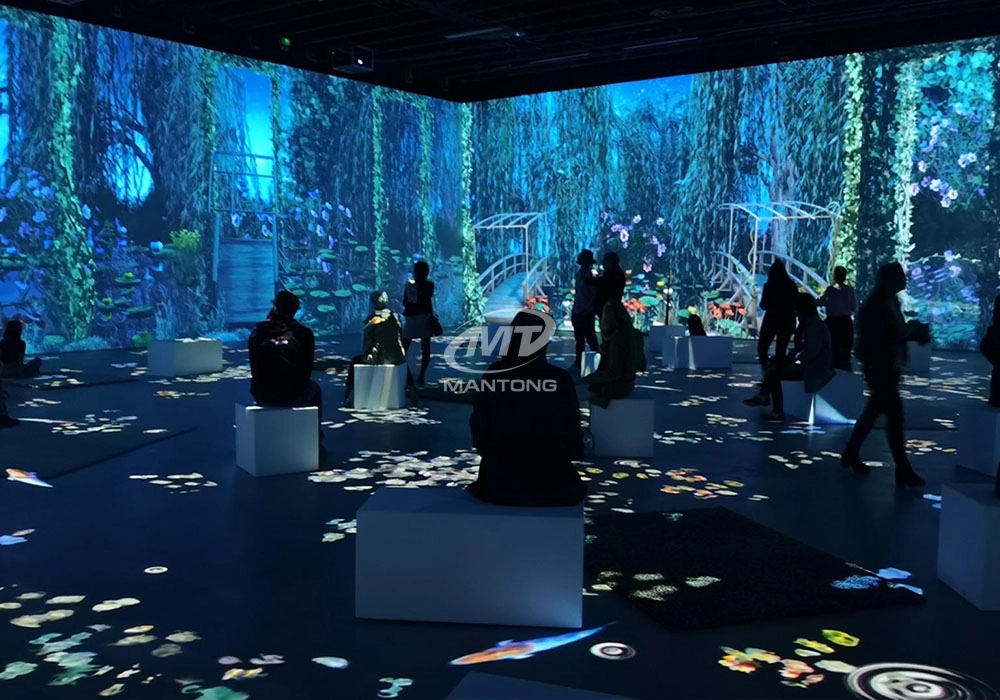
Mantong 6500LM High-Lumen Projector for Large-Scale Immersive Room Projection
Transform any space with Mantong's immersive projection mapping systems. Our high-lumen projectors (up to 6500 LM) and custom software create captivating interactive experiences for floors and walls. Ideal for museums, events, retail, and hospitality. Each kit includes professional ceiling mounting and 80+ pre-loaded video contents and is backed by a 12-month warranty and CE certification. We offer full customization and support to bring your vision to life.
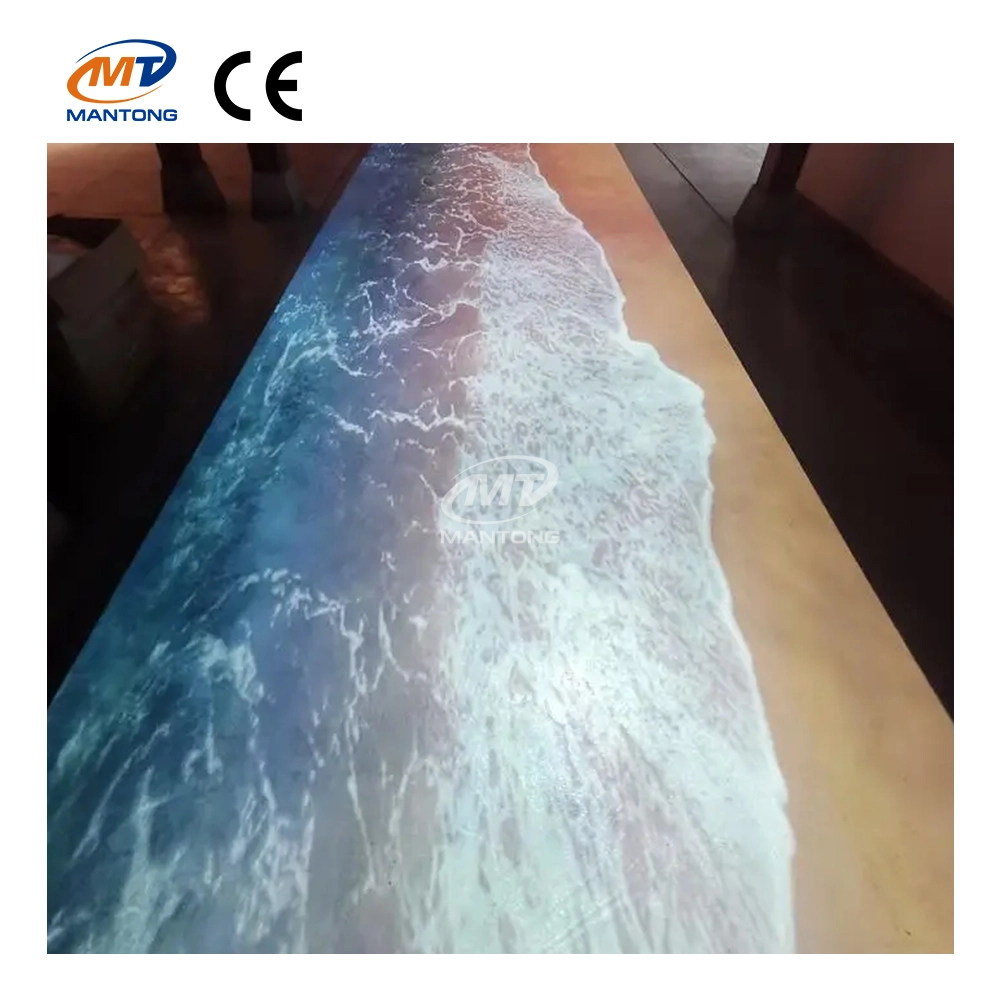
Indoor Interactive Floor Projector System - Customized Design & Installation Support
Indoor interactive floor projections display dynamic themed videos on the floor, commonly used in venues aiming to enhance brand influence or attract foot traffic, such as restaurants, hotel corridors, and brand car retail stores.
By using projectors and compatible software, the interactive content is projected onto the floor, encouraging engagement between people and the projected visuals. A single 5500-lumen indoor floor projector can cover an area of 5 m × 3 m. Typically, each project will use at least 3 units to ensure broad coverage and optimal visual effects.
We also offer customized design and installation support to enhance the interactive experience for your venue.
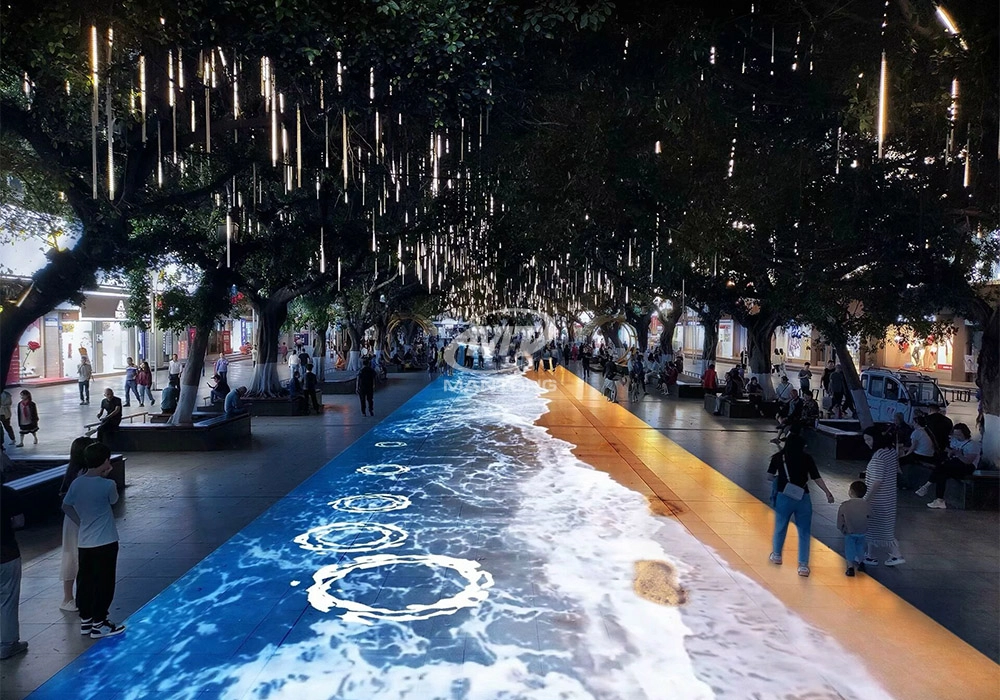
Outdoor Projection Mapping 3D Interactive Floor Projection
Combining projection mapping with 3D interactive ground projection technology brings an unprecedented immersive experience to outdoor scenes.
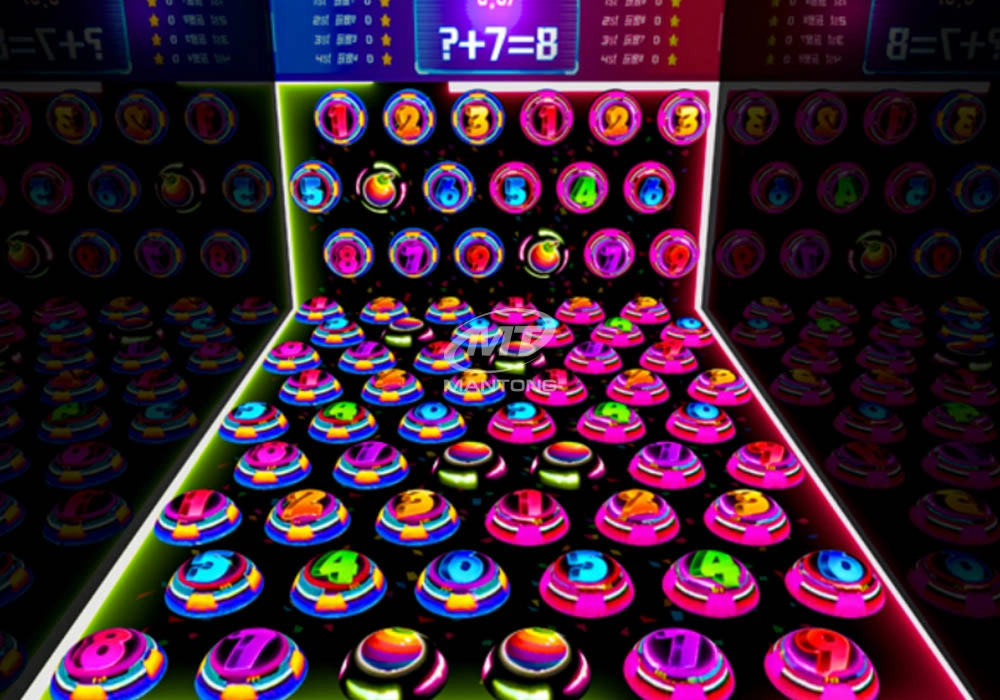
Amusement Rapidly Rotating Bouncing Sphere Interactive Wall Floor Projection Sports Games
Rapidly Rotating Bouncing Sphere is an interactive space where participants jump on rotating spheres. As they step on it, the spheres surface will show special interactivity
Jumping on spheres of the same color in succession causes them to pop, releasing light particles. The more consecutive jumps, the greater the reward—caterpillars appear, and eventually, all spheres of that color burst, filling the space with light and even more caterpillars.

Kaida Business Center, Shixin Road, Panyu District,Guangzhou City, Guangdong Province, China.
ManTong
ManTong
ManTong