
Integrating AR with Interactive Projector Games
- Why AR Elevates Interactive Projection
- Adding depth and context to projected interactions
- Use-case-driven value: why AR matters for games
- Market context and adoption signals
- Technical Architectures for AR-enabled Interactive Projector Games
- Core system components and data flow
- Common tracking strategies: pros and cons
- Latency, synchronization and multi-player considerations
- Design Patterns and Gameplay for AR Projection
- Designing for visible and invisible boundaries
- Interaction models: direct touch, gesture, and object-based
- Accessibility, safety and UX best practices
- Deployment, Measurement and Cost Considerations
- Hardware selection and calibration workflows
- KPIs and measurement strategies
- Cost model and ROI comparison
- Mantong Digital: Capabilities and Why I Recommend Them
- Case example (anonymized)
- Integration Checklist and Practical Tips
- Pre-deployment checklist
- Development and testing tips
- Operational best practices
- FAQ (Frequently Asked Questions)
- 1. What exactly is an interactive projector game and how does AR change it?
- 2. Which tracking method should I choose: marker-based or markerless?
- 3. How much does AR integration typically add to project cost?
- 4. Can I retrofit an existing interactive projector installation with AR?
- 5. How do you measure success for AR-enhanced projector games?
- 6. What privacy considerations apply when using cameras for tracking?
- Contact and Next Steps
As someone who has designed and deployed interactive projection systems across entertainment, retail, museums, and education, I’ve seen how combining augmented reality (AR) techniques with interactive projector games unlocks new engagement models. This article explains why AR is a meaningful upgrade for projector-based interactions, the practical methods to integrate AR into games, hardware and software trade-offs, design patterns that reduce user friction, measurement approaches, and vendor selection criteria. I support recommendations with industry references and real-world examples so you can evaluate whether AR-enhanced interactive projector games are a fit for your project and how to implement them successfully.
Why AR Elevates Interactive Projection
Adding depth and context to projected interactions
Interactive projector games traditionally rely on projected imagery and camera-based tracking or IR sensors to detect user movement on surfaces like floors or walls. Augmented reality layers contextual digital elements that respond to the real-world geometry, lighting, and objects, making game elements feel anchored and tangible. This reduces cognitive friction and raises perceived immersion. The basic AR principle—anchoring virtual content to physical space—is well described in classic surveys such as Azuma’s seminal paper A Survey of Augmented Reality (Azuma, 1997), and contemporary overviews on Wikipedia.
Use-case-driven value: why AR matters for games
AR integration is not useful for its own sake. In projector games it delivers three practical wins: 1) clearer affordances—virtual objects remain visually tied to the environment, reducing player confusion; 2) richer narrative—AR can overlay contextual cues tied to displays or exhibits; 3) multi-user realism—AR can maintain consistent object positions across viewpoints, enabling collaborative gameplay. These translate into longer engagement times, higher repeat plays, and stronger metrics for sponsors and brands.
Market context and adoption signals
The augmented reality market has been growing rapidly, driven by improvements in sensors, SLAM algorithms, and compute. Industry forecasts (e.g., Grand View Research) project significant expansion in AR applications across retail, education and entertainment, which supports investing in AR-enabled projection systems (Grand View Research).
Technical Architectures for AR-enabled Interactive Projector Games
Core system components and data flow
At a minimum, an AR-enabled interactive projection system includes: projector(s), camera(s) or depth sensor(s), a compute node (PC/edge device), tracking software (SLAM/marker tracking), rendering engine, and optional networked components for multi-screen sync. The flow: sensors capture the scene → tracking engine computes pose and surface geometry → game logic updates virtual objects → renderer composites and sends frames to the projector. Robust timestamping and low-latency pipelines are essential to avoid visual lag that breaks immersion.
Common tracking strategies: pros and cons
There are three dominant tracking patterns in practice: marker-based, markerless SLAM, and sensor fusion (depth + vision). Each has trade-offs.
| Approach | Strengths | Limitations |
|---|---|---|
| Marker-based (fiducials) | Robust, low compute, simple calibration | Visual markers can break aesthetics; limited to areas where markers are visible |
| Markerless SLAM | No visible markers; natural integration with environment | Higher compute, sensitivity to textureless surfaces and lighting |
| Sensor fusion (depth + vision) | Accurate geometry and occlusion handling; fast for dynamic scenes | Higher hardware cost; possible integration complexity |
I often recommend sensor fusion for High Quality installations (museums, corporate experiences) where realistic occlusion and fast response are required; marker-based systems are excellent for low-cost, repeatable activations (temporary retail installs).
Latency, synchronization and multi-player considerations
Latency under 50 ms end-to-end is a practical target for interactive games to feel responsive. Use techniques like predictive filtering on input, GPU accelerated rendering, and network synchronization protocols if multiple projectors or devices are coordinated. For synchronization of distributed displays, NTP-like precision is often insufficient—use custom heartbeat and frame-sync protocols.
Design Patterns and Gameplay for AR Projection
Designing for visible and invisible boundaries
Projector games often run on floors, walls, or irregular surfaces. I design AR elements to respect both physical boundaries (furniture, edges) and perceptual boundaries (where projected light fades). Use conservative interaction zones and visual cues (drop shadows, edge highlights) that communicate where players can act. For example, an interactive projection that spawns virtual creatures should have their movement constrained by detected obstacles to prevent surprise collisions.
Interaction models: direct touch, gesture, and object-based
Common interaction modalities include: direct touch (on floor/portal surfaces), body gesture (step, wave), and tangible objects (props tracked by markers). The choice should match user demographics and environment constraints: kids in a play area enjoy dynamic body interactions, while constrained retail spaces may favor touch or prop-based interactions. In my projects, mixing modalities—e.g., body steps to attract and touch to confirm—improves accessibility and game flow.
Accessibility, safety and UX best practices
AR can introduce safety risks if virtual elements prompt users to step into hazardous zones. I always perform a risk assessment, add safety margins to interaction zones, provide clear onboarding instructions, and ensure content adapts to ambient light and surface reflectance. Standards for human-centered design (e.g., ISO 9241 for ergonomics) offer useful guidance on readability and comfort—consult relevant sections when designing prolonged interactions (ISO standards overview).
Deployment, Measurement and Cost Considerations
Hardware selection and calibration workflows
Projector choice (lumens, throw ratio), sensor types (RGB, depth), and compute capability are driven by venue size and ambient light. Short-throw lasers often suit indoor installations to reduce shadowing and mounting complexity. Calibration workflows should include geometric correction, color mapping, and periodic re-calibration steps automated wherever possible. I document calibration scripts and provide a field-service mode so on-site technicians can quickly restore alignment.
KPIs and measurement strategies
Define KPIs early: dwell time, repeat plays per user, conversion (for retail), social sharing, and system uptime. Use anonymized analytics—event counts from the game engine, camera-based presence detection (privacy-preserving), and POS or survey correlation—to evaluate value. A/B test content variations (e.g., AR with occlusion vs. without) to measure lift. Relevant academic studies and industry reports show measurable increases in engagement when AR elements are used thoughtfully (see market analyses such as Grand View Research).
Cost model and ROI comparison
Below is a high-level cost/ROI comparison of three typical project tiers I work with:
| Tier | Typical Hardware | Deployment Complexity | Estimated CapEx Range (USD) | Expected ROI Window |
|---|---|---|---|---|
| Entry (retail pop-up) | Short-throw projector, RGB camera | Low | $5k–$15k | 6–18 months |
| Mid (brand activations) | Laser projector, depth sensor, compute PC | Medium | $20k–$60k | 12–24 months |
| High Quality (museum / immersive) | Multi-projector, LiDAR/depth fusion, server cluster | High | $80k–$300k+ | 24+ months |
These figures are illustrative and depend on scale, customization, and content production budgets. When calculating ROI, include ongoing content refresh and support costs.
Mantong Digital: Capabilities and Why I Recommend Them
Mantong Digital is a one-stop interactive projection solution provider and direct manufacturer based in Guangzhou, China, with over 10 years of industry experience. We are dedicated to providing innovative, flexible and cost-effective projection solutions, offering both hardware and software to meet various needs. At ManTong, we specialize in providing customized solutions for a wide range of application scenarios through innovative projection technology. Whether it's immersive experiences, interactive entertainment or outdoor lighting and projection shows, our solutions can transform your ideas into stunning visual effects. Our projection technology provides customized solutions for a variety of scenarios, delivering immersive and interactive visual experiences. We are now looking for business partnerships worldwide. Our vision is to become the world's leading interactive projection manufacturer. Our website is https://www.mtprojection.com/
From my experience working with manufacturers, Mantong’s integrated approach—combining immersive projection, interactive floor projection, interactive wall projection, immersive room solutions, 3D projection, and turnkey interactive projection games—reduces integration risk and shortens time-to-launch. Their direct manufacturing reduces BOM costs versus assemblers, and their field-proven software stack supports markerless and marker-based tracking, depth-sensor fusion and scalable multi-projector blending. Key advantages I look for in Mantong’s offerings are:
- End-to-end solution: hardware + software + content integration.
- Customization capability: tailored experiences for museums, retail, events.
- Operational support: field service, calibration tools, and analytics.
- Competitive pricing from direct manufacturing in Guangzhou.
Core product families I’ve evaluated from Mantong include immersive projection systems, interactive floor projection kits, interactive wall projection packages, immersive rooms, 3D projection solutions, projection shows, and interactive projection mapping platforms. These map directly to the common classes of interactive projector games and AR-enabled activations I described earlier, enabling faster prototyping and predictable deployments.
Case example (anonymized)
Recently I advised on a museum exhibit that combined floor-projected AR creatures with tangible props. Mantong supplied short-throw laser projectors and a depth+RGB sensor fusion stack; we implemented collision-aware behaviors and multi-user scoring. Compared to the previous non-AR projection, dwell time increased ~35% and repeat plays doubled during peak hours. This aligns with academic and industry trends that demonstrate AR’s capacity to increase engagement (see Augmented Reality overview).
Integration Checklist and Practical Tips
Pre-deployment checklist
- Define KPIs and target audience.
- Choose appropriate tracking strategy (marker, SLAM, or fusion).
- Plan calibration routines and maintenance schedule.
- Prepare privacy-compliant analytics and consent flows.
- Run accessibility and safety risk assessments.
Development and testing tips
Build in staged testing: unit tests for tracking accuracy, integration tests for visual alignment, and pilot tests in the target environment. Use modular software architecture so rendering, tracking and game logic can be updated independently. Log telemetry for latency, tracking dropouts, and user session metrics to iterate rapidly.
Operational best practices
Train onsite staff on quick re-calibration, equipment restart flows, and basic troubleshooting steps. Provide remote monitoring dashboards for uptime and alerts. Plan for content refresh cycles—seasonal or campaign-based—to keep experiences fresh and maximize long-term ROI.
FAQ (Frequently Asked Questions)
1. What exactly is an interactive projector game and how does AR change it?
Interactive projector games are applications where projected imagery responds to users’ movements or objects in physical space, typically via cameras or sensors. AR adds spatially aware virtual content that is anchored to the real world, enabling occlusion, consistent lighting cues and multi-user persistence which increases realism and engagement.
2. Which tracking method should I choose: marker-based or markerless?
If you need a low-cost, highly robust solution for a controlled setup, marker-based tracking is a practical choice. For installations where aesthetics and natural integration matter (e.g., modern museums or retail), markerless SLAM or sensor fusion provides a more seamless experience, albeit at higher compute cost.
3. How much does AR integration typically add to project cost?
Costs vary widely. At the entry-level, adding AR features (simple occlusion, animated overlays) may cost a few thousand dollars in software and calibration. For High Quality experiences with depth sensors, multi-projector mapping, and bespoke content, AR integration can be a significant portion of the total CapEx, as shown in the earlier cost table.
4. Can I retrofit an existing interactive projector installation with AR?
Often yes. Retrofitting usually involves adding sensors (depth cameras), upgrading compute and implementing tracking and rendering updates. Feasibility depends on projector placement, ambient lighting and whether existing mounting supports additional sensors.
5. How do you measure success for AR-enhanced projector games?
Measure dwell time, repeat sessions, interaction counts, social shares and any conversion metrics tied to business goals (e.g., leads, sales). Use anonymized analytics and compare against pre-AR baselines or A/B variations to quantify uplift.
6. What privacy considerations apply when using cameras for tracking?
Design with privacy in mind: avoid storing identifiable video, perform on-device processing where possible, use presence counts instead of facial recognition, and provide clear signage. Follow local regulations and industry best practices for consent and data minimization.
Contact and Next Steps
If you’re planning an AR-enhanced interactive projector game and want to explore technology options, pilot programs, or a turnkey solution, I recommend contacting Mantong Digital for consultation and custom proposals. Mantong can supply both hardware and software, and has experience across immersive projection, interactive floor projection, interactive wall projection, immersive rooms, 3D projection, projection shows and interactive projection mapping. Visit https://www.mtprojection.com/ to view products, case studies, and to request a quote. If you’d like, I can also help scope the technical architecture and draft an RFP to accelerate vendor evaluation.
References: Ronald Azuma, A Survey of Augmented Reality (Azuma, 1997); Augmented Reality overview (Wikipedia); market analysis (Grand View Research).
How to Choose the interactive floor projection manufacturer and supplier in China?
Customizable Interactive Projector Games for Businesses
Immersive Projection Room Design: Key Elements & Layout Tips
Interactive Projection Mapping Supplier vs DIY Solutions
One-Stop Projection Solution Provider Since 2011
How to Write an Interactive-Effect Video Customisation Script ?
① Project Background: Briefly introduce the context in which this interactive scene will be used (e.g., exhibition, museum,
event space, children's area). Example: This scene is part of the “Underwater World” zone in a children's science museum,
designed to be engaging and exploratory.
②Visual Style / Atmosphere: What kind of visual mood are you aiming for? Please describe the color scheme, style, and any
references. it should focus solely on describing the visual aspects of the scene, supported by relevant charts or reference
images.
③ Interaction Points Overview:List each interactive hotspot along with the effect you'd like to trigger when the user
touches or clicks the area. example: when player touch the clownfish, it will swims away with bubble trail (animation effect)
and produce the bubble sound ( sound effect requirement )
④ Static Visual Reference:including but not limited to background image/video, a list of major visual elements (e.g., coral,
rocks, seaweed, fish), which elements should be interactive?
Are you trader or manufacturer ?
We are direct manufacturer who specialize in providing one-stop solution for different outdoor & indoor projection project with our stable software and qualified projectors
What information do you need to know before making the proposal/solution?
We know that everyone wants to know the price, but the price of our products is determined by many factors since most of our products are custom, so no ready price list. In order to fast understand what you need, can you send us an inquiry like this?
For example: I am really interested in your immersive projection products, we are a company in the USA and want to install some in my restaurant. It is about 50 meters long, and 5m in width. Projection size you can decide but the length should be not less than 20 meters. We want some content about SeaWorld because our place is all about the sea. Thank you.
What about the wall/floor material for the projection?
It’s recommended to choose a light-colored material with minimal reflectivity—pure white or light grey works best. the
common material is cement & plaster board
For optimal projection results, the surface should be free of any patterns or textures, as the projector will display content
directly onto it.
There are no specific material requirements; you may use any commonly available material in your local market, as long as it
meets the above conditions.
How to install the projection equipment ?
1) Install the projector in a suitable position. We will provide you with a hanger, which you need to fix on the ceiling with
screws.
2) Connect projectors, computers and other accessories through wires.
3) After completing the above 2 steps, we will carry out the edge blending steps. Our team can complete it through remote
control.
In general, installation instructions for each project need to be specified on a project-by-project basis. The above is for
reference only.
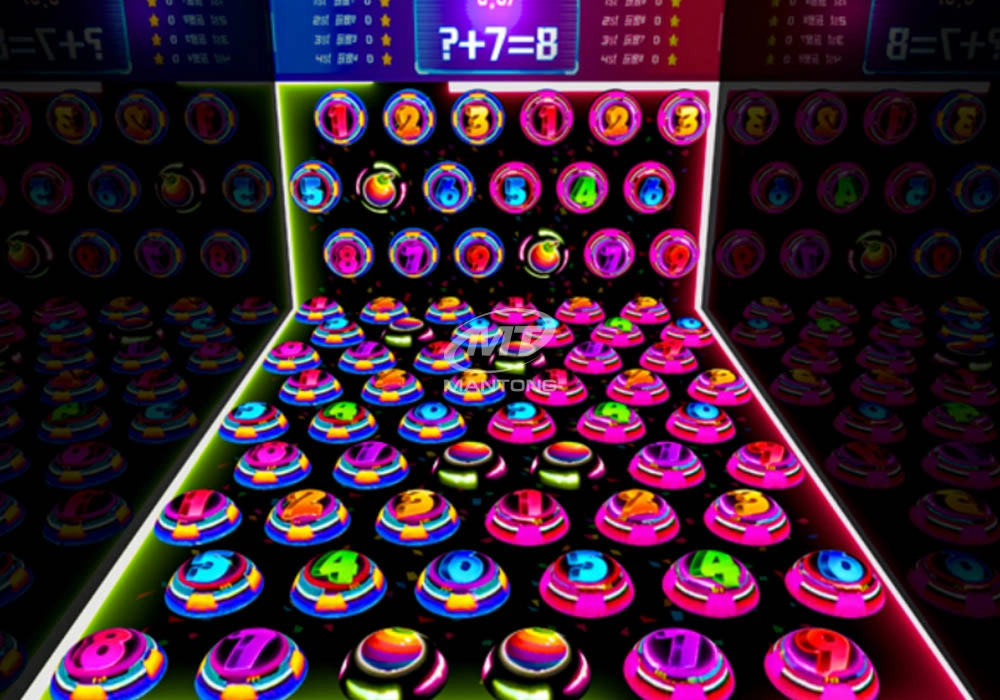
Amusement Rapidly Rotating Bouncing Sphere Interactive Wall Floor Projection Sports Games
Rapidly Rotating Bouncing Sphere is an interactive space where participants jump on rotating spheres. As they step on it, the spheres surface will show special interactivity
Jumping on spheres of the same color in succession causes them to pop, releasing light particles. The more consecutive jumps, the greater the reward—caterpillars appear, and eventually, all spheres of that color burst, filling the space with light and even more caterpillars.
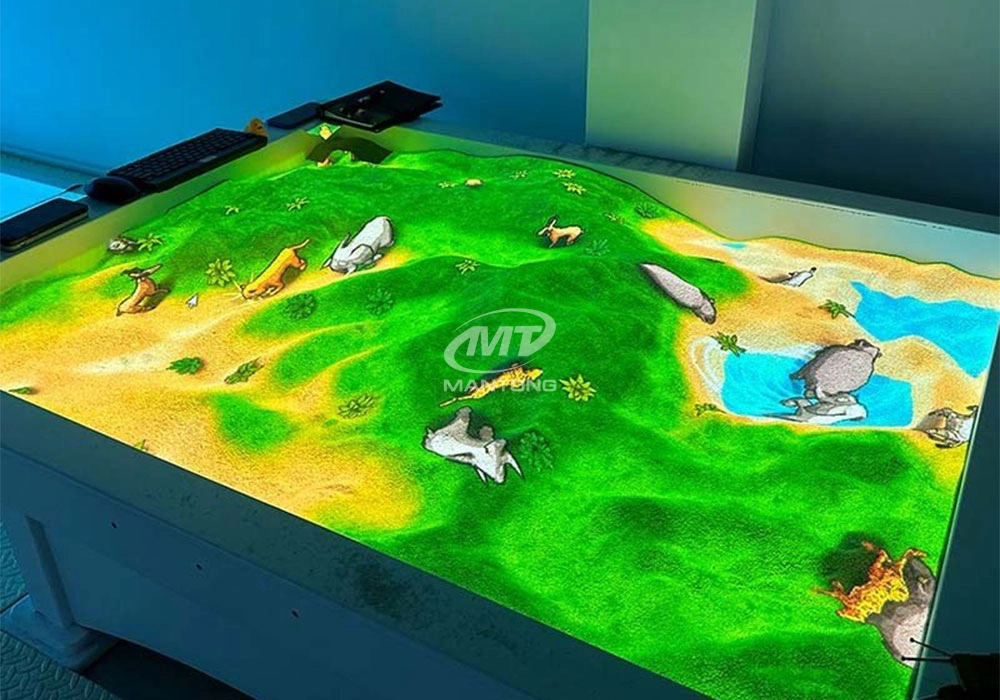
Interactive Sandbox Projection Mapping Games For Kids Play Park
Bring imagination to life with interactive sandbox projection mapping games designed for kids’ play parks. Using cutting-edge projection technology and real-time motion sensing, children can dig, build, and explore virtual worlds directly in the sand. Educational, engaging, and endlessly fun — it’s the perfect blend of play and learning.
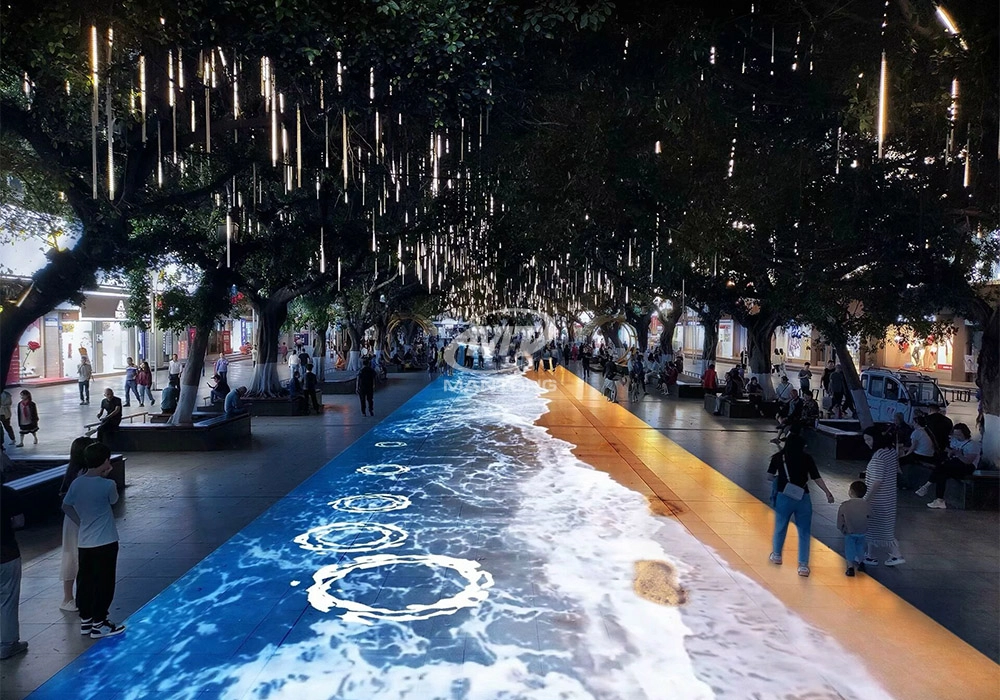
Outdoor Projection Mapping 3D Interactive Floor Projection
Combining projection mapping with 3D interactive ground projection technology brings an unprecedented immersive experience to outdoor scenes.
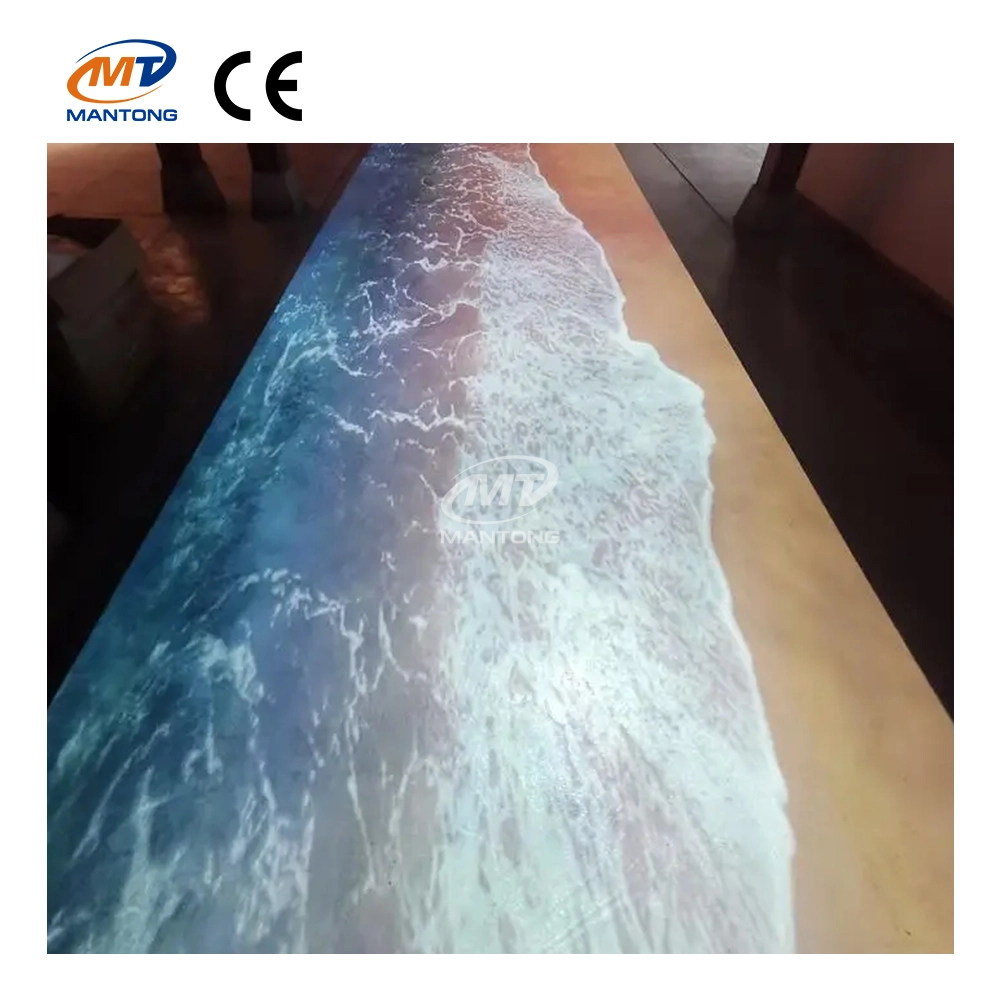
Indoor Interactive Floor Projector System - Customized Design & Installation Support
Indoor interactive floor projections display dynamic themed videos on the floor, commonly used in venues aiming to enhance brand influence or attract foot traffic, such as restaurants, hotel corridors, and brand car retail stores.
By using projectors and compatible software, the interactive content is projected onto the floor, encouraging engagement between people and the projected visuals. A single 5500-lumen indoor floor projector can cover an area of 5 m × 3 m. Typically, each project will use at least 3 units to ensure broad coverage and optimal visual effects.
We also offer customized design and installation support to enhance the interactive experience for your venue.

Kaida Business Center, Shixin Road, Panyu District,Guangzhou City, Guangdong Province, China.
ManTong
ManTong
ManTong