
Interactive Wall Projection: The Ultimate Guide to Immersive Experiences in 2026 and Beyond
A comprehensive guide to interactive wall projection technology, covering how it works, key components like LiDAR and laser projectors, and its transformative impact on retail, education, and events. Includes future trends for 2026 and expert buying advice.
- What is Interactive Wall Projection?
- How It Transforms Spaces
- Core Benefits
- Key Takeaways: Your Quick Guide to Interactive Wall Projection
- The Core Components: How Interactive Wall Projection Systems Work
- Beyond the Wall: Comparing Interactive Wall, Floor, and Table Projections
- Unlocking Potential: Diverse Applications of Interactive Wall Projection
- Retail & Experiential Marketing
- Education & Training
- Entertainment & Museums
- Designing for Impact: Content and User Experience Strategies
- Installation & Maintenance: Practical Considerations for Longevity
- Choosing the Right System: A Buyer's Guide and Expert Tips
- The Future is Now: Trends Shaping Interactive Wall Projection in 2026 and Beyond
- FAQ
What is Interactive Wall Projection?
Interactive wall projection is a display technology that transforms standard surfaces into dynamic, touch-sensitive, or motion-reactive digital canvases using high-brightness projectors, sensors, and computer vision software. It allows users to control projected content through physical gestures, touch, or body movement, creating a two-way communication channel between the user and the digital environment.
How It Transforms Spaces
Unlike traditional static signage, interactive projection technology turns passive viewing into active participation. By mapping digital content onto physical walls, businesses and educators can create immersive display solutions that respond in real-time. This technology leverages the physical architecture of a room, overlaying it with digital information, games, or art without the need for fragile physical screens.
Core Benefits
· Engagement: dramatically increases dwell time and user attention.
· Flexibility: can turn any size or shape of wall into a screen.
· Hygiene: offers touchless interaction options perfect for public spaces.
· Scalability: seamless edge-blending allows for massive, room-scale installations.
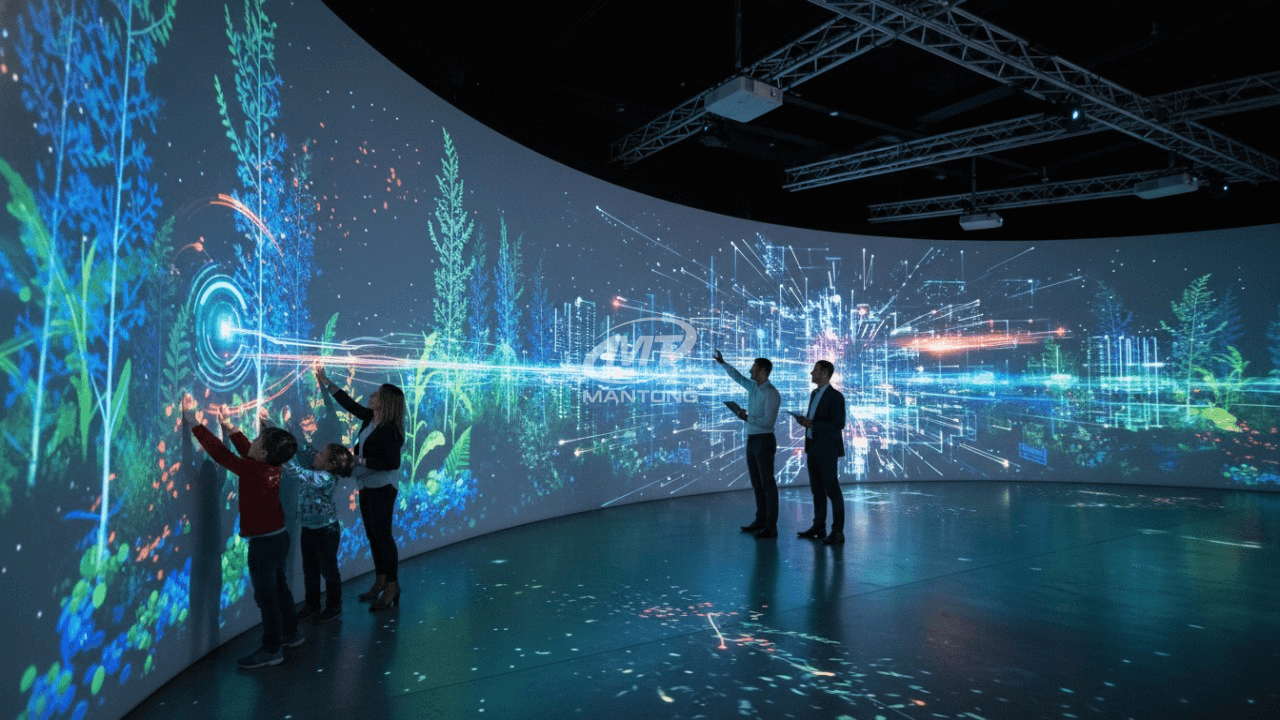
Key Takeaways: Your Quick Guide to Interactive Wall Projection
Interactive wall systems are powerful tools for engagement, blending hardware and software to create memorable experiences across various industries.
· Dynamic Canvas: Turns any wall into a responsive digital interface.
· Essential Hardware: Composed of projectors, advanced sensors (like cameras or LiDAR), and intelligent software.
· Versatile Use: Ideal for engaging audiences in retail, education, entertainment, events, and museums.
· Immersive Potential: Offers unique opportunities for storytelling, collaborative learning, and experiential marketing installations.
· Future-Ready: Evolving with advancements in AI, haptic feedback, and IoT integration for 2026 and beyond.
The Core Components: How Interactive Wall Projection Systems Work
An interactive projection system consists of three primary elements: the display hardware, the sensing layer, and the processing brain.
1. High-Brightness Projectors:
o Types: Laser projectors are preferred for their longevity (20,000+ hours) and color accuracy. DLP and LCD options exist for various budgets.
o Specs: Look for high lumens (4,000+) to combat ambient light and short-throw lenses to minimize shadows.
2. Advanced Sensing Technologies:
o Sensors: Motion sensor projection systems utilize Infrared (IR) cameras or LiDAR to detect movement.
o Precision: LiDAR offers superior depth sensing, enabling precise touch detection even on large walls without physical contact.
3. Powerful Software Platforms:
o Engine: The software processes sensor data to trigger visual changes instantly (low latency is critical).
o CMS: Content Management Systems allow for easy scheduling and updating of media.
4. Interactive Surfaces:
o Preparation: While any wall works, a smooth, matte white surface delivers the crispest visuals and most accurate tracking.
Beyond the Wall: Comparing Interactive Wall, Floor, and Table Projections
Interactive projection creates distinct experiences depending on the surface orientation and user posture.
· Interactive Wall Projection: Best for standing interactions, large-scale displays, brand storytelling, and digital art interactive walls. It draws attention from a distance.
· Interactive Floor Projection: Ideal for active play, wayfinding, and high-traffic areas. It is particularly effective for children's gaming and guiding foot traffic in malls.
· Interactive Table Projection: Suited for collaborative work, detailed interaction with smaller objects, and tabletop gaming. Common in lobbies and design studios.
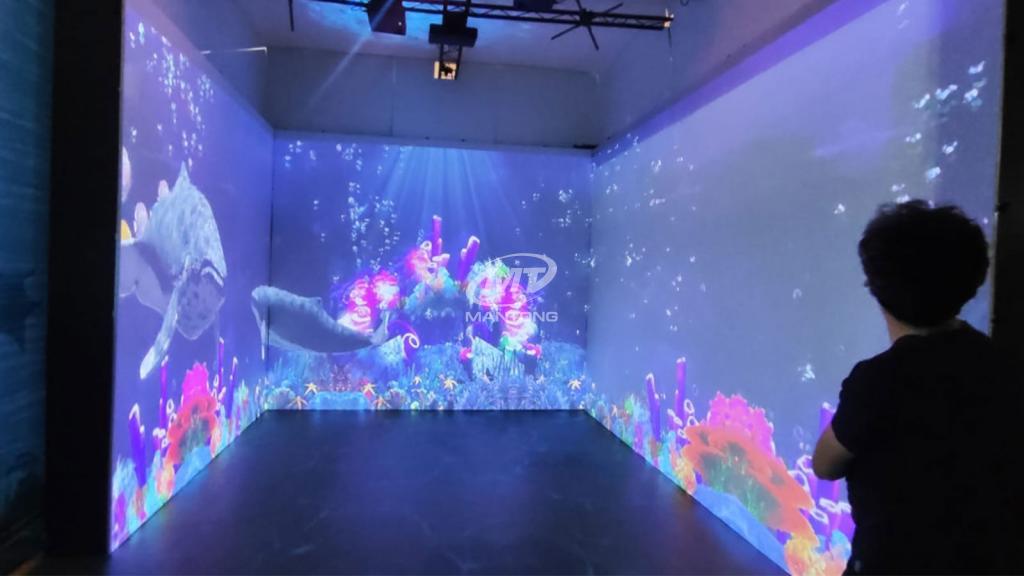
· Hybrid Systems: Integrating walls and floors creates a fully immersive "CAVE" environment where the physical world seems to dissolve entirely.
Unlocking Potential: Diverse Applications of Interactive Wall Projection
Industries ranging from retail to healthcare are leveraging this technology to drive measurable results.
Retail & Experiential Marketing
Retailers use experiential marketing installations to stop shoppers in their tracks. According to recent data from PosterBooking (2024), digital signage solutions can increase foot traffic by up to 24% and boost average purchase amounts by nearly 30%.
· Virtual Try-Ons: Project clothing onto a user's reflection.
· Product Exploration: Touching a projected product reveals specs and pricing.
Education & Training
In classrooms, interactive walls foster collaboration. Research cited by Virtu IT Solutions indicates that classrooms equipped with interactive screens can see an increase in student engagement by as much as 85%.
· Gamified Learning: Turning math problems into wall-sized team games.
· Immersive History: Projecting life-size historical environments for "virtual field trips."
Entertainment & Museums
Museums use these walls to modernize exhibits without damaging artifacts.
· Living Timelines: Visitors can scroll through history physically.
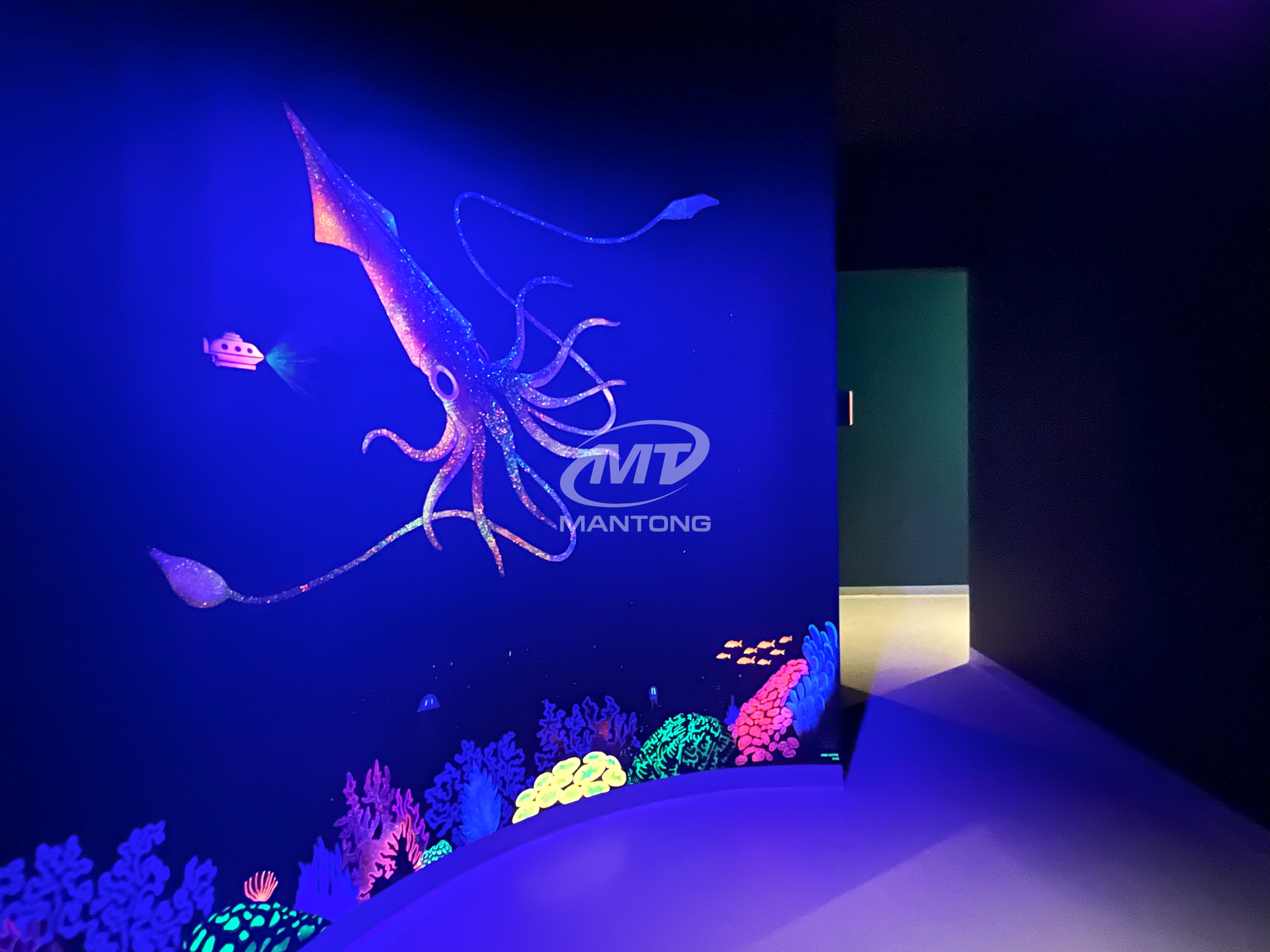
· Digital Art: Galleries display dynamic, changing art pieces that react to viewer proximity.
Designing for Impact: Content and User Experience Strategies
Successful interactive walls rely 80% on content design and 20% on hardware; a beautiful projector is useless with confusing software.
1. Crafting Engaging Visuals:
Use high-contrast assets to ensure visibility.
Keep interactive elements within the "golden zone" (shoulder to waist height) for accessibility.
2. Intuitive Interaction Design:
Feedback: Visuals must react instantly (under 100ms) to touch to maintain the illusion of reality.
Gestures: Stick to simple, natural movements (swiping, tapping) rather than complex codes.
3. Personalization and Adaptability:
Use AI to adapt content complexity based on the user's dwell time or age group (detected via camera).
4. Measuring Engagement:
Utilize analytics tools to track heatmaps of where users touch the wall most frequently.
Installation & Maintenance: Practical Considerations for Longevity
Proper installation ensures your system runs smoothly for years, minimizing downtime and repair costs.
· Site Assessment: Measure ambient light levels carefully. Direct sunlight is the enemy of projection; use window film or choose high-lumen projectors if window proximity is unavoidable.
· Hardware Mounting: Rigid mounting is crucial. Even a millimeter of projector vibration can de-calibrate the touch sensors.
· Calibration: most modern systems offer "auto-calibration" (using a camera to map the screen), but manual fine-tuning is often needed for edge cases.
· Routine Maintenance:
Clean Filters: Dust is the #1 killer of projectors. Clean filters monthly.
Software Updates: Keep the OS patched to ensure security and smooth animation performance.
Choosing the Right System: A Buyer's Guide and Expert Tips
Selecting the right system requires balancing performance, environment, and budget.
· Defining Goals & Budget: Basic setups can start around $3,000, while professional, large-venue systems often exceed $20,000. Factor in content creation costs, which can equal hardware costs.
· Key Specifications:
Lumens: 3,000 for dark rooms, 5,000+ for lit rooms.
Throw Ratio: 0.25:1 ultra-short throw is best to prevent users from casting shadows on the screen they are touching.
· Expert Tips:
Prioritize UX: A smaller, brighter, responsive wall is better than a huge, dim, laggy one.
Test Thoroughly: innovative content must be play-tested by actual users, not just developers.
The Future is Now: Trends Shaping Interactive Wall Projection in 2026 and Beyond
The market for interactive displays is projected to reach nearly $100 billion by 2034, driven by rapid technological convergence.
· AI & Machine Learning: By 2026, systems will use "Vision AI" to recognize specific users and pull up personalized dashboards or greetings automatically.
· IoT Integration: Walls will talk to the building—dimming room lights automatically when a presentation starts or changing content based on the weather outside.
· Haptic & Multi-Sensory: Future projections won't just look real; they will feel real. 4D mapping technology is evolving to include scent and directed sound.
· Sustainability: Manufacturers like Epson and Panasonic are pushing for laser projectors that consume 30% less energy, aligning with global green building standards.
FAQ
How much does an interactive wall projection system cost?
The cost varies widely based on projector brightness, sensor technology (e.g., basic IR vs. advanced LiDAR), and software complexity. Basic DIY-style kits can start from a few thousand dollars, while large-scale, custom commercial installations often range from $15,000 to over $50,000.
What kind of content can be displayed on an interactive wall?
Interactive walls can display diverse content including educational games, dynamic advertising, corporate dashboards, and digital art interactive walls. Content can be rendered in real-time (using engines like Unity) or pre-rendered video files triggered by touch.
Is interactive wall projection suitable for outdoor use?
While standard systems are designed for controlled indoor lighting, specialized outdoor setups exist. These require weather-proof enclosures (IP65 rated) and extremely high-brightness laser projectors (10,000+ lumens) to compete with daylight or streetlights.
What are the technical requirements for an interactive wall setup?
You typically need a high-lumen ultra-short-throw projector, a detection sensor (LiDAR or IR camera), and a dedicated media server (PC) with a strong graphics card (GPU) to handle real-time rendering.
How is an interactive wall different from an interactive LED screen?
Interactive projection technology turns existing architectural surfaces into screens, offering a seamless look that "disappears" when turned off. LED screens are physical panels that offer better brightness but are obtrusive black rectangles when not in use and are harder to install on curved surfaces.
Can interactive wall projections be controlled remotely?
Yes, professional Content Management Systems (CMS) allow administrators to update media, schedule playlists, and monitor hardware health from a central cloud dashboard anywhere in the world.
What are the benefits of interactive wall projection in educational settings?
It supports kinesthetic learning by allowing students to move and touch to learn. Data suggests this active learning style can boost engagement by 85% and improve information retention compared to passive listening.
How long do interactive projection systems typically last?
Modern laser projectors have a light source life of 20,000 to 30,000 hours, which equates to roughly 8-10 years of typical daily use. Sensors and PCs may require upgrades every 3-5 years to keep up with software demands.


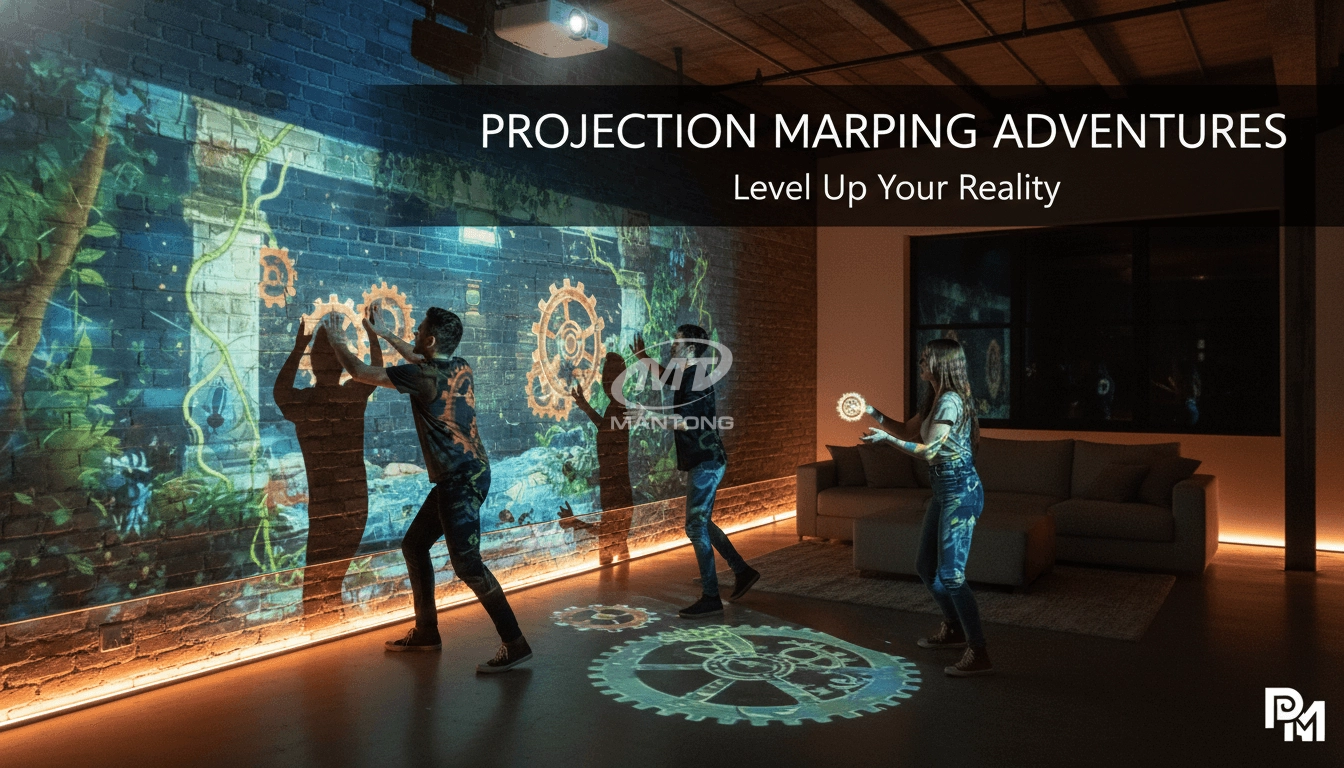

One-Stop Projection Solution Provider Since 2011
What about the wall/floor material for the projection?
It’s recommended to choose a light-colored material with minimal reflectivity—pure white or light grey works best. the
common material is cement & plaster board
For optimal projection results, the surface should be free of any patterns or textures, as the projector will display content
directly onto it.
There are no specific material requirements; you may use any commonly available material in your local market, as long as it
meets the above conditions.
How to Write an Interactive-Effect Video Customisation Script ?
① Project Background: Briefly introduce the context in which this interactive scene will be used (e.g., exhibition, museum,
event space, children's area). Example: This scene is part of the “Underwater World” zone in a children's science museum,
designed to be engaging and exploratory.
②Visual Style / Atmosphere: What kind of visual mood are you aiming for? Please describe the color scheme, style, and any
references. it should focus solely on describing the visual aspects of the scene, supported by relevant charts or reference
images.
③ Interaction Points Overview:List each interactive hotspot along with the effect you'd like to trigger when the user
touches or clicks the area. example: when player touch the clownfish, it will swims away with bubble trail (animation effect)
and produce the bubble sound ( sound effect requirement )
④ Static Visual Reference:including but not limited to background image/video, a list of major visual elements (e.g., coral,
rocks, seaweed, fish), which elements should be interactive?
Are you trader or manufacturer ?
We are direct manufacturer who specialize in providing one-stop solution for different outdoor & indoor projection project with our stable software and qualified projectors
How to install the projection equipment ?
1) Install the projector in a suitable position. We will provide you with a hanger, which you need to fix on the ceiling with
screws.
2) Connect projectors, computers and other accessories through wires.
3) After completing the above 2 steps, we will carry out the edge blending steps. Our team can complete it through remote
control.
In general, installation instructions for each project need to be specified on a project-by-project basis. The above is for
reference only.
What's the application of Immersive projection ?
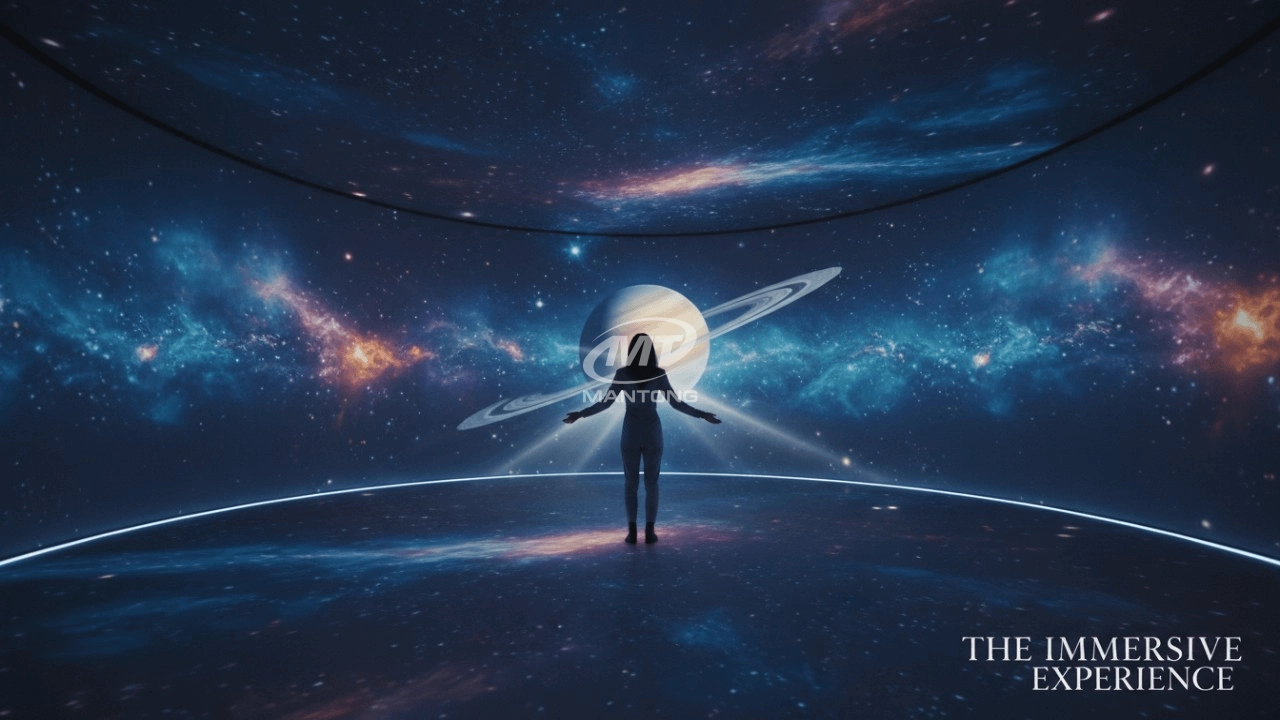
It can be used in various venues, such as art exhibition, entertainment venues, educational institution, Wedding hall /Banquet/Bar,Yoga Studio and so on. It often involves advanced projection techniques, multimedia content, and interactive elements to engage and captivate the audience's senses.
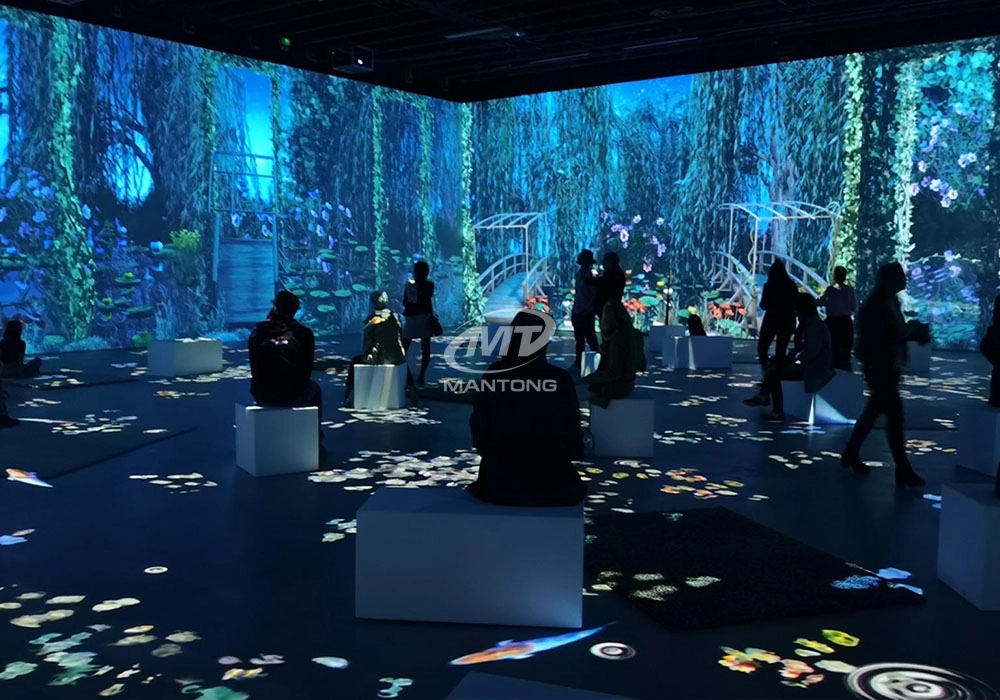
Transform any space with Mantong's immersive projection mapping systems. Our high-lumen projectors (up to 6500 LM) and custom software create captivating interactive experiences for floors and walls. Ideal for museums, events, retail, and hospitality. Each kit includes professional ceiling mounting and 80+ pre-loaded video contents and is backed by a 12-month warranty and CE certification. We offer full customization and support to bring your vision to life.
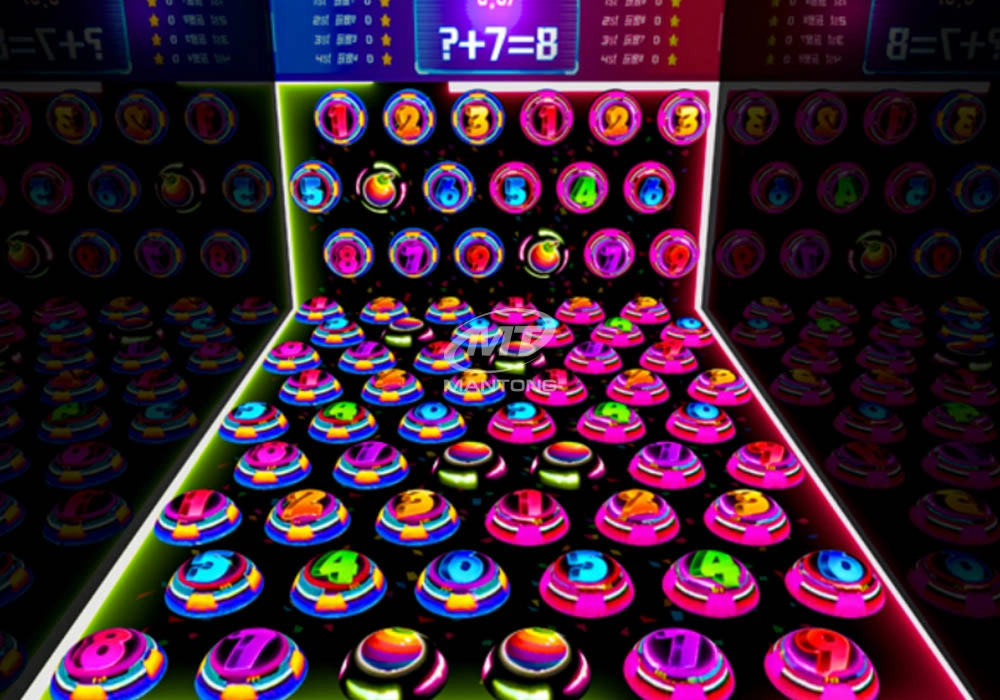
Rapidly Rotating Bouncing Sphere is an interactive space where participants jump on rotating spheres. As they step on it, the spheres surface will show special interactivity
Jumping on spheres of the same color in succession causes them to pop, releasing light particles. The more consecutive jumps, the greater the reward—caterpillars appear, and eventually, all spheres of that color burst, filling the space with light and even more caterpillars.
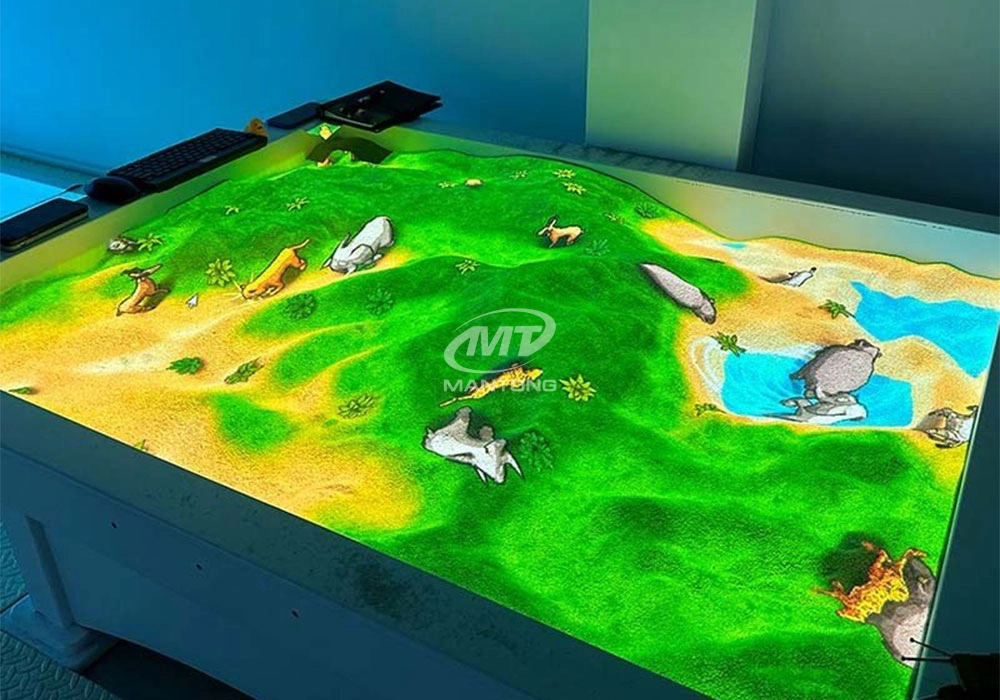
Bring imagination to life with interactive sandbox projection mapping games designed for kids’ play parks. Using cutting-edge projection technology and real-time motion sensing, children can dig, build, and explore virtual worlds directly in the sand. Educational, engaging, and endlessly fun — it’s the perfect blend of play and learning.
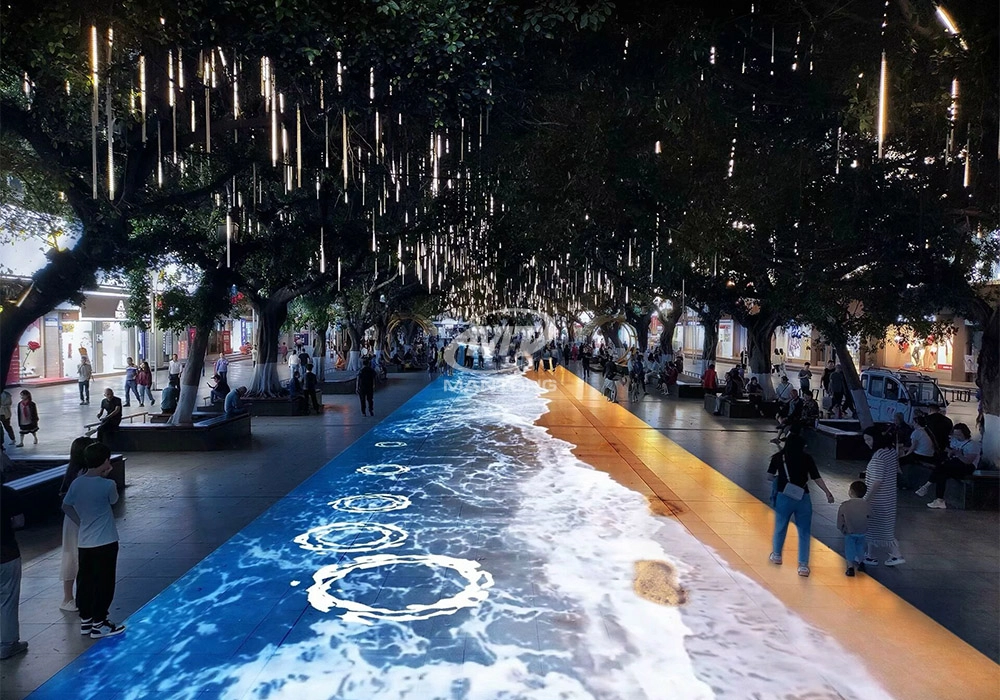
Combining projection mapping with 3D interactive ground projection technology brings an unprecedented immersive experience to outdoor scenes.
Contact Us to Start Your Interactive Projection Journey
Contact us now to discuss how to create innovative projection solutions for your space.

Kaida Business Center, Shixin Road, Panyu District,Guangzhou City, Guangdong Province, China.
ManTong
ManTong
ManTong